


Efforts to forge a post-Taliban government progressed yesterday, as Northern Alliance commanders offered an exit to some non-Afghan fighters holed up with the Taliban in the northern city of Kunduz despite US opposition to any "negotiated surrender."
Germany said it offered to host an all-party conference on the future of Afghanistan and is awaiting a response from the UN, which is overseeing the international efforts.
Iranian state radio said the conference would take place in Berlin on Saturday.
UN envoy Francesc Vendrell "is very hopeful [about giving] a positive announcement" at a news conference later in the day, a spokesman said in Kabul.
Vendrell met late Monday with General Mohammad Qasim Fahim, the Alliance's defense minister, as well as foreign minister Abdullah Abdullah and interior minister Younis Qanooni in talks the spokesman described as "warm."
US planes pursued their raids on Kunduz and the Taliban's southern stronghold of Kandahar, the last two major pockets of Taliban resistance.
A Taliban commander said Monday that he was willing to surrender Kunduz under UN supervision, after weekend bombings killed more than 1,000 people.
The Alliance's General Mohammad Daoud said yesterday that foreign "mercenaries," except "those who have committed crimes," could be allowed to leave the besieged city if the UN or other countries accept them.
Estimates of Taliban troops defending Kunduz run as high as 30,000, with a hardcore element of Arab, Chechen and Pakistani al-Qaeda fighters making up about one-third.
Daoud said he rejected a Taliban request that they be taken by convoy from Kunduz to Kandahar, where talks between the Taliban and fellow Pashtun tribal leaders for a peaceful handover appeared deadlocked.
"Our holy war continues," a ranking Taliban official said yesterday at Spin Boldak, near the besieged city. "There are no negotiations going on in Kandahar."
Negotiators in Kabul were hoping to flesh out a plan for a post-Taliban government after an intensive round of political talks involving Northern Alliance president Burhanuddin Rabbani and envoys from the UN, the US and Britain.
Qanooni said an agreement was reached "in principle," but added: "On the details, we have some observations" that would be aired later yesterday.
US special envoy James Dobbins said he was confident a UN-backed meeting of eminent Afghans could take place this week.
An inter-Afghan conference at a neutral European venue would be the first step of a five-point UN plan for a broad-based new Afghan government.
The Alliance is "ready to move forward to the creation of a new, broader government, which will represent all regions, all ethnicities," Dobbins said.
After chasing the Taliban from the Afghan capital a week ago, the Northern Alliance had been hesitant about the UN plan, prompting concerns that it is unwilling to relinquish its hold on power.
The UN and US envoys had met earlier with exiled Afghan leaders, including former king Mohammed Zahir Shah, seen as a potential unifying force despite having spent the last 28 years in exile.
A spokesman for Zahir Shah, 87, warned in Rome that any attempt to sideline the ex-king would increase internal strife.
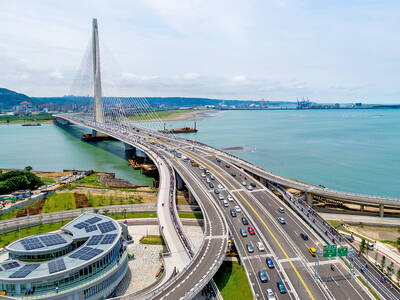
The Ministry of Transportation and Communications yesterday inaugurated the Danjiang Bridge across the Tamsui River in New Taipei City, saying that the structure would be an architectural icon and traffic artery for Taiwan. Feted as a major engineering achievement, the Danjiang Bridge is 920m long, 211m tall at the top of its pylon, and is the longest single-pylon asymmetric cable-stayed bridge in the world, the government’s Web site for the structure said. It was designed by late Iraqi-British architect Zaha Hadid. The structure, with a maximum deck of 70m, accommodates road and light rail traffic, and affords a 200m navigation channel for boats,
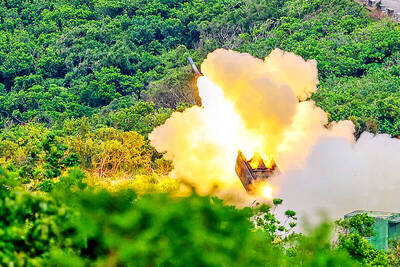
PRECISION STRIKES: The most significant reason to deploy HIMARS to outlying islands is to establish a ‘dead zone’ that the PLA would not dare enter, a source said A High Mobility Artillery Rocket System (HIMARS) would be deployed to Penghu County and Dongyin Island (東引) in Lienchiang County (Matsu) to force the Chinese military to retreat at least 100km from the coastline, a military source said yesterday. Taiwan has been procuring HIMARS and Army Tactical Missile Systems (ATACMS) from the US in batches. Once all batches have been delivered, Taiwan would possess 111 HIMARS units and 504 ATACMS, which have a range of 300km. Considering that “offense is the best defense,” the military plans to forward-deploy the systems to outlying islands such as Penghu and Dongyin so that

Taiwan Semiconductor Manufacturing Co (TSMC, 台積電), the world’s largest foundry service provider, yesterday said that global semiconductor revenue is projected to hit US$1.5 trillion in 2030, after the figure exceeds US$1 trillion this year, as artificial intelligence (AI) demand boosts consumption of token and compute power. “We are still at the beginning of the AI revolution, but we already see a significant impact across the whole semiconductor ecosystem,” TSMC deputy cochief operating officer Kevin Zhang (張曉強) said at the company’s annual technology symposium in Hsinchu City. “It is fair to say that in the past decade, smartphones and other mobile devices were

‘CLEAR MESSAGE’: The bill would set up an interagency ‘tiger team’ to review sanctions tools and other economic options to help deter any Chinese aggression toward Taiwan US Representative Young Kim has introduced a bill to deter Chinese aggression against Taiwan, calling for an interagency “tiger team” to preplan coordinated sanctions and economic measures in response to possible Chinese military or political action against Taiwan. “[Chinese President] Xi Jinping [習近平] has directed the People’s Liberation Army to be ready to invade Taiwan by 2027. China has a plan. America should have one too,” Kim said in a news release on Thursday last week. She introduced the “Deter PRC [People’s Republic of China] aggression against Taiwan act” to “ensure the US has a coordinated sanctions strategy ready should


 RSS
RSS