


Opposition parties yesterday thwarted an urgent DPP attempt to amend the Public Officials Elections and Recall Law (公職人員選舉罷免法) to attack the problem of vote-buying within the DPP, on the grounds that the amendment would be unlikely to be completed in time to affect the DPP primaries on April 1.
Legislators turned down a request to hold a legislature sitting tomorrow to finish the ongoing legislative process for the amendment.
"We believe the DPP is sincere about the reform, but we regret the fact that it is already too late for this amendment," said Hsieh Chi-ta (謝啟大), convener of the New Party caucus in the legislature.
"All the votes [for sale] will have been bought. There will be no people to arrest after the law is passed," Hsieh added.
The amendment was proposed by a group of DPP legislators last week, following reports of vote-buying in the period leading up to the party primaries -- held to decide the party's nominees for the year-end legislative elections.
The legislature's Home and Nations Committee finished a preliminary review of the amendment on Monday, and it was the DPP's wish that the amendment could be passed, in light of the limited time available, before April 1.
The DPP negotiated with opposition caucuses to seek to rearrange the agenda for this week -- which had already been fixed a week before -- proposing that the legislature convene tomorrow to go through the second and final readings for the amendment.
However, according to leaders of the opposition caucuses participating in the negotiation, even if the amendment were to pass tomorrow, it would not take effect until March 22 at the earliest.
While it takes at least one day for the paperwork involved to be completed before a piece of legislation is sent to the president for signing, a law will only take effect three days after it has been signed.
As the amendment would be a non-retroactive one, there would be approximately one week for law-enforcement authorities to step in and start handling vote-buying allegations.
People First Party Legislator Chou Hsi-wei (
"Any prosecutions must be supported by substantial physical evidence. It would be impossible for prosecutors to start their crackdown before the amendment is passed," Chou said.
In addition, opposition lawmakers argued that the proposal put forth by the DPP is incomplete, and that it needs further consideration.
For example, under the DPP proposal, a candidate who buys his or her victory at a party primary would not have his candidacy nullified, although he or she would face imprisonment.
"The KMT will definitely support efforts against vote-buying and `black-gold,' but we hope the amendment is a comprehensive one," said KMT caucus whip Cheng Yung-chin (
The DPP said yesterday's development was a regrettable one.
DPP Legislator Trong Chai (
The KMT is set to hold primaries for the very first time on May 5.
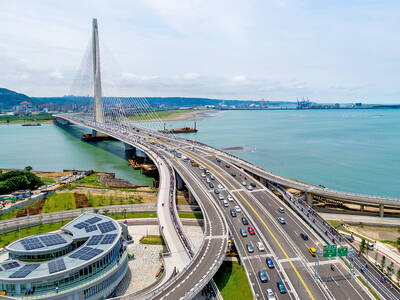
The Ministry of Transportation and Communications yesterday inaugurated the Danjiang Bridge across the Tamsui River in New Taipei City, saying that the structure would be an architectural icon and traffic artery for Taiwan. Feted as a major engineering achievement, the Danjiang Bridge is 920m long, 211m tall at the top of its pylon, and is the longest single-pylon asymmetric cable-stayed bridge in the world, the government’s Web site for the structure said. It was designed by late Iraqi-British architect Zaha Hadid. The structure, with a maximum deck of 70m, accommodates road and light rail traffic, and affords a 200m navigation channel for boats,
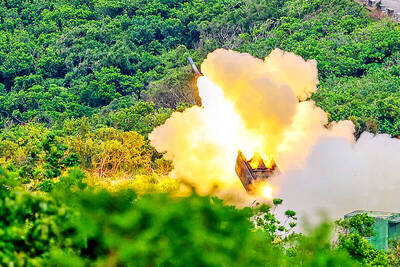
PRECISION STRIKES: The most significant reason to deploy HIMARS to outlying islands is to establish a ‘dead zone’ that the PLA would not dare enter, a source said A High Mobility Artillery Rocket System (HIMARS) would be deployed to Penghu County and Dongyin Island (東引) in Lienchiang County (Matsu) to force the Chinese military to retreat at least 100km from the coastline, a military source said yesterday. Taiwan has been procuring HIMARS and Army Tactical Missile Systems (ATACMS) from the US in batches. Once all batches have been delivered, Taiwan would possess 111 HIMARS units and 504 ATACMS, which have a range of 300km. Considering that “offense is the best defense,” the military plans to forward-deploy the systems to outlying islands such as Penghu and Dongyin so that

WHAT WAS ALL THAT FOR? Jaw Shaw-kong said that Cheng Li-wen had pushed for more drastic cuts and attacked him, just for the outcome to be nearly identical to his bill The legislature yesterday passed a supplementary budget bill to fund the purchase of separate packages of US military equipment, with the combined amount of spending capped at NT$780 billion (US$24.8 billion). The Chinese Nationalist Party (KMT) and Taiwan People’s Party (TPP) used their legislative majority to pass the bill, which runs until 2033 and has two main funding provisions. One was for NT$300 billion of arms sales already approved by the US for Taiwan on Dec. 17 last year, the other was for NT$480 billion for another arms package expected to be announced by Washington. The bill, which fell short of the NT$1.25

‘CLEAR MESSAGE’: The bill would set up an interagency ‘tiger team’ to review sanctions tools and other economic options to help deter any Chinese aggression toward Taiwan US Representative Young Kim has introduced a bill to deter Chinese aggression against Taiwan, calling for an interagency “tiger team” to preplan coordinated sanctions and economic measures in response to possible Chinese military or political action against Taiwan. “[Chinese President] Xi Jinping [習近平] has directed the People’s Liberation Army to be ready to invade Taiwan by 2027. China has a plan. America should have one too,” Kim said in a news release on Thursday last week. She introduced the “Deter PRC [People’s Republic of China] aggression against Taiwan act” to “ensure the US has a coordinated sanctions strategy ready should


 RSS
RSS