


The Taiwanese government can not accept the "one China" principle when engaging in cross-strait talks, despite it being a precondition for China, because both sides must be on an equal footing if involved in any negotiations, according to Wei Jingsheng (魏京生), one of China's most well-known exiled dissidents.
"When both countries enter into negotiations, it is vital that both sides are treated equally. Taiwan should never accept the `one China' principle [requested by the Chinese government] and no negotiations should be opened under this premise. If you give in on this, [China] will ask you to concede more," said Wei,
"No matter what possibilities the negotiations may hold, it is crucial [for Taiwan] to stand steadfast. Otherwise, it would be like surrendering to the enemy before the war begins."
Wei made the remarks yesterday when paying a visit to the New Party headquarters to exchange views with New Party lawmakers concerning Taiwan-China relations and the prospects for Chinese democratization.
The Chinese dissident, jailed for 17 years by the Beijing government for advocating multi-party democracy in China, seized the opportunity to reiterate the importance of democracy and partisan politics.
"On the surface, China's elections might look democratic, but in fact the overwhelming majority can not participate in them. People's basic human rights are not being protected and they are being deprived of their freedom of speech," he said.
Despite his dauntless effort in support of multi-party democracy in China, Wei was not optimistic about China's political environment.
It seems unlikely Chinese authorities are going to liberalize the establishment of parties, he said, because the Chinese regime has taken a very tough stance on the formation of any organizations.
When asked why he opposed Beijing's hosting of the 2008 Olympics, Wei said he was concerned about the lack of progress in the protection of human rights.
He said if China were permitted to host the Olympic Games, it would be great propaganda for the Chinese government, which would utilize being a host country for the Olympics as a pretext to justify its being anti-democratic.
Being allowed to host the prestigious games would be a message China leaders would read as meaning the international community did not care about and would not punish their infringements of human rights, Wei said.
He stressed that the Chinese people were not the only force in the drive to make China a democracy. The pressure from other countries played an important role as well.
Beijing is competing against four other cities to become the host of the 2008 Olympics. Chinese authorities have gone all out vying for the position, bridling at suggestions that politics should be a consideration. The International Olympic Committee will announce its choice in July.
Wei is in Taiwan for a two-week stay under the invitation of Shih Ming-teh (施明德), a former Taiwanese dissident and now an independent lawmaker.
The two are to conduct nine rounds of dialogues on issues concerning democracy, human rights and the future of cross-strait relations. Today, Wei will visit Green Island, previously a jail for political prisoners, with Shih.

‘NO SECURITY RISK’: The Railway Bureau reassured the public that the technicians’ activities were limited to technical guidance and did not involve sensitive systems The Railway Bureau yesterday said it had invited eight Chinese technicians to assist with an airport MRT construction project. The bureau issued the confirmation after an Internet user said Chinese nationals had entered the construction zone of Taiwan Taoyuan International Airport’s Terminal 3 project. They asked why “individuals from an enemy state” were allowed access to such a major national infrastructure project, which raised serious concerns over Taiwan’s industrial safety, sensitive systems and information security. The bureau’s Northern Region Engineering Branch Office said subcontractor Taiwan Handle Industrial Co (台灣手把工業) of the Taoyuan airport MRT’s “Contract No. CU05 Project A14 Station Civil, MEP &

The National Chungshan Institute of Science and Technology yesterday showcased its locally developed variants of the Vision 60 robotic patrol dog, which it plans to deploy on the nation’s outlying territories in the South China Sea. The variants were produced under the Joint Lab project — created by the institute and domestic companies — and assembled with domestically produced motors, lenses and artificial intelligence (AI) systems alongside licensed tech from the US, Missile and Rocket Systems Research Division deputy director Jen Kuo-kang (任國光) told the media event at a military base in Taipei’s Dazhi (大直) area. Taiwan has built up its strengths

TIT-FOR-TAT: The US allegedly revoked the visa of a Chinese national working at Xinhua News Agency in the US in response to Beijing’s expulsion of Vivian Wang The Presidential Office yesterday condemned China for expelling a New York Times correspondent from Beijing following the newspaper’s interview with President William Lai (賴清德), saying the move highlighted Beijing’s suppression of press freedom and its threat to international news media. Taiwan has noted a series of recent incidents in which Beijing used similar tactics to “threaten and pressure international media outlets and journalists,” Presidential Office spokeswoman Karen Kuo (郭雅慧) said in a statement. “This concerns not only press freedom and freedom of expression, but also the safety of journalists, and Taiwan and relevant partners are paying close attention to the situation,” she
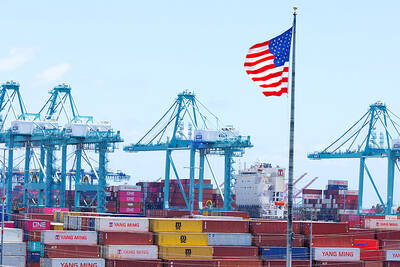
NOT IMMEDIATE: Taiwan has a chance to appeal the proposed 10 percent tariff before it starts, while other countries face a 12.5 percent tariff from the trade office Taiwan is among 60 economies determined by the US to have failed to impose or enforce a ban on the importation of goods produced with forced labor, according to a notice released on Tuesday by the Office of the US Trade Representative (USTR), which proposed imposing an additional 10 percent or more tariff on them. The USTR in a statement said that following an investigation, it had determined under Section 301 of the Trade Act of 1974 that the failure of the 60 economies to impose and effectively enforce a prohibition on the importation of goods produced with forced labor is


 RSS
RSS