


A Taipei City police officer was handed a one-year prison term yesterday for lying about his role during a 1997 shootout with one of three fugitives involved in a high-profile kidnap-murder case.
The Taipei District Court found that the officer wasn't even at the scene during the time of the shootout, and that the officer, head of the Chienkuo Precinct, tried to steal credit from his colleagues.
In April 1997, Chen Chin-hsing (陳進興), Lin Chun-sheng (林春生) and Kao Tien-min (高天民) kidnapped and eventually killed Pai Hsiao-yen (白曉燕), the daughter of popular TV entertainer Pai Ping-ping (白冰冰).
The court ruled that Chang Yao-sheng (張耀昇), 37, fabricated details of an August 1997 shootout with the suspects and attempted to steal credit from subordinates who had been chasing Lin and Kao.
Amid an intense nationwide manhunt for the three suspects, Chang's station received a tip-off on August 19, 1997, that two men believed to be Pai's murderers were hiding in an apartment on Wuchang Street, northern Taipei.
Two officers went to the apartment and were shot at by two men later identified as Lin and Kao.
As a chase ensued, the two policemen called for back up; they were hit by gunfire at roughly 11:40am that morning, and one of the officers later died.
As Kao fled on a motorcycle, Lin continued to exchange gunfire with other officers arriving on the scene. After 15-minutes of running and shooting, policed chased Lin into dead-end alley.
Seriously injured and with little hope of escape, Lin shot himself in the head at roughly 11:55am, the court found.
The court ruled that Chang, who did not arrive at the scene until 12:04pm, had concocted a story about his heroic performance during the shootout and incorporated it into his report on the incident.
Chang reported that he fired three shots at Lin as the suspect was chased into the alley.
To back up his claim, the officer filed an application for three bullets to replenish his stock.
But he failed to show up for a ceremony where he was to be presented with an award for bravery -- raising suspicions among his fellow officers.
During the trial, Chang denied that he had made up the story and insisted he was involved in the confrontation.
But the court found that Chang, who received word of the shootout at around 11:46am, had arrived at the scene 10 minutes after Lin had killed himself.
Other policemen also involved in the shootout testified that they had not seen their supervisor at the scene.
The Taipei District Court sentenced Chang to one year in prison, without suspension, on a charge of forgery yesterday. He may appeal to the High Court.
Fan Jen-hsun (范仁勳), the presiding judge in the case, said he had given Chang a "lenient sentence" because he had taken into consideration Chang's work as a policeman.
"The defendant has served as a policeman for quite a few years. Even though he did not receive any major awards, he deserves some sort of recognition for his service," Fan said.
"But on the other hand, we did not give him a suspended sentence because we believe that deception of this sort should not be encouraged."
If Chang had been granted a suspended sentence, he would not be required to serve time behind bars unless convicted of another crime during the one-year period.
Although Kao eluded police during the August 1997 shootout, he was killed in another shootout with police in November the same year.
Chen, who was the last of the three to be arrested, was sentenced to death for Pai's brutal murder and executed in October last year.

RESOLUTE BACKING: Two Republican senators are planning to introduce legislation that would impose immediate sanctions on China if it attempts to invade Taiwan US House of Representatives Speaker Mike Johnson on Sunday reaffirmed US congressional support for Taiwan, saying the US and “all freedom-loving people” have a stake in preventing China from seizing Taiwan by force. Johnson made the remarks in an interview with Fox News Sunday on US President Donald Trump’s summit with Chinese President Xi Jinping (習近平) last week. In an interview that aired on Friday on Fox News, just as Trump wrapped up a high-stakes visit to China, he said he has yet to green-light a new US$14 billion arms package to Taiwan and that it “depends on China.” “It’s a very good
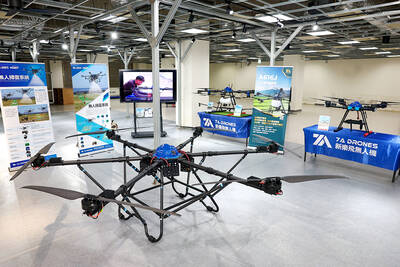
DRONE CENTRAL: Taiwan aims to become Asia’s democratic hub for drones, with most exports focused on high-quality military-grade models, an official said Taiwan’s drone industry is expected to expand significantly by 2030, producing 100,000 units per month and exporting half of them, the Ministry of Economic Affairs said yesterday. Current drone production capacity is about 15,000 units per month, but the industry can quickly scale up as demand increases, Industrial Development Administration Director-General Chiou Chyou-huey (邱求慧) told a news conference in Taipei. Taiwan’s drone output grew 2.5-fold last year to NT$12.9 billion (US$408.3 million) under a government program to develop the uncrewed vehicle sector, he said. The Executive Yuan in October last year approved plans to invest NT$44.2 billion into domestic production of uncrewed aerial
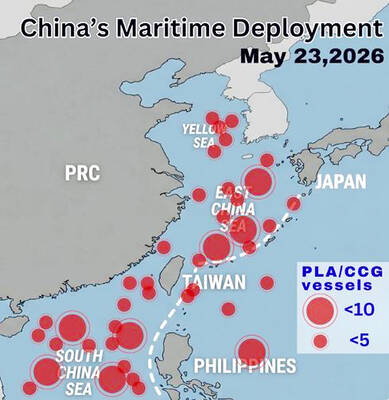
WARNING: China should stop engaging in actions that undermine regional peace and stability, as it would only build resentment among people across the Strait, the CGA said China has deployed more than 100 navy, coast guard and other vessels in waters from the Yellow Sea to the South China Sea and the western Pacific since US President Donald Trump and Chinese President Xi Jinping (習近平) met in Beijing, National Security Council Secretary-General Joseph Wu (吳釗燮) said yesterday. “In this part of the world, #China is the one & only PROBLEM wrecking the #StatusQuo & threatening regional peace & stability,” Wu wrote on X. In a separate post, he said Beijing was coercing Taiwan’s maritime domain, calling it illegal and provocative, after the Coast Guard Administration (CGA) expelled a
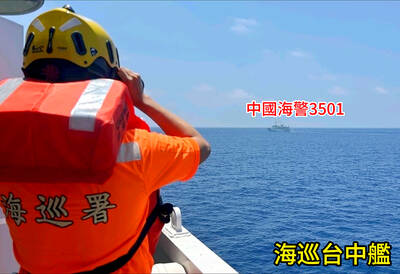
VERBOSE VESSELS: A CGA cutter and a China Coast Guard exchanged verbal barbs for more than a day in Taiwanese-controlled waters before the Chinese vessel left The Taiwanese and Chinese coast guards had a standoff near the strategically located Pratas Islands (Dongsha Islands, 東沙群島) in the north of the South China Sea, the Coast Guard Administration (CGA) said yesterday. The two sides engaged in intense radio exchanges over sovereignty claims during the 33-hour standoff. China Coast Guard vessel 3501 eventually left the restricted waters, 26.6 nautical miles (49.2km) west of the Pratas Islands, at 5pm yesterday, the CGA said. Lying approximately between southern Taiwan and Hong Kong, the Taiwan-controlled Pratas are seen by some security experts as vulnerable to Chinese attack due to their distance — more than


 RSS
RSS