

Frank Hsieh (
The meeting was notable for being the first time that a KMT leader has ever called upon the DPP, something that Lien pointed out while expressing his congratulations to Hsieh on the latter's inauguration as the DPP's ninth chairman.
At their meeting the two party leaders agreed to open more dialogue between the DPP and KMT and to accelerate the attainment of better interaction between parties in accordance with the principles of party politics.

PHOTO: CHIANG YING-YING, TAIPEI TIMES
There was, however, no resolution of the issue that the meeting had actually been called to address, namely the KMT's participation in a round-table meeting of the heads of Taiwan's major political parties called by President Chen Shui-bian
Hsieh urged Lien to attend the meeting but the KMT chairman said that his attendance was dependent upon what issues were on the agenda. Lien, however, did say that KMT Secretary-General Lin Feng-cheng
Lien is scheduled to depart for the US today for a month-long trip.
"It is possible that the KMT is still hesitant about attending the round-table meeting," said Wu, speaking to the media after the Hsieh-Lien meeting.
"On the basis of Lien's remarks today, however, the presidential round-table meeting will probably proceed," he said.
During the 30-minute meeting, Lien also said that parties should have mutual respect and interact in a mature fashion, while Hsieh agreed that interaction carried out in good faith would be conducive to the eradication of emotional and ideological conflicts between rival parties.
"Dialogue and exchange has been undertaken by both parties on either side of the Taiwan Strait. So why not between political parties [in Taiwan]?" Hsieh said.
Others taking part in the Hsieh-Lien meeting from the KMT included party spokesman Jason Hu (
Participants from the DPP included central standing committee member Chiu Yi-ying (邱議瑩), social promotion department director Lee Wen-ying (李文英) and spokeswoman Phoenix Cheng (鄭運鵬).
Some political analysts saw yesterday's meeting as an attempt to highlight the importance of party politics over the "government for all the people" (
"Political interaction is very important. The concept of `government for all the people' is based on the concept of party politics," the KMT's Chen said, hinting that the new government still needed the KMT's support.
Following his meeting with Lien, Hsieh visited the Presidential Office for his weekly Wednesday meeting with President Chen. He then returned to DPP headquarters and addressed reporters again.
"The concepts of party politics and `government for all the people' are not mutually exclusive," said Hsieh, quoting remarks reportedly just made to him by the president.
Hsieh said that the president was pleased to see that the DPP and KMT had met and he hoped that there would be more harmonious political interaction. Hsieh added that the president would assign acting Secretary-General to the President Chen Che-nan (
Hsieh met with New Party leader Hau Lung-bin (
On Monday Hsieh proposed a meeting with the PFP's Chairman James Soong
Soong has said he would welcome such dialogue.

Taiwan, which accounts for more than half of the global outsourced semiconductor assembly and testing market, is well-positioned to develop copackaged optics (CPO) and manufacture precision silicon photonics chips, the Ministry of Economic Affairs said yesterday. Silicon photonics are emerging as a mainstream optical communications technology and is seen as key to overcoming bottlenecks in AI computing power. The technology is a key project under the government’s New 10 Major AI Infrastructure Projects, with industry, government, academia and research institutions working to overcome critical technological hurdles and build a self-reliant silicon photonics supply chain, the ministry said. Nvidia Corp in March invested US$4
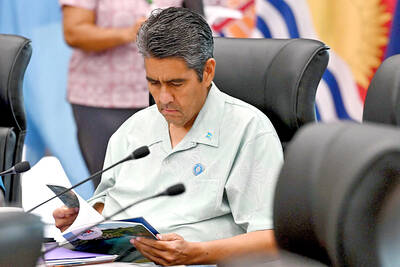
Palau’s president yesterday called for a “unified” Pacific response to a missile test by China in July, while Taiwan and its Pacific allies a day earlier at the Pacific Islands Forum (PIF) reaffirmed their commitment to peace, stability and prosperity. China gave only a handful of nations short notice before test-firing an intercontinental ballistic missile in July, sparking condemnation from several Pacific leaders. The 18-member PIF being held in Palau was expected to release a communique after press time last night, with a formal response to the test possibly included. Palau, which invited Taiwan to attend sideline events as an aid partner, urged
China’s continued efforts to inject geopolitical rivalry into the region and disrupt Pacific nations’ discussions of regional issues warrant greater international attention, a foreign affairs official said yesterday. Minister of Foreign Affairs Lin Chia-lung (林佳龍) last week led a delegation to diplomatic ally Palau to attend events related to the 55th Pacific Islands Forum (PIF) summit. However, the absence of some member-state leaders has been interpreted by some people as a sign of fracturing in Pacific unity. Thirteen PIF members were represented by their heads of state or government, while Fiji, New Caledonia, Vanuatu and Samoa sent ministerial-level representatives, a diplomatic official
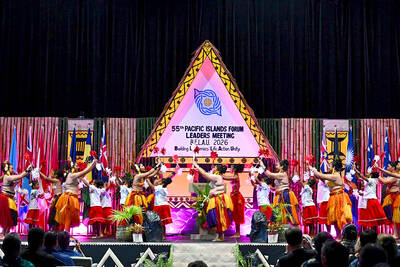
STATE DEPARTMENT: A US official said that Washington would provide more than US$150m for Pacific island nations, with Minister Lin Chia-lung welcoming the plans The US Department of State has announced partnerships with Taiwan on two Palau projects after Washington pledged more than US$150 million for Pacific island nations. Following the opening of the 55th Pacific Islands Forum (PIF) Leaders Meeting in Palau on Sunday, the department on Tuesday issued a statement titled “Promoting Pacific Prosperity: US Engagement at the Pacific Islands Forum,” which said that the US’ commitment to the security and prosperity of Pacific island nations “is steadfast and enduring, and remains a core pillar of its ‘America first’ foreign policy.” Meanwhile, US Deputy Secretary of State Christopher Landau announced at the PIF Partners


 RSS
RSS