


In a move aimed at reorganizing state-run China Airlines (CAL, 中 華航空), Minister of Transportation and Communications Yeh Chu-lan (葉菊蘭) announced yesterday the formation of a new board for the China Aviation Development Foundation (CADF, 中華航空事業發展基金會), which holds a 71 percent stake in CAL and is the main policy-making force behind the carrier.
Yeh also suggested National Chiao-tung University President, Chang Chun-yen (張俊彥) be named president of the group, replacing former Premier Hsu Li-teh (徐立德).
Chang has a long record of public service, including recent work as a member of the National Policy Advisory Committee (
Relatives in Chang's family were killed in the 228 Incident, and because of his family's political leanings, Chang had virtually no chance of studying abroad during the White Terror period. Chang received a PhD from National Chiao-tung University in 1970.
Chang is currently attending a seminar in San Jose, California, and was unavailable for comment.
An anonymous observer said the new CADF board members exclude all the former KMT members who previously held board positions. In addition, the source said CAL's competitor, EVA Air (長榮航空), has been blocked from gaining a board seat.
There had been speculation recently that EVA had sought to take control of CAL through the board, using its influence with President Chen.
EVA is widely rumored to have strong ties with the president, as its founder, Chang Yung-fa (
Both Yeh and Premier Tang Fei (
Other new board members include lawyer Chang Cheng-hsiung (
Yeh said Huang was invited to be CAL's representative in CADF as a fulfillment of the administration's promise to bring more democracy to the domestic airline industry.
CAL employee representatives have sought recently to capitalize on the timing of the board reshuffle to gain representation and have their voices heard.
"We hope that company employees can be represented both on the board of the foundation as well as in the company itself at the June election," said Lee Chao-ping (李昭平), chairman of the China Airlines Union (華航產業工會), at a hearing last Friday.
The youngest CADF board member, Huang is said to be a member of CAL's "Taiwan faction," known for its pro-DPP leanings.
The majority of CAL staff are strong supporters of the New Party and the recently formed People First Party.
"Current chairman Chiang Hung-yi (蔣洪彝) and president Sandy Liu (劉克涯) will be replaced in the near future to totally reform CAL's industry culture and management," MOTC officials said.
MOTC officials said the CADF should be reorganized by June 30 and the group will nominate 10 out of CAL's 11 board members soon after.

The Tourism Administration yesterday announced that it would reward repeat international visitors with incentives of up to NT$8,000 to boost inbound tourism. The incentives are available to all international tourists, it said, adding that repeat visitors would be rewarded with NT$5,000 and would receive an additional NT$3,000 if they bring travel companions. The nation received 2,990,657 inbound visitors during the first quarter, marking a 3.8 percent increase from the same period last year, agency data showed. Japanese nationals are among groups visiting Taiwan the most. About 1.48 million Japanese tourists arrived last year, a year-on-year increase of more than 12
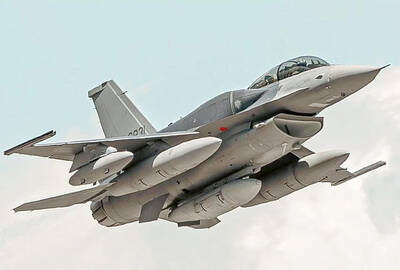
66 FIGHTER JETS: The aircraft is likely undergoing preparations for its transfer to Taiwan — a significant step forward in the nation’s modernization program, a lawmaker said The first of Taiwan’s order of F-16V Block 70 aircraft has been sighted in Texas ahead of delivery, Democratic Progressive Party (DPP) Legislator Wang Ting-yu (王定宇) said. Taiwan’s first F-16V Block 70 two-seat aircraft, tail number 6831, was seen flying from Lockheed Martin’s production facility in Greenville, South Carolina, to Naval Air Station Joint Reserve Base Fort Worth in Texas, Wang wrote on Facebook yesterday. The plane is likely undergoing preparations for its transfer to Taiwan, marking a significant step forward in the Republic of China Air Force’s modernization program, Wang said, citing military analysts. The F-16V Block 70 is a new-build version
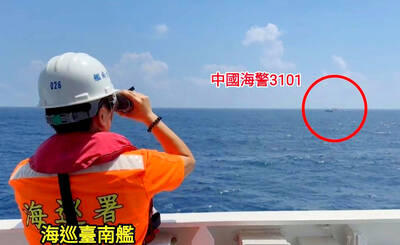
‘BRAZEN’: The holiday did not stop China from activities that infringe on Taiwan’s maritime jurisdiction, but the CGA is ready to defend the nation, Kuan Bi-ling said Beijing is intensifying maritime pressure on Taiwan, but the nation will never yield, Ocean Affairs Council Deputy Minister Sung Chen-en (宋承恩) said. The Coast Guard Administration (CGA) has adopted a “shadowing and monitoring” approach to avoid falling into a Chinese trap to escalate tensions and deepen the conflict, Sung said in an interview published yesterday in the Chinese-language Liberty Times (the Taipei Times’ sister newspaper). China Coast Guard formations patrolling waters east of Taiwan, as well as official Chinese vessels entering areas around Itu Aba Island (Taiping Island, 太平島) and Pratas Islands (Dongsha Islands, 東沙群島) show Beijing’s attempts to significantly step up
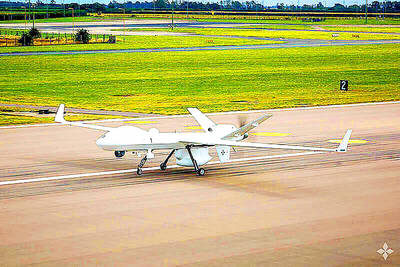
BOOST: By operating the same advanced systems as the US military, Taiwan would be better positioned to share and integrate intelligence with partners, an expert said The first batch of MQ-9B SkyGuardian drones has arrived in Taiwan, and is being assembled and tested by drone manufacturer General Atomics and the military ahead of flight trials as part of the air force’s acquisition to bolster its aerial surveillance capabilities, a source said yesterday. The air force allocated a budget of NT$21.7 billion (US$687 million) from 2022 to 2029 to procure four MQ-9B uncrewed aerial vehicles (UAVs) manufactured by General Atomics along with associated equipment such as ground control stations. The US has agreed to deliver the four MQ-9Bs to Taiwan in two batches this year and next


 RSS
RSS