


As the 20th anniversary of the murder of DPP chairman Lin I-hsiung's (
Family friends said it was once impossible for Lin and his wife Fang Su-min (
But today, the couple and their friends say they are finally able to move on and feel they want to do something in memory of the twins.
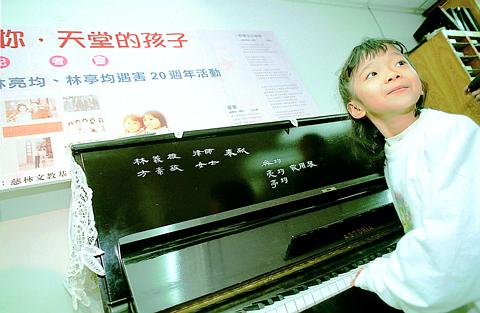
PHOTO: GEORGE TSORNG, TAIPEI TIMES
On Feb. 28, 1980, when Lin was jailed and awaiting trial for his participation in the Kaohsiung Incident the year before, an unknown killer came to his house in an alley off Hsinyi Road and fatally stabbed Lin's then 60-year-old mother and his three daughters.
His eldest daughter, Lin Huan-chin (
The murder, which remains unsolved, is often thought to have been politically motivated because of Lin's active role in the opposition movement.
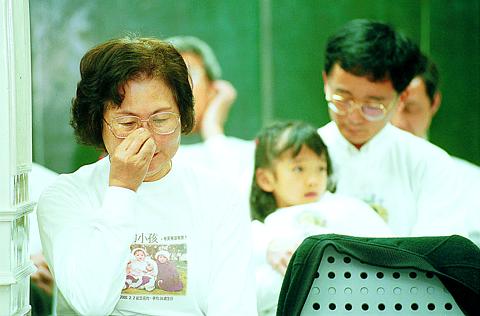
PHOTO: GEORGE TSORNG, TAIPEI TIMES
The standard claim by officials at the time was that a burglar was responsible.
Physically, the twin girls may have been absent from the family for 20 years, but they are living every moment in their mother's memory.
"It would have been their 26th birthday on Feb. 2 this year. They should have had dates like other girls at their age. And they might have married like their elder sister did," Fang said.
"I had only six years to be with Ting-chin and Liang-chin. But it is a lifelong memory they have left with me," Fang said.
The Chilin Foundation (慈林文教基金會), founded by the Lins and some of their friends, will hold a memorial event on the birthdays of the sisters on Feb. 2, instead of Feb. 28, the day they died.
"We'd like to remember the joy the girls' births brought to the Lin family and many other friends, rather than recall the anger and sadness their deaths brought us," said Chen Ming-chung (陳銘政), organizer of the event, to be held at the 228 Peace Park.
"Politics is something we want to avoid during the event. We miss the two lovely kids and we believe we have to do something for them 20 years after their deaths," Chen added.
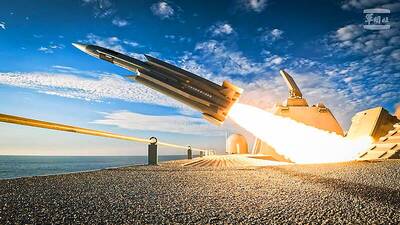
DETERRENCE: With 1,000 indigenous Hsiung Feng II and III missiles and 400 Harpoon missiles, the nation would boast the highest anti-ship missile density in the world With Taiwan wrapping up mass production of Hsiung Feng II and III missiles by December and an influx of Harpoon missiles from the US, Taiwan would have the highest density of anti-ship missiles in the world, a source said yesterday. Taiwan is to wrap up mass production of the indigenous anti-ship missiles by the end of year, as the Chungshan Institute of Science and Technology has been meeting production targets ahead of schedule, a defense official with knowledge of the matter said. Combined with the 400 Harpoon anti-ship missiles Taiwan expects to receive from the US by 2028, the nation would have
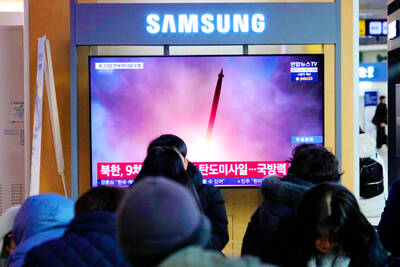
North Korea yesterday fired about 10 ballistic missiles to the sea toward Japan, the South Korean Joint Chiefs of Staff (JCS) said, days after Pyongyang warned of “terrible consequences” over ongoing South Korea-US military drills. Pyongyang recently dashed hopes of a diplomatic thaw with Seoul, Washington’s security ally, describing its latest peace efforts as a “clumsy, deceptive farce.” Seoul’s military detected “around 10 ballistic missiles launched from the Sunan area in North Korea toward the East Sea [Sea of Japan] at around 1:20pm,” JCS said in a statement, referring to South Korea’s name for the body of water. The missiles

‘UNWAVERING FRIENDSHIP’: A representative of a Japanese group that co-organized a memorial, said he hopes Japanese never forget Taiwan’s kindness President William Lai (賴清德) yesterday marked the 15th anniversary of the Tohoku earthquake and tsunami, urging continued cooperation between Taiwan and Japan on disaster prevention and humanitarian assistance. Lai wrote on social media that Taiwan and Japan have always helped each other in the aftermath of major disasters. The magnitude 9 earthquake struck northeastern Japan on March 11, 2011, triggering a massive tsunami that claimed more than 19,000 lives, according to data from Japanese authorities. Following the disaster, Taiwan donated more than US$240 million in aid, making it one of the largest contributors of financial assistance to Japan. In addition to cash donations and
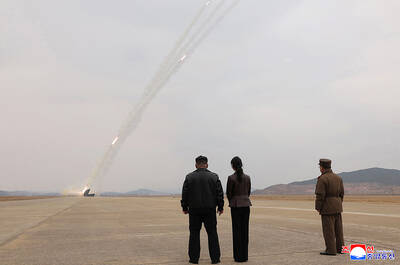
North Korea tested nuclear-capable rocket launchers, state media reported yesterday, a day after Seoul detected the launch of about 10 ballistic missiles. The test comes after South Korean and US forces launched their springtime military drills, due to run until Thursday. North Korean leader Kim Jong-un on Saturday oversaw the testing of the multiple rocket launcher system (MRLS), the Korean Central News Agency (KCNA) said. The test involved 12 600mm-caliber ultra-precision multiple rocket launchers and two artillery companies, it said. Kim said the drill gave Pyongyang’s enemies, within the 420km striking range, a sense of “uneasiness” and “a deep understanding


 RSS
RSS