


The most important election in Taiwan's short democratic history -- to choose its leader for the post-Lee Teng-hui (
On the final night of campaigning, as mandated by law, all three candidates drove themselves to the brink of exhaustion with last-minute efforts to sway voters. Mostly on foot, they "swept the streets" by walking through key townships, pressing the flesh as they went, stopping only to hold a number of mass rallies.
Each camp expressed its confidence of victory, though members of some expressed concern that last-minute vote-buying by rivals could sway the outcome.

PHOTO: CHEN CHENG-CHANG
The KMT, as had been expected, brought in its heavyweights to help the party's candidate, Chang Cheng-hsiung (
The honor guard included KMT Secretary-General John Chang (
Dripping sweat from the intensity of the day, the KMT candidate passed from door to door shaking voters' hands. With supporters filling the narrow streets of his hometown amid the din of the firecrackers, officials said they were feeling ever-more optimistic.
Meanwhile, the DPP's candidate, Lin Chung-li (
Lin, escorted by DPP presidential candidate Chen Shui-bian (
At least one time during the day, the two camps came face-to-face on a street -- though no incidents of violence were reported.
While nothing is for certain in this race, all three candidates' camps had the same message -- that they will be taking home the main prize today, barring unforeseen incidents.
Liao Feng-jung (1顳p榮), a KMT official in the Yunlin county office, estimated that the party's candidate would garner around 147,000 votes. Kao Meng-ting (高孟定), Chang Jung-wei's campaign manager, predicted Chang will take away 148,000 votes. And DPP official Chou Yi-cheng (周弈|? said Lin is expected to gain 130,000 votes.
A total of 530,000 residents are eligible to vote in the by-election, and many observers expect a voter turnout of approximately 60 percent.
KMT organization department chief Johnson Chen (3紐?g) said the difference between Chang Cheng-hsiung and Chang Jung-wei will be fewer than 3,000 votes. He said the KMT had to boost its candidate's support along the county's coastal areas if it hoped to win.
From observing conditions in Yunlin County, however, it appears that the specter of vote-buying could well be the deciding factor in the race -- something both party officials and analysts have been saying from the beginning.
It is widely claimed that two of the candidates are attempting to buy votes with prices of NT$500 and NT$1,000 per vote, respectively.
In certain areas, such as an opponent's hometown, prices are said to be as high as NT$3,000.
DPP secretary-general Yu Shyi-kun said he worried about last-minute vote-buying today, just before voters begin filing into polling stations around the county.
Another official at Chang Jung-wei's headquarters said if no more money is injected into the "market," the independent candidate is definitely going to win.

The Tourism Administration yesterday announced that it would reward repeat international visitors with incentives of up to NT$8,000 to boost inbound tourism. The incentives are available to all international tourists, it said, adding that repeat visitors would be rewarded with NT$5,000 and would receive an additional NT$3,000 if they bring travel companions. The nation received 2,990,657 inbound visitors during the first quarter, marking a 3.8 percent increase from the same period last year, agency data showed. Japanese nationals are among groups visiting Taiwan the most. About 1.48 million Japanese tourists arrived last year, a year-on-year increase of more than 12
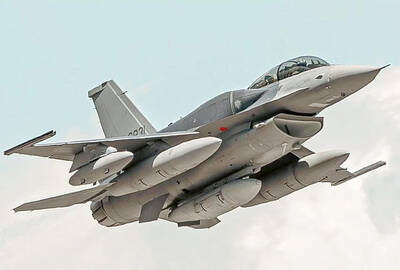
66 FIGHTER JETS: The aircraft is likely undergoing preparations for its transfer to Taiwan — a significant step forward in the nation’s modernization program, a lawmaker said The first of Taiwan’s order of F-16V Block 70 aircraft has been sighted in Texas ahead of delivery, Democratic Progressive Party (DPP) Legislator Wang Ting-yu (王定宇) said. Taiwan’s first F-16V Block 70 two-seat aircraft, tail number 6831, was seen flying from Lockheed Martin’s production facility in Greenville, South Carolina, to Naval Air Station Joint Reserve Base Fort Worth in Texas, Wang wrote on Facebook yesterday. The plane is likely undergoing preparations for its transfer to Taiwan, marking a significant step forward in the Republic of China Air Force’s modernization program, Wang said, citing military analysts. The F-16V Block 70 is a new-build version
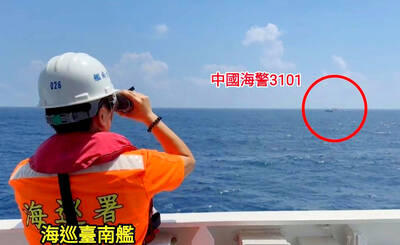
‘BRAZEN’: The holiday did not stop China from activities that infringe on Taiwan’s maritime jurisdiction, but the CGA is ready to defend the nation, Kuan Bi-ling said Beijing is intensifying maritime pressure on Taiwan, but the nation will never yield, Ocean Affairs Council Deputy Minister Sung Chen-en (宋承恩) said. The Coast Guard Administration (CGA) has adopted a “shadowing and monitoring” approach to avoid falling into a Chinese trap to escalate tensions and deepen the conflict, Sung said in an interview published yesterday in the Chinese-language Liberty Times (the Taipei Times’ sister newspaper). China Coast Guard formations patrolling waters east of Taiwan, as well as official Chinese vessels entering areas around Itu Aba Island (Taiping Island, 太平島) and Pratas Islands (Dongsha Islands, 東沙群島) show Beijing’s attempts to significantly step up
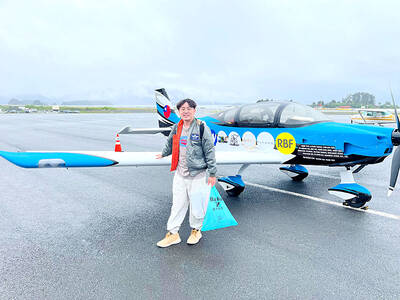
Taiwanese aviator Roger Lin (林睿哲) returned to Taiwan on Saturday after completing a nine-day round-the-world journey in a single-engine aircraft, becoming the first Taiwanese pilot to achieve the feat. Lin departed on June 5 from Los Angeles, California, and continued through Alaska, Japan, Taiwan, the Philippines, Indonesia, Malaysia, Thailand, Nepal, Jordan, Norway, Iceland and Canada before landing at the Taipei International Airport (Songshan) via Los Angeles and Japan. Lin shared numerous photos and videos of his journey on a Facebook page titled “Pilot Roger’s Around the World Flight,” including a video showing his aircraft flying over the Danjiang Bridge and


 RSS
RSS