


Visiting Chinese President Jiang Zemin told his host, French president Jacques Chirac, that China intends to ratify the nuclear weapons test ban treaty, rejected by the US senate earlier this month.
``Our objective is to obtain the ratification of this treaty,'' the French presidency's spokeswoman Catherine Colonna quoted the Chinese leader as saying during breakfast at president Chirac's countryside chateau. China's parliament has already made an initial examination of a ratification project, she added. Jiang said that China wants to ratify the nuclear weapons test ban treaty to help ``permit to create a more peaceful world,'' Colonna said.
Chirac had expressed his ``consternation'' at the US senate's Oct. 13 refusal to ratify the treaty, and Colonna said that Jiang had the same reaction.

PHOTO: REUTERS
In talks with his French counterpart, Jiang said his country would move ``step by step'' toward democracy with an eye to maintaining the nation's stability, Colonna said yesterday.
Jiang explained his approach to democracy during three hours of talks Saturday evening with Chirac, who hosted the Chinese leader at his estate in the Correze region, in the heart of France, on the second day of a five-day visit to the country.
The first two days were billed as a ``personal'' visit, with the state visit starting later yesterday when Jiang, on a two-week foreign tour that began in Britain, was to arrive in Paris.
But first, he enjoyed the pleasures of the French countryside, dancing to accordion music with French First Lady Bernadette Chirac at a local fair in the town of Chaumeil.
The night before, at Chirac's Chateau Bity, more serious matters were on the agenda.
Chirac expressed his concern about respect for democracy and political and religious freedoms, said Colonna.
Jiang in turn expressed ``his wish for his country to make progress step by step in this direction (toward democracy) without putting into question the stability of an ensemble of more than a billion inhabitants,'' Colonna said.
On the question of Chinese-occupied Tibet, the two men discussed the ``conditions of a dialogue'' between Chinese authorities and the Dalai Lama.
Colonna described the talks as ``deep, free and frank'' and said that Jiang remarked that the conversation was ``the deepest he has had with a foreign leader on this subject.''
Chirac, she added, was ``convinced that China will not remain at the side of the world's great evolutionary movement.''
Chirac has come under severe criticism from Chinese dissidents, human rights groups and some French politicians for inviting Jiang to his personal country estate, the first time such an invitation was extended to a foreign leader.
China and France meanwhile announced a ``hot line'' between their two nations described as a ``direct, secure telephone line permanently open,'' Colonna said. France currently has such lines with Washington and Moscow.
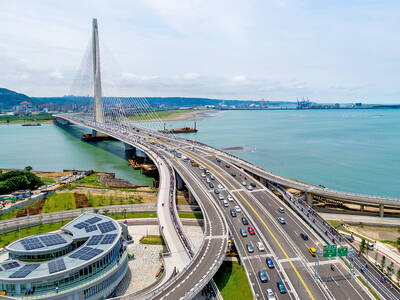
The Ministry of Transportation and Communications yesterday inaugurated the Danjiang Bridge across the Tamsui River in New Taipei City, saying that the structure would be an architectural icon and traffic artery for Taiwan. Feted as a major engineering achievement, the Danjiang Bridge is 920m long, 211m tall at the top of its pylon, and is the longest single-pylon asymmetric cable-stayed bridge in the world, the government’s Web site for the structure said. It was designed by late Iraqi-British architect Zaha Hadid. The structure, with a maximum deck of 70m, accommodates road and light rail traffic, and affords a 200m navigation channel for boats,
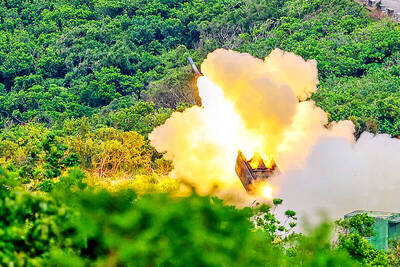
PRECISION STRIKES: The most significant reason to deploy HIMARS to outlying islands is to establish a ‘dead zone’ that the PLA would not dare enter, a source said A High Mobility Artillery Rocket System (HIMARS) would be deployed to Penghu County and Dongyin Island (東引) in Lienchiang County (Matsu) to force the Chinese military to retreat at least 100km from the coastline, a military source said yesterday. Taiwan has been procuring HIMARS and Army Tactical Missile Systems (ATACMS) from the US in batches. Once all batches have been delivered, Taiwan would possess 111 HIMARS units and 504 ATACMS, which have a range of 300km. Considering that “offense is the best defense,” the military plans to forward-deploy the systems to outlying islands such as Penghu and Dongyin so that

WHAT WAS ALL THAT FOR? Jaw Shaw-kong said that Cheng Li-wen had pushed for more drastic cuts and attacked him, just for the outcome to be nearly identical to his bill The legislature yesterday passed a supplementary budget bill to fund the purchase of separate packages of US military equipment, with the combined amount of spending capped at NT$780 billion (US$24.8 billion). The Chinese Nationalist Party (KMT) and Taiwan People’s Party (TPP) used their legislative majority to pass the bill, which runs until 2033 and has two main funding provisions. One was for NT$300 billion of arms sales already approved by the US for Taiwan on Dec. 17 last year, the other was for NT$480 billion for another arms package expected to be announced by Washington. The bill, which fell short of the NT$1.25

‘CLEAR MESSAGE’: The bill would set up an interagency ‘tiger team’ to review sanctions tools and other economic options to help deter any Chinese aggression toward Taiwan US Representative Young Kim has introduced a bill to deter Chinese aggression against Taiwan, calling for an interagency “tiger team” to preplan coordinated sanctions and economic measures in response to possible Chinese military or political action against Taiwan. “[Chinese President] Xi Jinping [習近平] has directed the People’s Liberation Army to be ready to invade Taiwan by 2027. China has a plan. America should have one too,” Kim said in a news release on Thursday last week. She introduced the “Deter PRC [People’s Republic of China] aggression against Taiwan act” to “ensure the US has a coordinated sanctions strategy ready should


 RSS
RSS