


Birdwatchers in Taiwan are used to driving up into the mountains, or standing at windswept spots along the coast. Yet the big cities are not totally lacking in places where you can get in a decent afternoon of birding.
In the north, Taipei Botanical Garden (台北植物園) is probably the best location for urban birdwatching. In the built-up core of Kaohsiung, Niaosong Wetland Park (鳥松濕地公園) is the go-to for birders who have just a few hours to spare.
The 3.6-hectare park, named for and located in Kaohsiung’s Niaosong District (鳥松), was the first wetland in Taiwan planned and deliberately brought into existence. Of course, humans have inadvertently created others, such as Gaomei Wetlands (高美濕地) in Taichung.
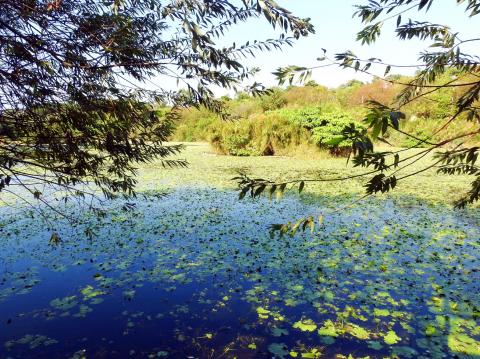
Photo: Steven Crook
Until the mid-1990s, this parcel of land was occupied by the state-run water utility. After they stopped using it, conservationists lobbied the government to turn it into a wetland education park. The water company dropped its initial objections, and work got underway. In September 2000, the park was ready for its grand opening. Admission is free, the park is open 24/7, and getting there isn’t difficult even if you’re depending on public transportation.
According to the website of Kaohsiung Wild Bird Society (www.kwbs.org.tw/wetland/english/Bird.html) — the NGO selected by the government to manage and maintain the park — 96 avian species are regularly seen around the wetland. The park is also home to up to 30 types of aquatic plants, various turtles, squirrels, insects, amphibians, and piscine species such as Mosquitofish (which Taiwanese call 大肚魚, “big-bellied fish”).
BIRDWATCHING
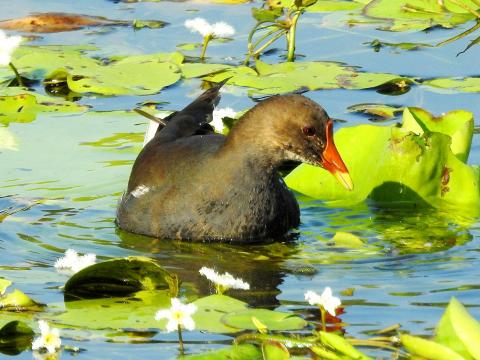
Photo: Steven Crook
Over the space of a couple of hours on a recent Sunday afternoon, my wife, my son and myself identified more than a dozen different birds. We’re occasional and minimally-skilled birders, but we had a decent pair of binoculars and favorable weather.
We weren’t surprised to see Little and Intermediate egrets. Nor were we especially excited: These white birds are found wherever there’s some greenery and some water.
We were a little too early to find any Great Egrets, but if you go to the wetland between now and May, you’ve a good chance of seeing one or two. To tell these three species apart, look at their beaks. That of the Little Egret is black; its Intermediate counterpart has a short, thick yellow beak that turns red or black during breeding season; the Great Egret’s beak is longer and thinner, and changes from yellow to a darker hue in the breeding season.
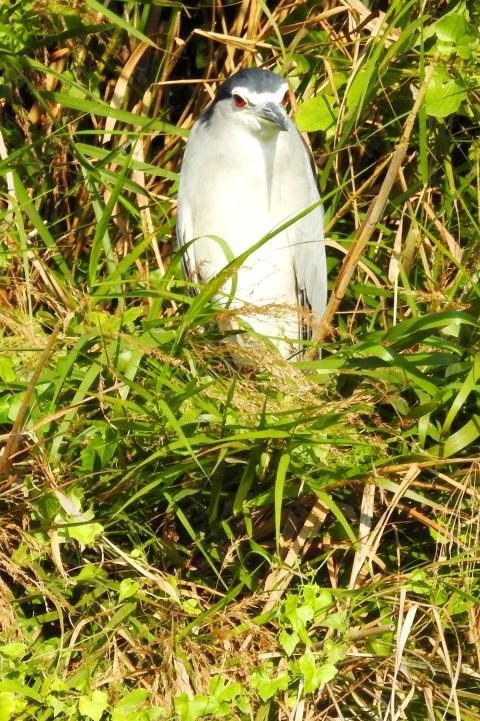
Photo: Steven Crook
The Common Moorhen is another year-round resident. Its beak, which is mostly red with a yellow tip, is its most colorful feature. The body is almost entirely black.
In the bamboo on the southern edge of the wetland, several Japanese White-eyes (sometimes called Warbling White-eyes) were hopping around. In the same patch of semi-woodland, there were at least three Taiwan Scimitar-Babblers. This species is endemic, meaning it isn’t seen in other countries. It’s also a particularly handsome bird, thanks to the red-brown around its shoulders.
The Black-Crowned Night Herons were almost as numerous as the egrets. A few had positioned themselves on the banks of the main pond, while others stood on posts or floating branches. An adult specimen can weigh up to 800g, so a good amount of food is required each day. Like some other herons, they have been seen to throw tiny scraps into the water, to lure fish to within striking distance.
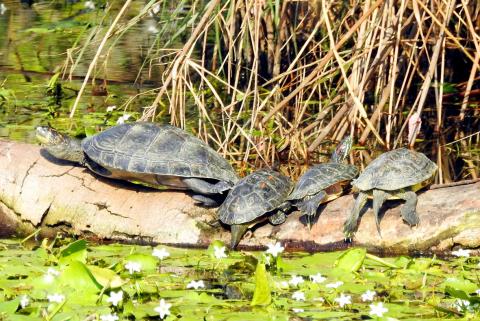
Photo: Steven Crook
Just as we were returning to our car, we found another kind of hunter on the very edge of the wetland park. My wife spotted a Crested Goshawk, motionless on a branch, almost within arm’s reach. These raptors are quite a bit smaller than some of the other birds of prey seen in Taiwan. I wondered if many people, seeing its grey-brownish patterning, assume it’s nothing but a well-fed pigeon.
There’s evidence from Southeast Asia that this species adapts fairly well to urban life, so perhaps it shouldn’t be a surprise to see one here. In the countryside they hunt smaller birds, mammals and reptiles. In the city, there are plenty of rats.
If you want to make a full day’s excursion to this part of Kaohsiung, you can also visit Chengcing Lake (澄清湖, open Tuesday to Sunday, 6am to 5:30pm; admission NT$100 for adults but free for Kaohsiung residents), or take in a game at the nearby sports venue which takes its name, Chengcing Lake Baseball Stadium (高雄市立澄清湖棒球場).
Because the lake’s current name was chosen by Chiang Kai-shek (蔣介石) in 1963, some think the authorities should restore the original Taiwanese-language toponym, Toapi Lake (大埤湖). Chiang had one of his many retreats by the lake, as well as an underground military headquarters. The old bunker is now an aquarium called Chengcing Lake Exotic Marine Life Museum (澄清湖海洋奇珍園).
Less than 1km northwest of the wetland, there’s further evidence of the Chinese Nationalist Party’s impact on this side of the city in the form of a landmark building which resembles Taipei’s Grand Hotel (圓山大飯店). The similarity is entirely intentional, because this is a sister establishment of the capital’s landmark called the Grand Hotel Kaohsiung (高雄圓山大飯店). If your budget stretches that far, consider finishing your trip in the cafe on the second floor.
Steven Crook has been writing about travel, culture, and business in Taiwan since 1996. He is the co-author of A Culinary History of Taipei: Beyond Pork and Ponlai, and author of Taiwan: The Bradt Travel Guide, the third edition of which has just been published.

The Lee (李) family migrated to Taiwan in trickles many decades ago. Born in Myanmar, they are ethnically Chinese and their first language is Yunnanese, from China’s Yunnan Province. Today, they run a cozy little restaurant in Taipei’s student stomping ground, near National Taiwan University (NTU), serving up a daily pre-selected menu that pays homage to their blended Yunnan-Burmese heritage, where lemongrass and curry leaves sit beside century egg and pickled woodear mushrooms. Wu Yun (巫雲) is more akin to a family home that has set up tables and chairs and welcomed strangers to cozy up and share a meal
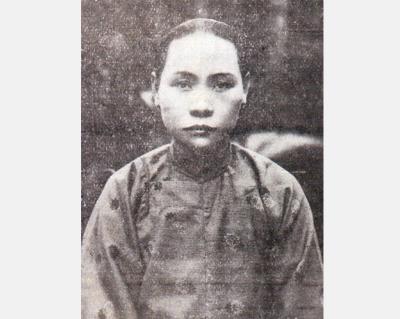
Dec. 8 to Dec. 14 Chang-Lee Te-ho (張李德和) had her father’s words etched into stone as her personal motto: “Even as a woman, you should master at least one art.” She went on to excel in seven — classical poetry, lyrical poetry, calligraphy, painting, music, chess and embroidery — and was also a respected educator, charity organizer and provincial assemblywoman. Among her many monikers was “Poetry Mother” (詩媽). While her father Lee Chao-yuan’s (李昭元) phrasing reflected the social norms of the 1890s, it was relatively progressive for the time. He personally taught Chang-Lee the Chinese classics until she entered public

Last week writer Wei Lingling (魏玲靈) unloaded a remarkably conventional pro-China column in the Wall Street Journal (“From Bush’s Rebuke to Trump’s Whisper: Navigating a Geopolitical Flashpoint,” Dec 2, 2025). Wei alleged that in a phone call, US President Donald Trump advised Japanese Prime Minister Sanae Takaichi not to provoke the People’s Republic of China (PRC) over Taiwan. Wei’s claim was categorically denied by Japanese government sources. Trump’s call to Takaichi, Wei said, was just like the moment in 2003 when former US president George Bush stood next to former Chinese premier Wen Jia-bao (溫家寶) and criticized former president Chen

President William Lai (賴清德) has proposed a NT$1.25 trillion (US$40 billion) special eight-year budget that intends to bolster Taiwan’s national defense, with a “T-Dome” plan to create “an unassailable Taiwan, safeguarded by innovation and technology” as its centerpiece. This is an interesting test for the Chinese Nationalist Party (KMT), and how they handle it will likely provide some answers as to where the party currently stands. Naturally, the Lai administration and his Democratic Progressive Party (DPP) are for it, as are the Americans. The Chinese Communist Party (CCP) is not. The interests and agendas of those three are clear, but


 RSS
RSS