


Technology has a bad rep these days. Each news cycle seems to bring more reports of data mining, fake news and other social ills of the digital age. Big Tech has fallen from its pedestal, increasingly criticized for monopolizing data, finance and power in ways that have had unforeseen consequences on the non-virtual world.
These thoughts were never far from my mind at the 17th Digital Art Festival, now showing at the Museum of Contemporary Art, Taipei (MOCA, Taipei) until Nov. 10. Walking into a sinister soundtrack of electronic instruments, I’m prepared for doomsday predictions of how human civilization has wrought our own destruction through technological evolution.
Instead, levity abounds. If digital art is a commentary on the relationship between humanity and technology, then this festival paints a redemptive picture. Artworks revel in the unique aesthetic of the digital age, its connection to (rather than severance from) the natural sciences and how it enhances our capacity to create and relate.
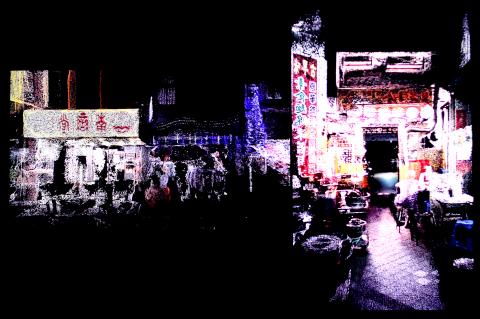
Photo: Davina Tham, Taipei Times
VIEWER INTERACTION
This also means a particularly fun time for visitors, as unlike traditional media, almost every artwork is designed for some form of viewer interaction. These range from the obvious — virtual reality (VR) technology — to the more experimental — brain waves and blockchain.
Hung Yu-hao’s (洪譽豪) The Hallway of City No. 1 (城市穿廊計畫No. 1) transforms Taipei’s oldest neighborhoods into a pathway that viewers “walk” through on a manually-powered treadmill. Even as it captures rich, lived-in architecture, the still landscape, which dissolves into unrecognizable points of light upon closer inspection, is a melancholy reminder of transience and how such historic spaces are being destroyed by the march of progress.
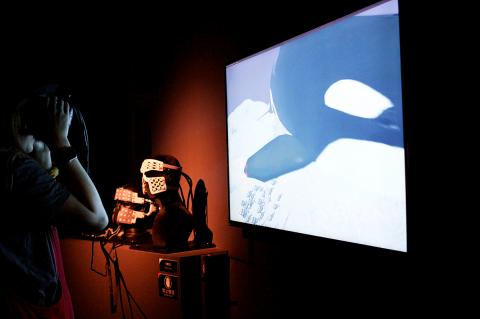
Photo: Davina Tham, Taipei Times
In Shota Yamauchi’s Zone Eater, players use VR controllers to enter the “souls” of characters and perform actions. Through character design, the game plays with the concept of the uncanny valley, which hyothesizes that humanoid objects which imperfectly resemble us can trigger feelings of revulsion and eeriness.
Aesthetic theories aside, faith in technology is strongest in the works that push the boundaries of VR for practical application. Bio I/O by Chun-cheng Hsu Laboratory (許峻誠實驗室), based out of the National Chiao Tung University Institute of Applied Arts, expands VR from its usual visual and aural applications to the other senses. Contraptions worn on the arms and face not only allow viewers to navigate a fantastical seaworld, but also simulate the physical sensation of moving through a body of water.
Li Chien-yu (李建佑), one of the project’s two creative and technical directors, says that the technology has applications for people with visual impairments as it uses the same underlying principles as Braille. Even under art museum conditions, this is a convincing version of a future in which such body augmentations become the norm, especially if the line between human and cyborg continues to blur. After all, I already think of my smartphone as an extension of my hand.
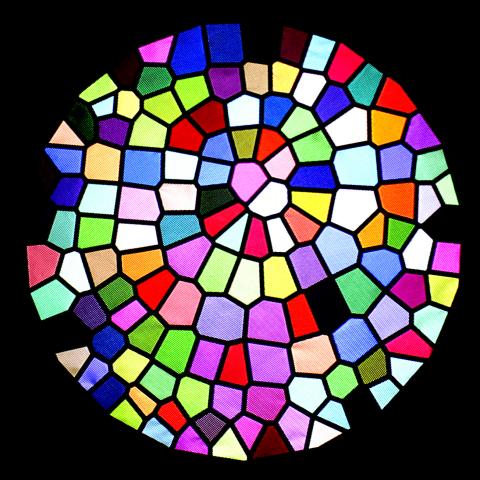
Photo: Davina Tham, Taipei Times
Themes of surveillance, control and dehumanization are still on the cards, such as in Semi Su’s (蘇紳源) Lines — Online (界—在線), which uses computer vision and 3D rendering to convert museum visitors into “data subjects.” German artist Clemens von Wedemeyer’s film Transformation Scenario pits algorithmic crowd simulations against footage of real-life crowds to ominous effect.
There are still some doomsday narratives, although these tend to be backdrops to scenarios that deepen a sense of humanity. Wu Tzu-ning’s (吳梓寧) Metaverse 2.0 (魅塌域2.0) uses VR to plunge viewers into a wasteland filled with the detritus of civilization and its memories, provoking a reflection on the value of objects in everyday life.
At other times, however, the exhibition is a reminder that principles of computing, also found in nature, can produce wonder and whimsy. Voronoi Guess 2 (沃羅諾伊的猜想2) by Lee Chia-hsiang (李家祥) uses a Voronoi diagram — an algorithm that partitions a plane into regions — to produce a stained glass window-lookalike on the wall of the museum. Viewers manipulate its appearance using a sensor, resulting in surprising and beautiful configurations.

Photo: Davina Tham, Taipei Times
The festival saves its showstopper for the last gallery. At first glance, Value of Values, a collaboration between French artist Maurice Benayoun, German artist Tobias Klein, Colombian artist Nicolas Mendoza and French composer Jean-Baptiste Barriere, resembles a sci-fi noir movie. People sit in pod-like chairs with sensors around their foreheads, staring expressionless into screens that project unrecognizable, pulsating forms.
Settling into my chair, the screen tells me to visualize the value of “kindness” and runs through a detailed list of attributes like color, radius and viscosity. I imagine a sunshine yellow blob in the shape of two outstretched palms.
I can’t be sure whether this part of the work is entirely performative or whether it’s actually tapping into my neurotransmissions. But what appears on screen is instead a brick-red object in the shape of a finger or a phallus, depending on scale.
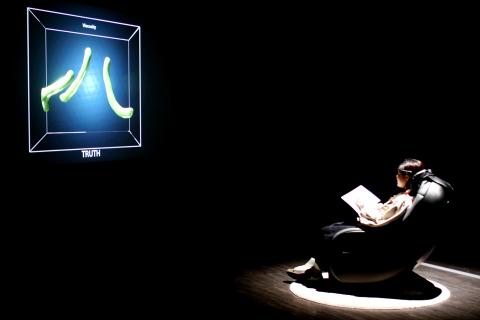
Photo: Davina Tham, Taipei Times
A gallery assistant comes over in amazement, because she hasn’t seen anyone create such a streamlined shape.
“Everyone else’s has things growing out all over the place,” she laughs. But while my attention is diverted, the shape starts spreading out.
After the visualization is complete, I get a QR code to scan my value into a virtual marketplace modeled after a cryptocurrency barter system. I start getting ideas about the radical democracy of the digital age, which allows us to create personalized experiences and even customized values. I whip out my phone to start trading.
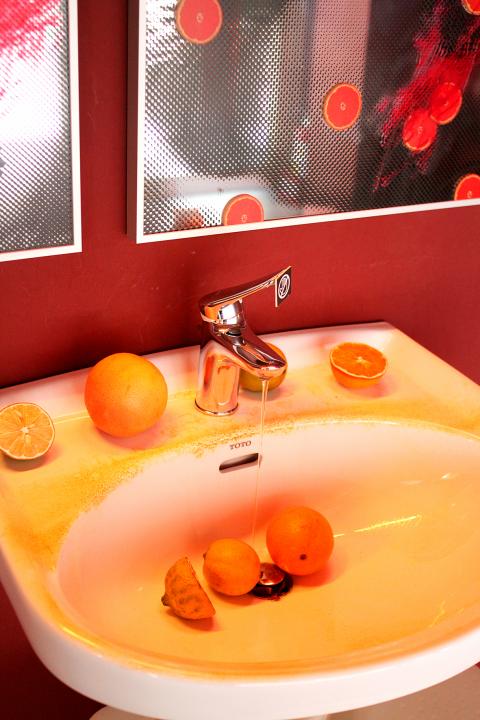
Photo: Davina Tham, Taipei Times
Unfortunately, after a day of pondering how my experience of the world has been irreversibly altered by technological achievements, this is where technology fails me — my QR code doesn’t work.
ENDING HIV/AIDS STIGMA
Running concurrently with the Digital Art Festival is Interminable Prescriptions for the Plague (瘟疫的慢性處方), a co-presentation with the Taiwan HIVStory Association (臺灣感染誌協會) that will be on view until World AIDS Day on Dec. 1.
Located in MOCA Cube — a repurposed shipping container located outside the museum’s main building — the exhibition uses this open, public space to showcase activists’ efforts to enhance access to medical treatment and end the stigmatization around HIV/AIDS.
The works question stereotypes about HIV/AIDS by drawing thought-provoking links between other features of modern life.
Blockchain rears its head again here, as an analogy for HIV transmission. Positive Coin: Automatic Transaction Machine (帕斯堤貨幣: 自動交易機) by Lee Tzu-tung (李紫彤) transacts a “bionic currency” that has features of a virus — it grows but also expires, and is kept alive by paying a trading tax.
At the end of the trading cycle on Dec. 1, participants can exchange their coin for actual HIV/AIDS activism merchandise. Tickets to participate as a trader have sold out, but visitors can view the ATM and consider how values and attitudes shift when a virus is packaged as cryptocurrency.
Next to the ATM, the bathroom set-up in Lo Chih-hsin’s (羅智信) Like a filter, matters passed through you and became a part of you. (Twilight) (像是顆濾心,物質穿越過你便成為你的一部份(暮光之城)) is a tongue-in-cheek commentary on our fascination with blood and hygiene through contemporary vampire romance novels.
Compared to the museum’s immersive main presentation, these works lack breathing room in the relatively tight exhibition space. But the exhibition promises some engaging live presentations. On Nov. 3 and 17 respectively, Mandarin tours by intensive care physician Tu Han-hsiang (杜漢祥) and Taiwan Tongzhi Hotline Association director Ka Fei (喀飛) will flesh out the themes of the exhibition as they relate to the experiences of the HIV/AIDS community.
And on Dec. 1, American poet and performance artist Brad Walrond will present Blood Brothers, a multi-disciplinary work integrating interviews with Taiwan’s HIV/AIDS activists and data on the epidemiology of HIV/AIDS in Taiwan.
Ajay Verma, a consultant gastroenterologist at Kettering general hospital in Northamptonshire, says our gut is a “complex machine.” “It is constantly providing us with the nutrition we need, initially to grow and develop, and then for us to survive, thrive and repair from injury and illness.” How can we keep it functioning well? Put simply: “Make sure what you put into it is balanced, and that you clear out its waste products adequately,” Verma says. “In a general gastroenterology clinic, the most common conditions we see are irritable bowel syndrome (IBS), gastroesophageal reflux disease, inflammatory bowel disease and constipation,” says Nisha
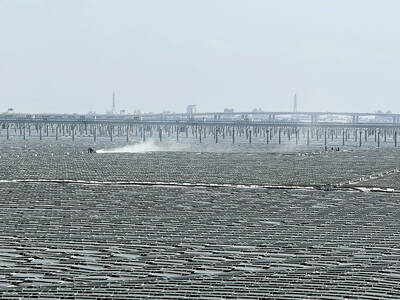
The arithmetic is straightforward and uncomfortable. By the end of 2025, Taiwan had committed itself to a 50-30-20 electricity mix — half natural gas, 30 per cent coal, 20 per cent renewables. The Ministry of Economic Affairs’s (MOEA) own monthly energy reports tell a different story. Natural gas reached 47.8 per cent of generation last year. Coal stood at 35.4 per cent, comfortably above its target ceiling. Renewables came in at 13.1 per cent, well short of the 20 per cent Taipei had pledged a decade earlier. Installed renewable capacity reached roughly half of the 12 gigawatts (GW) the government
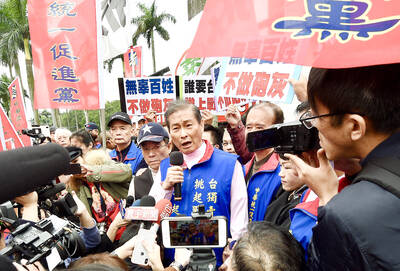
There are shadowy cabals plotting to sell out Taiwan to be annexed by China, by invasion if necessary. Fortunately, they are buffoons. In 2019, former Bamboo Union gangster and founder of the China Unification Promotion Party (CUPP), Chang An-le (張安樂, colorfully known as “White Wolf”), led a protest at the Legislative Yuan against comments made by then-premier Su Tseng-chang (蘇貞昌) that in the event of an attack by China, he would never surrender, but would protect the nation by fighting to the end, even if he only had a broom. Chang had party members bring a wooden casket that they
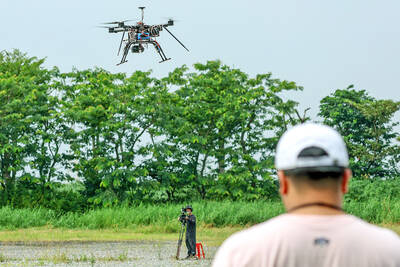
Taiwan’s drone exports are taking off, fuelled by the war in Ukraine, as Taiwanese companies seek a stake in the fast-growing global market for unmanned aerial vehicles (UAV). Low-cost drones used for reconnaissance and strikes are in high demand as governments around the world boost defense spending in the face of intensifying conflicts. A relative new player in the increasingly competitive industry, Taiwan’s pitch is to be an “Asian hub” for the production of UAVs and components free of Chinese materials, or “non-red.” That means its UAVs can be up to three times more expensive than their Chinese competitors, like the world’s biggest


 RSS
RSS