


For the eighth annual Hong Kong Week, the Hong Kong-Taiwan Cultural Co-operation Committee used “From Text to Stage” as its theme in selecting works by the territory’s top dance, theater and music companies to present in Taipei.
While “week” is part of the title, the program actually runs slightly longer, from tomorrow through Sept. 29, plus an extra performance by the Hong Kong Sinfonetta at the National Taichung Theater on Oct. 8.
One unique feature of this year’s festival is that a number of Taiwanese artists are among the performers.
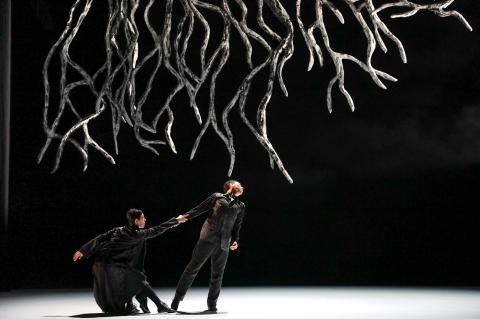
Photo Courtesy of City Contemporary Dance Company
Hong Kong Week opens tomorrow with a hotly awaited performance by City Contemporary Dance Company (城市當代舞蹈團, CCDC) of the double bill that launched its 40th anniversary program in April, Helen Lai’s (黎海寧) Winterreise and The Rite of Spring (冬之旅.春之祭).
It is doubtful that anyone at CCDC or the organizing committee knew just how pertinent the program would be.
Lai’s 1992 classic The Rite of Spring was inspired by Vaslav Nijinsky’s 1913 Le Sacre du Printemps, using the same 33-minute score by Russian composer Igor Stravinsky, but her piece reflects the chaos of Hong Kong in the 1990s. It centers on the struggle for power between a choreographer, performers and audiences.
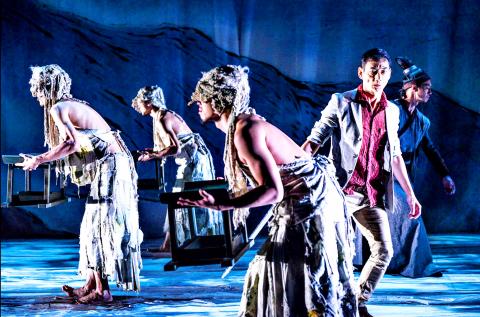
Photo Courtesy of Fung Wai-sun
A year ago, Lai met with Taiwanese dancer/choreographer Chou Shu-yi (周書毅) to discuss collaborating on a revival of the work, in which he would join the CCDC dancers and other guest artists.
Lai told a news conference in Taipei last month that she was both surprised and worried by the parallels between her 27-year-old work and the current situation in Hong Kong, having taken part in several of this summer’s anti-extradition bill protests.
Chou said Lai’s Rite of Spring demonstrates how unrest in the world “has been repeated and has never died down.”
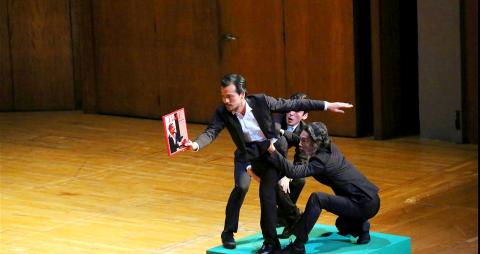
Photo Courtesy of the Hong Kong Sinfonietta
Lai's new work, Winterreise, is set to 10 of the songs from Franz Schubert’s 1828 song cycle of the same name
Winterreise depicts the loneliness of travelers on wintry roads and Lai said the double bill presents “two distinct styles of dancing and two unique stories.”
On Friday night, the Tang Shu-wing Theatre Studio (鄧樹榮戲劇工作室) opens a two-show run of renowned theater director Tang Shu-wing’s (鄧樹榮) The Tragedy of Macbeth (馬克白的悲劇) at the Taipei City Shuiyuan (Wellspring) Theater (台北市水源劇場).
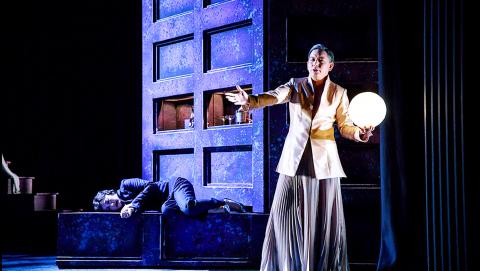
Photo courtesy of RhapsoArts Management
Tang has adapted William Shakespeare’s classic to tell the story of a modern couple who assume the roles of Macbeth and Lady Macbeth as they commit a series of murders in their bid for the throne.
The production was originally commissioned by Shakespeare’s Globe of London and the Hong Kong Arts Festival.
The following weekend offers a choice of two shows: Ghost Love, a chamber opera at the National Taiwan University of Arts Performance Hall (國立臺灣藝術大學臺藝表演廳) on Sept. 27 and 28, or the Hong Kong Sinfonietta’s (香港小交響樂團) A Soldier’s Story 5.0 — The Devil Returns (小城大兵的故事—魔鬼回歸) at the National Concert Hall on Sept. 27.
Ghost Love, by composer Chan Hing-yan (陳慶恩) to a libretto by Yi Heng (意珩) is based on Xu Xu’s (徐訏) 1939 novella by the same name. Japanese director Tomo Sugao helmed the piece, with Lio Kuok-man (廖國敏) conducting.
Set in 1945, it tells the story of a man who is alone in Hong Kong after fleeing Shanghai and who meets the ghost of woman and wants to know more about her. It will be performed in Mandarin with Chinese and English surtitles.
A Soldier’s Story 5.0 — The Devil Returns is described by the organizers as “a dialogue between music, text and dance,” as it features three very different works.
The first is Autumn Rhythm, by composer Daniel Lo (盧定彰), which was commissioned by the Sinfonietta and inspired by Jackson Pollock’s art.
The second is Mozart’s “Violin Concerto No. 5 in A,” which will feature Taiwanese violinist Tseng Yu-chien (曾宇謙).
The third is an updating of choregrapher Yuri Ng’s (伍宇烈) 2005 collaboration with the Sinfonetta, The Devil’s Tale, set to Stravinsky’s The Soldier’s Tale. Taiwanese dancer/choreographer Chen Wu-kang (陳武康) is one of the four performers from around Asia in the cast.
The Sinfonetta and cast will return to Taiwan to perform the show in Taichung on Oct. 8.
The final two parts of Hong Kong Week, both at Huashan 1914 Creative Park, are free: In The Shifting Scenes — Mao Chun-fai on Text, Stage and Performance (談戲風生—毛俊輝說文本、舞台、表演) and the HK Illustration X Original Design Brands Exhibition (香港插畫 X 創意設計品牌展).
From 2pm to 4pm on Sept. 29, famed theater director and producer Mao Chun-fai (毛俊輝) will discuss his works and insights on creation honed over three decades, alongside a panel of three artists he has collaborated with: Taiwanese poet and author Lo Chih-cheng (羅智成), actress Alice Lau (劉雅麗) and Cantonese opera actress Amy Wu (胡美儀).
Admission is free, but you need to register via Acupass (www.accupass.com/event/1907080918251134297990).
There will also be an exhibition of photographs and other materials from Mao’s career, which will be open from 4pm to 6pm on Sept. 28, from 10am to 6pm on Sept. 29 and from 10am to 1pm on Sept. 30.
The design exhibition, which opens tomorrow and runs through Sept. 29, is centered on the theme “IDNA” — “Illustration,” “Design,” “New Form” and “Art” — and aims to showcase the work of Hong Kong illustrators and IP designers in two sections.
The first is new works especially created by 11 illustrators especially for the show, all based on the same text. The second part is a display of illustrations, toys, animation, comics and licensed design works and related products and augmented reality games.
The Hong Kong Week Web site has more information on the shows and casts and links to ticketing, in English and Chinese, at www.hongkongweek-taiwan.hk.
This story has been corrected since it was first published to show that Chou Shu-yi is performing in "Rite of Spring," not "Winterreise."
If one asks Taiwanese why house prices are so high or why the nation is so built up or why certain policies cannot be carried out, one common answer is that “Taiwan is too small.” This is actually true, though not in the way people think. The National Property Administration (NPA), responsible for tracking and managing the government’s real estate assets, maintains statistics on how much land the government owns. As of the end of last year, land for official use constituted 293,655 hectares, for public use 1,732,513 hectares, for non-public use 216,972 hectares and for state enterprises 34 hectares, yielding
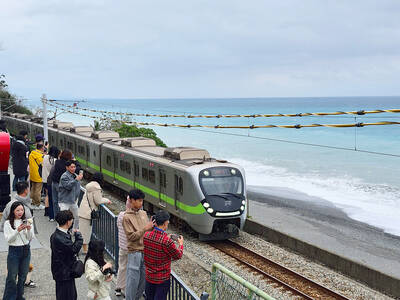
The small platform at Duoliang Train Station in Taitung County’s Taimali Township (太麻里) served villagers from 1992 to 2006, but was eventually shut down due to lack of use. Just 10 years later, the abandoned train station had become widely known as the most beautiful station in Taiwan, and visitors were so frequent that the village had to start restricting traffic. Nowadays, Duoliang Village (多良) is known as a bit of a tourist trap, with a mandatory, albeit modest, admission fee of NT$10 giving access to a crowded lane of vendors with a mediocre view of the ocean and the trains

The March/April volume of Foreign Affairs, long a purveyor of pro-China pablum, offered up another irksome Beijing-speak on the issues and solutions for the problems vexing the People’s Republic of China (PRC) and the US: “America and China at the Edge of Ruin: A Last Chance to Step Back From the Brink” rang the provocative title, by David M. Lampton and Wang Jisi (王緝思). If one ever wants to describe what went wrong with US-PRC relations, the career of Wang Jisi is a good place to start. Wang has extensive experience in the US and the West. He was a visiting

One of the challenges with the sheer availability of food in today’s world is that lots of us end up spending many of our waking hours eating. Whether it’s full meals, snacks or desserts, scientists have found that it’s not uncommon for us to be mindlessly grazing at some point during all of our 16 or so waking hours. The problem? As soon as this food hits the bloodstream in the form of glucose, it initiates the release of the hormone insulin. This in turn activates a switch present in every one of our cells, which is responsible for driving cell


 RSS
RSS