


It is unlikely that the producers of the first international touring production of The Lion King thought they would be facing off against a rival production this month in Taipei, but that is what is happening.
Director Jon Favreau’s technology-driven live-action remake of Disney’s animated 1994 hit opened in movie theaters in the capital and around the nation on Wednesday. Not only are movie tickets much, much cheaper, but the star-studded film cast includes some very famous voices, such as Beyonce’s.
The good news for the touring show, which Kuang Hong Arts Management (KHAM) has brought back to the Taipei Arena 11 years after an earlier version packed one of the capital’s biggest venues for three weeks, is that the initial reviews of Favreau’s remake have been pretty ho-hum.
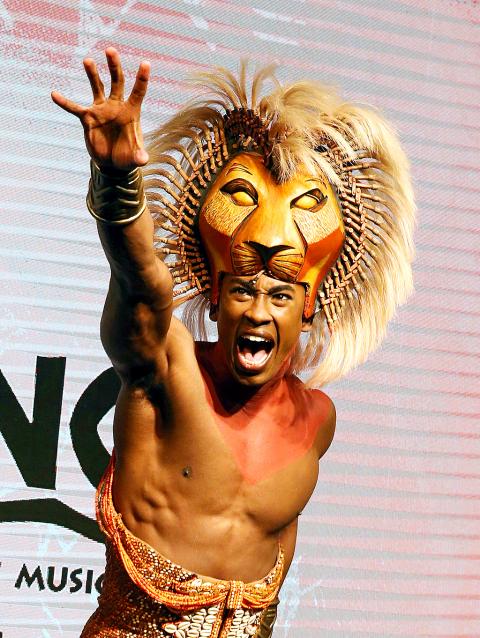
The live show, the 25th global production, but first “international” one, premiered in Manila in March last year, followed by runs in Singapore and three South Korean cities, and is now in Taipei for 19 performances.
Most of the leads and ensemble members are South African, with some British and Filipinos in the mix, as well as Tainan-born dancer Wu Tzu-jung (吳姿蓉).
Director Julie Taynor’s costumes, and the mask and puppets she codesigned, are as amazing as ever, as is the music, which includes the Elton John-Tim Rice songs made famous by the 1994 movie, such as Circle of Life and Hakuna Matata, plus others by South African composer Lebo Morake, as well as contributions by Hans Zimmer, Mark Mancina and Jay Rifkin.
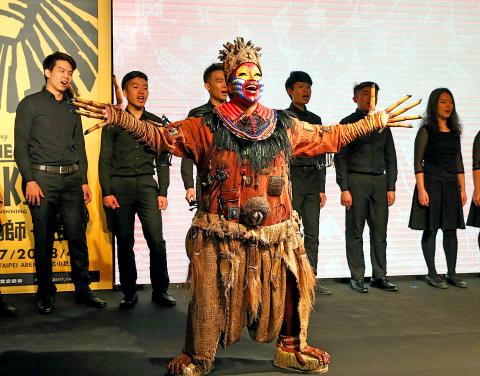
Photo: CNA
There are more than 230 masks and puppets in the show to portray 25 kinds of creatures, ranging from body-suit puppets or masks of lions, birds, fish and insects, to an elephant that is operated by four actors.
The show is performed in English, with Chinese surtitles.
■ Tomorrow through Aug. 4 at the Taipei Arena (台北小巨蛋), 2, Nanjing E Rd Sec 4, Taipei City (台北市南京東路四段2號), with evening performances Tuesdays to Saturdays at 7:30pm, matinees on July 27 and Aug. 3 at 2:30pm, and Sunday shows at 1pm and 6pm.
■ Remaining tickets range from NT$3,800 to NT$6,600, available through Kuang Hong Arts Management’s Web site, www.kham.com.tw, OK Mart convenience store ticket kiosks or by calling (07) 780-7071, Monday to Friday from 9:30am to 5:30pm, or faxing (07) 780-5353. The premiere is sold out as is the matinee on Saturday next week. More seats are available during the second week of the run than for next week’s shows.

Taiwan’s English education system is being pulled apart by three opposing forces. Bilingual Nation 2030 pulls students toward English and global communication. Artificial Intelligence (AI) readiness pulls them toward digital judgment, verification and AI-mediated work. But Taiwan’s old exam culture pulls them back toward memorization, grammar drills, timed reading and correct answers. If the education system keeps using old exams to define success, it risks producing graduates who are neither genuinely bilingual nor genuinely AI-ready, but trained for tasks machines can already perform. The first force is Bilingual Nation 2030. Launched in 2018, the policy aimed to “help Taiwan’s workforce connect

“Taiwan’s Opposition Leader Comes to US With a Message Straight Out of Beijing” read a May 31 headline in the Wall Street Journal. Top US administration officials and members of Congress almost certainly read the WSJ, and if there was a bullet point takeaway that people in Washington should absorb ahead of Chinese Nationalist Party (KMT) Chair Cheng Li-wun’s (鄭麗文) arrival in DC on June 9, that headline is it. The last few columns have discussed this very topic, and the timing is not coincidental. While those top officials likely do not read the Taipei Times, judging by the number

With weighty, anxiety-inducing geopolitical topics dominating the headlines, checking in on the wild and weird state of local politics can take some of the edge off. This November’s elections will determine who will be in charge of fixing potholes in your neighborhood, not the potholes in Taiwan’s complicated geopolitical space. Recently, after an online interview with a Taipei-based journalist, I commented that Taipei journalists never go further than the MRT can take them. He laughed and agreed. Naturally, the Taipei mayoral race is eating up much of the press attention. TAIPEI CITY Democratic Progressive Party (DPP) candidate Puma Shen (沈伯洋) has
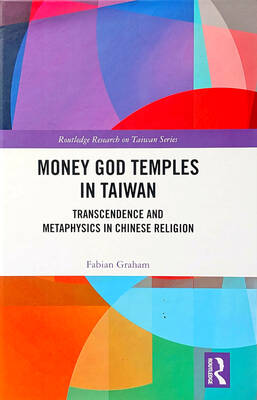
As someone who normally steers clear of books with “transcendence” or “metaphysics” in their subtitles, this reviewer — a casual observer of local belief systems since the 1990s — found Fabian Graham’s Money God Temples in Taiwan a challenging read. Those who’ve only dipped their toes into temple culture will likely need to parse several sections with special care if they’re to keep up with the author, a British ethnographic researcher whose previous books have investigated religious practices among ethnic Chinese in Southeast Asia. This scholarly volume examines a facet of Taiwan’s religious landscape that didn’t exist a century ago, and


 RSS
RSS