


Ann Hsieh (謝于安) says people today value their online identities more than who they really are, choosing to share only the positive aspects of their lives.
“In the online world, it is as though we are all colorblind,” the Fu Jen Catholic University’s Department of Textiles and Clothing student tells the Taipei Times as she explains the idea behind her six-piece collection Love Blindness (色覺辨認障愛). “We can only see the colors other people want to present to us.”
Inspired by this observation, in one of her outfits made of synthetic leather, Hsieh incorporates the Ishihara plates used to test colorblindness. But instead of numbers, at the center of the dotted patterns are different faces that can barely be distinguished.
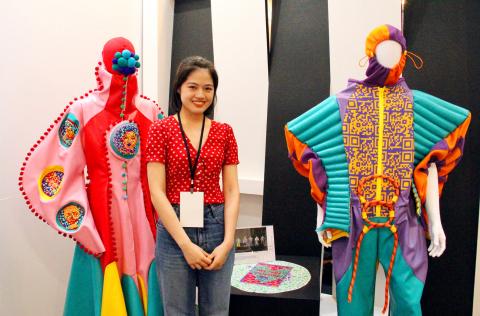
Photo: Sherry Hsiao, Taipei Times
Hsieh was one of 10,333 students showing off 3,848 projects from 137 design departments across Taiwan as part of the 38th Young Designers’ Exhibition (YODEX, 新一代設計展), which ended on Monday.
Organized by the Taiwan Design Center (TDC, 台灣創意設計中心), the exhibition brought together students from six fields: digital multimedia design, product and craft design, apparel and fashion design, visual communication design, interdisciplinary integrated design and spatial and architectural design.
On the opening day, the two exhibition halls of the venue were packed with students dressed in coordinated outfits standing in front of their works and poster boards, explaining their ideas to visitors.
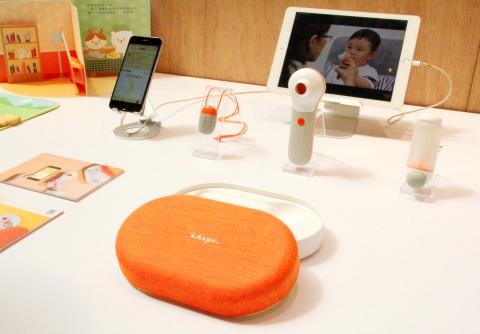
Photo: Sherry Hsiao, Taipei Times
The students had clearly been asked by their professors to rehearse their spiels — and it showed.
HEALTH AND MEDICINE
Perhaps the most common theme among the designs was health and medicine. Created by Shih Chien University Department of Industrial Design’s Chi Liang-yu (紀良諭), Asthma Protector (兒童氣喘保衛戰), or Aspr, is an asthma kit and app that encourages young asthma sufferers to be more proactive about keeping track of their peak expiratory flow rates and medication usage through games and digital rewards.
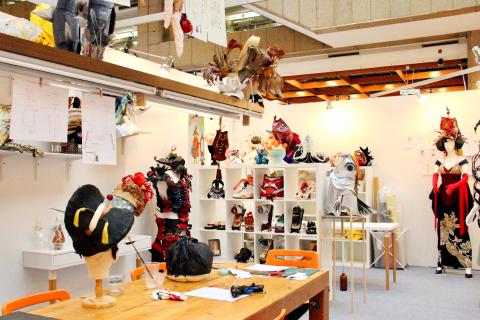
Photo: Sherry Hsiao, Taipei Times
vThe app was intuitive and visually inviting, and at a time when the purpose of mobile health apps is getting lost in an oversaturated market, Chi’s design is a welcome reminder that medically-inspired technology can, and is meant to, save lives.
Aspr, which specifically targets asthma patients aged five to 12, stands out from a swarm of apps all striving towards the same thing.
Drone regulations are still ambiguous, but that did not stop students from imagining what the future of airspace might look like. Acystem (車禍處理系統) is a drone designed to perform a hybrid of the functions of an emergency dispatch service, an insurance company and a traffic cone.
The idea is that it would be the first responder to a traffic accident, scanning and capturing a wide-angle shot of the scene before emergency personnel arrive. Drivers in minor collisions would then have the option of lowering the drone and position it at an appropriate distance from their vehicle using an app, minimizing the risk of further injuries.
Acystem would serve as a neutral third party, and the photographic evidence it records could be used to resolve disputes, said Wong Kei-sum (黃琦琛), who developed the concept with his classmates Ke Zhao-yu (柯昭宇) and Keni Matsunaga (松永軒易) from National Kaohsiung Normal University’s Department of Industrial Design.
WHERE DO THEY GO FROM HERE?
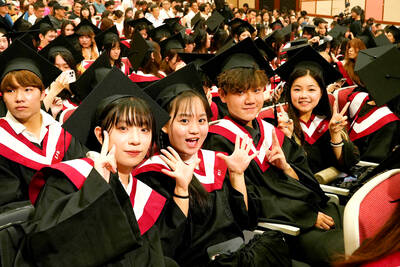
The four-day exhibition was certainly a bittersweet experience for the students as they prepare for graduation in the coming weeks.
And hopefully, with design departments being much more hands-on than other majors, the ones who do want to take a shot at working in the field already have sizable portfolios to show potential employers. In her four years in college, Hsieh, who says she wants to design costumes for the stage, managed to put a couple of partnerships and cases under her belt, mostly by posting her work on Instagram.
Online recruiting service 1111 Job Bank (1111 人力銀行) was also at YODEX inviting students to take its Holland career aptitude test and complete a virtual mock interview that an artificial intelligence program would then analyze for facial expressions.
From the inside looking out, the future may seem like a haze; but from the outside, things are looking bright.
All of this year’s participating designs can be found in the Online Exhibition tab at www.yodex.com.tw
Taiwan’s English education system is being pulled apart by three opposing forces. Bilingual Nation 2030 pulls students toward English and global communication. Artificial Intelligence (AI) readiness pulls them toward digital judgment, verification and AI-mediated work. But Taiwan’s old exam culture pulls them back toward memorization, grammar drills, timed reading and correct answers. If the education system keeps using old exams to define success, it risks producing graduates who are neither genuinely bilingual nor genuinely AI-ready, but trained for tasks machines can already perform. The first force is Bilingual Nation 2030. Launched in 2018, the policy aimed to “help Taiwan’s workforce connect

“Taiwan’s Opposition Leader Comes to US With a Message Straight Out of Beijing” read a May 31 headline in the Wall Street Journal. Top US administration officials and members of Congress almost certainly read the WSJ, and if there was a bullet point takeaway that people in Washington should absorb ahead of Chinese Nationalist Party (KMT) Chair Cheng Li-wun’s (鄭麗文) arrival in DC on June 9, that headline is it. The last few columns have discussed this very topic, and the timing is not coincidental. While those top officials likely do not read the Taipei Times, judging by the number

With weighty, anxiety-inducing geopolitical topics dominating the headlines, checking in on the wild and weird state of local politics can take some of the edge off. This November’s elections will determine who will be in charge of fixing potholes in your neighborhood, not the potholes in Taiwan’s complicated geopolitical space. Recently, after an online interview with a Taipei-based journalist, I commented that Taipei journalists never go further than the MRT can take them. He laughed and agreed. Naturally, the Taipei mayoral race is eating up much of the press attention. TAIPEI CITY Democratic Progressive Party (DPP) candidate Puma Shen (沈伯洋) has
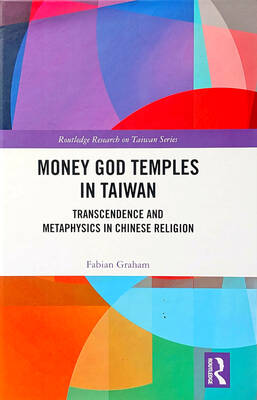
As someone who normally steers clear of books with “transcendence” or “metaphysics” in their subtitles, this reviewer — a casual observer of local belief systems since the 1990s — found Fabian Graham’s Money God Temples in Taiwan a challenging read. Those who’ve only dipped their toes into temple culture will likely need to parse several sections with special care if they’re to keep up with the author, a British ethnographic researcher whose previous books have investigated religious practices among ethnic Chinese in Southeast Asia. This scholarly volume examines a facet of Taiwan’s religious landscape that didn’t exist a century ago, and


 RSS
RSS