


Tina Keng Gallery presents Wanderers of the Abyssal Darkness II: Somber Seas (黯黑的放浪者II:幽遊之域), a solo exhibition by Yang Mao-lin (楊茂林). Yang began creating work in the post-Martial Law era, working in painting, computer animation, installation and sculpture to examine how colonialism shapes nationalism and culture. The show marks Yang’s return to the practice of painting after an extended period of time focusing on sculpture. He has represented Taiwan twice at the Venice Biennial, showing works that express original commentary on Taiwan with playfulness and humor. Yang says Taiwan is a hybrid culture that has been under the long-term influence of Japan and the US. The metaphor of the sea is prominent in his solo exhibition of new paintings, which depict dramatic narratives of fish life amid finely articulated vegetation.
■ Tina Keng Gallery (耿畫廊), 15, Ln 548, Ruiguang Rd, Taipei City (台北市瑞光路548巷15號), tel: (02) 2659-0798. Open Tuesdays to Sundays from 10am to 7pm
■ Until April 7
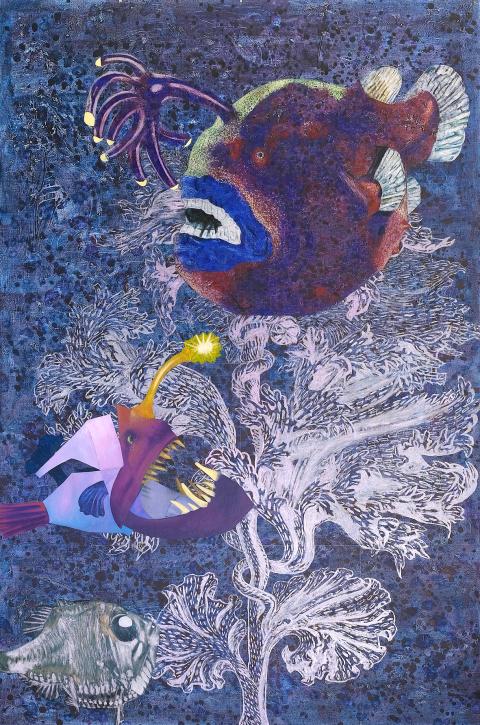
Photo Courtesy of Tina Keng Gallery
Huang Wei-hsuan (黃偉軒) works in theater design, sound design and video art. In his latest solo project featured in the multi-screen gallery of National Taiwan Museum of Fine Arts, Huang explores ideas of place and memory from the perspective of the subjective body. People rely on the sense of sight to orient and guide themselves through different spaces, but when a site no longer exists, is it possible experience it through alternative means? Huang’s project, The Dust and Light (和光同塵), utilizes photoscan (a technique that builds 3D models by way of digital photography) to recreate sites in virtual form that are soon to be dismantled. He then reassembles its spatial experience according to video footage of the space shot from a first person point of view. The result is a virtual terrain that is modeled after physical reality, and yet is also the starting point of a new reality, says the artist. Huang examines and memory traces associated with the modeled site. After the space is demolished, is it possible to experience the remains of its history with the aid of digital technology?
■ National Taiwan Museum of Fine Arts (國立台灣美術館), 2, Wuquan W Rd Sec 1, Taichung City (台中市五權西路一段2號), tel: (04) 2373-3552. Open Tuesdays to Fridays from 9am to 5pm, Saturdays and Sundays from 9am to 6pm.
■ Until April 28
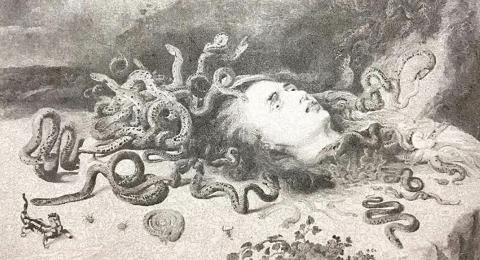
Photo Courtesy of Donna Art & Consulting
Sagaki Keita is a Tokyo-based artist who reinterprets famous Old Master paintings with distinctly original manga techniques. On first glance, his paintings resemble familiar images, such Leonardo da Vinci’s Mona Lisa, Hokusai’s The Great Wave Off Kanagawa and Sandro Boticelli’s The Birth of Venus. Upon closer inspection, however, his depictions are rendered with countless tiny, improvised cartoon characters. Sagaki says that “Western paintings offer depth, while my characters are flat. Even in many classical Japanese paintings, perspective is not used much.” On several occasions, the artist has described his practice as creating mandalas, a Buddhist drawing technique that is used to aid meditation. Mandalas are not only religious paintings made of countless details, “the purpose of such drawings is the reproduction of the unconscious self,” writes critic Chen Kuang-yi (陳貺怡) in a commentary on Keita’s work. A selection of his latest drawings is currently on view at Donna Art & Consulting. Entitled My Girl, the exhibition explores various representations of the female in art history. From Roy Lichtenstein’s The Melody Haunts My Reverie, Jean Ingre’s Odalisque to Edvard Munch’s Scream, Keita presents a panorama of Western art classics altered by his whimsical touch.
■ Donna Art & Consulting (多納藝術), 7F, 112 Keelung Rd Sec 2, Taipei City (台北市基隆路二段112號7樓), tel: (02) 7746-7463. Open Mondays to Saturdays from 11am to 7pm
■ Until March 30
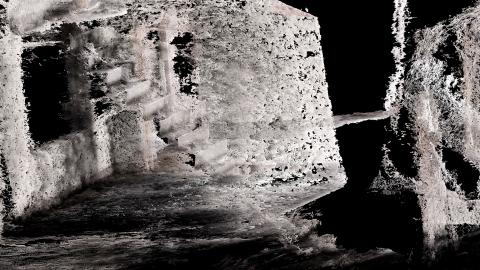
Photo Courtesy of National Taiwan Museum of Fine Arts
In 1998, Goino Tadashi, the honorary chairperson of the Utawa Society, donated 300 pieces of Japanese art to five institutions and universities in Taiwan. These works belonged to the style of Ukiyo-e, a 17th century Japanese art movement that literally translates to “floating road.” Ukiyo-e is a product of the Edo period, a time in which the then Japanese capital Edo enjoyed a thriving urban economy and stable political conditions. While a rising class of newly rich sought material goods to show off their social status, an influx of artists to the city cultivated a robust market for art. Ukiyo-e typically portrays narratives of female beauty, notable landscapes, dramatic characters and folk customs. The works were typically prints sold at affordable prices. Currently on view at the National Tsinghua University Museum is a selection of 40 Ukiyo-e paintings and prints donated to the National Museum of History. The Twilight Beauty by Utagawa Toyokuni III depicts a scene from The Tale of Genji, a Japanese literary classic about love affairs among the nobility. A Parade of Vassals in Kasumigaseki by Utagawa Hiroshige II is a horizontal print that shows an endless procession traversing through Tokyo’s historic government district.
■ National Tsinghua University Museum (國立清華大學文物館籌備處), 101, Guangfu Rd Sec 2, Hsinchu City (新竹市光復路二段101號), tel: (03) 574-2245. Open Tuesdays to Saturdays from 11am to 6pm
■ Until March 30
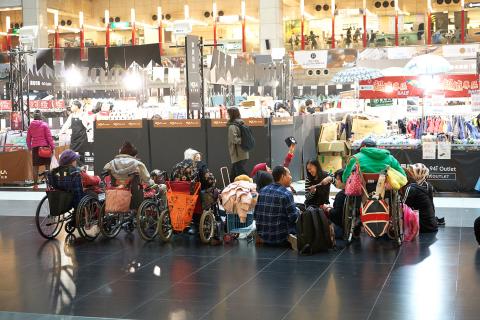
Photo Courtesy of Taipei Artist Village
Non-verbal Communication (非言語溝通) is the first iteration of exhibitions by Taipei Artist Village residents this year. The three artists featured in this show share an interest in communicating methods beyond words, interpreting environments, communities and social issues from different perspectives. Gabriele de Seta is an Italian artist based in Taipei who has a background in anthropology. His project, Listening/Accidents, explores Taipei through video and sound, with special attention to daily and unexpected voices that might seem unstructured but contain insights into a cultural context. Japanese artist Masayuki Harada’s video piece, Touch Us, examines Taipei’s migrant workers. The film captures the workers relaxing in their off-hours at the Taipei Main Station. According to the artist, documentation of physical expressions and social interactions communicate a non-verbal language that is telling of their social structure. Yunyo Ayo Shih’s (施昀佑) art publication, A Manual, How to Use Domestic Robot HK-ORCHID-35 in Hong Kong Region examines the future of Hong Kong’s domestic helpers. When labor is replaced by machines, will empathy disappear? Is equality possible?
■ Barry Room, Taipei Artist Village (台北國際藝術村百里廳), 7 Beiping E Rd, Taipei City (台北市北平東路7號), tel: (02) 3393-7377. Open Tuesdays to Sundays from 11am to 9pm
■ Until March 17
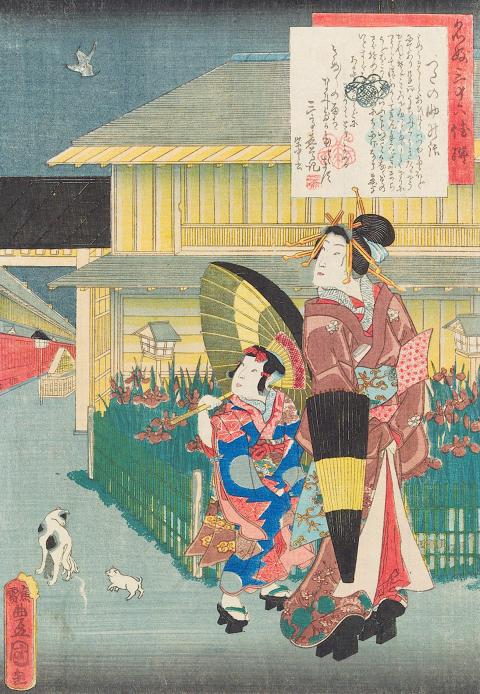
Photo Courtesy of National Museum Of History
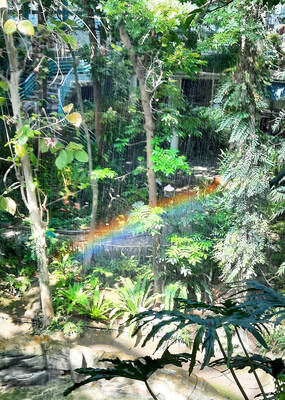
It’s only half the size of its more famous counterpart in Taipei, but the Botanical Garden of the National Museum of Nature Science (NMNS, 國立自然科學博物館植物園) is surely one of urban Taiwan’s most inviting green spaces. Covering 4.5 hectares immediately northeast of the government-run museum in Taichung’s North District (北區), the garden features more than 700 plant species, many of which are labeled in Chinese but not in English. Since its establishment in 1999, the site’s managers have done their best to replicate a number of native ecosystems, dividing the site into eight areas. The name of the Coral Atoll Zone might
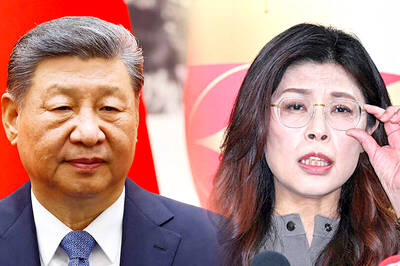
On Monday morning, in quick succession, the Chinese Communist Party (CCP) and the Chinese Nationalist Party (KMT) released statements announcing “that the Central Committee of the Communist Party of China and General Secretary Xi Jinping (習近平) have invited KMT Chairwoman Cheng Li-wun (鄭麗文) to lead a delegation on a visit to the mainland” as the KMT’s press release worded it. The KMT’s press release added “Chairwoman Cheng expressed her gratitude for the invitation and has gladly accepted it.” Beijing’s official Xinhua news release described Song Tao (宋濤), head of the Taiwan Work Office of the CCP Central Committee, as
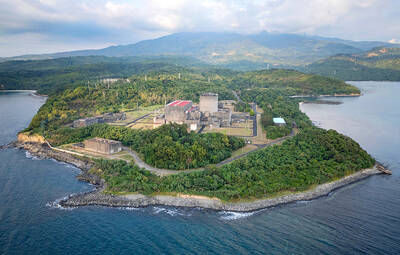
Nuclear power is getting a second look in Southeast Asia as countries prepare to meet surging energy demand as they vie for artificial intelligence-focused data centers. Several Southeast Asian nations are reviving mothballed nuclear plans and setting ambitious targets and nearly half of the region could, if they pursue those goals, have nuclear energy in the 2030s. Even countries without current plans have signaled their interest. Southeast Asia has never produced a single watt of nuclear energy, despite long-held atomic ambitions. But that may soon change as pressure mounts to reduce emissions that contribute to climate change, while meeting growing power needs. The
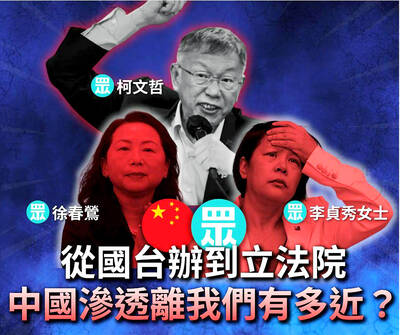
Last week saw Ko Wen-je (柯文哲), former Taipei mayor and founder of the Taiwan People’s Party (TPP), receive a 17-year sentence for crimes involving political corruption. This was only the opening round: the case is likely to drag on for several more years in appeals. Both the TPP and the Chinese Nationalist Party (KMT) are claiming that the prosecutors are engaging in a political witch hunt, green terror, fascism and so forth. It is easy to see this as a kind of compensation. After all, otherwise they would have to admit that the rather impressive collection of evidence against Ko actually


 RSS
RSS