


Greek director Theodoros Terzopoulos has proven popular with Taiwanese audiences and National Theater programmers since his first visit five years ago with his Attis Theater Group to perform Prometheus Bound as part of the Taiwan International Festival of Arts.
He was invited back to direct The Bacchae for the 2016 International Theater Festival, for which he trained a group of Taiwanese actors in his unique physical and vocal training method.
That show was so well received that the National Theater immediately asked him back for this year’s theater festival.
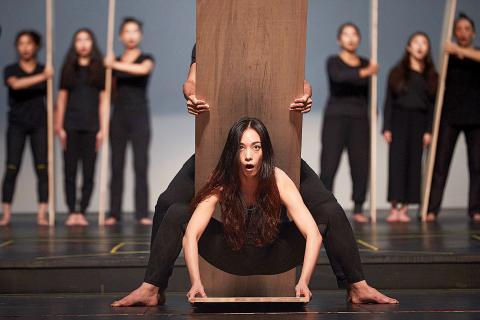
Yerma, which opens at the National Theater tonight, is Terzopoulos’ retelling of Spanish author and playwright Federico Garcia Lorca’s 1934 play about motherhood and the social oppression of women.
The play tells the story of a young married woman in a Spanish village who cannot conceive, making her the object of village gossip and coldness from her husband, and how her barrenness comes to define her life and the choices she makes.
Driven to despair and desperate to change her fate, she ends up murdering her husband.
Terzopoulos said he first directed a production of Yerma in 1981, with 60 actors, and he found it was very similar to the Greek tragedies, a theatrical form that he built his career on.
Coming back to it after 37 years, he wanted to make the story bigger than just a tale about a couple and a village, to make it more universal, he said.
Once again, he selected a cast of Taiwanese actors —23 this time, but also recruited flamenco dancer Lin Keng (林耕), the Ten Drum Art Percussion Group (十鼓擊樂團) and flamenco musician Sergio Munoz.
The two leads, Tsai Yi-ling (蔡佾玲) and Lin Tzu-heng (林子恆) traveled to Greece in June to train with Attis, and then helped teach the rest of the cast Terzopoulos’s techniques. Assistant director Savvas Stroumpos arrived in Taipei in August to help lead the rehearsals.
■ Tonight and tomorrow at 7:30pm, Sunday at 2:30pm at the National Theater (國家戲劇院), 21-1 Zhongshan S Rd, Taipei City (台北市中山南路21-1號)
■ Tickets are NT$800; available at NTCH box offices, Eslite ticket desks, online at www.artsticket.com.tw and at convenience store ticketing kiosks. The show runs about 105 minutes without intermission

Taiwan’s English education system is being pulled apart by three opposing forces. Bilingual Nation 2030 pulls students toward English and global communication. Artificial Intelligence (AI) readiness pulls them toward digital judgment, verification and AI-mediated work. But Taiwan’s old exam culture pulls them back toward memorization, grammar drills, timed reading and correct answers. If the education system keeps using old exams to define success, it risks producing graduates who are neither genuinely bilingual nor genuinely AI-ready, but trained for tasks machines can already perform. The first force is Bilingual Nation 2030. Launched in 2018, the policy aimed to “help Taiwan’s workforce connect
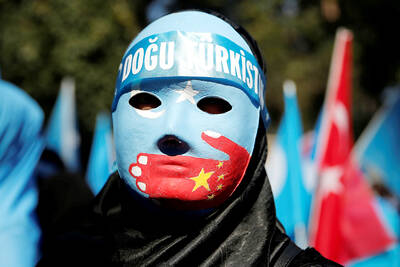
It seems every few days one bumps into one of those “real man” comments in which Taiwan is urged to “face reality” or similar, and “make a deal,” with the speaker implying that soon it will be too late. “Deal” advocates always present themselves as having a superior grip on reality, and the manly ability to make the “hard choice.” Their testosterone-laden language often echoes that of Taiwan sellout advocates. Note that such commentary always specifies a process (“make a deal, work with, make progress”), never the end state of what occupation by a violent authoritarian colonialist state will entail. In

There are shadowy cabals plotting to sell out Taiwan to be annexed by China, by invasion if necessary. Fortunately, they are buffoons. In 2019, former Bamboo Union gangster and founder of the China Unification Promotion Party (CUPP), Chang An-le (張安樂, colorfully known as “White Wolf”), led a protest at the Legislative Yuan against comments made by then-premier Su Tseng-chang (蘇貞昌) that in the event of an attack by China, he would never surrender, but would protect the nation by fighting to the end, even if he only had a broom. Chang had party members bring a wooden casket that they
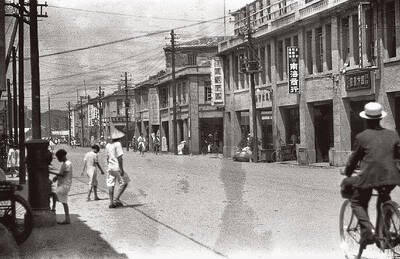
June 1 to June 7 "If all Taiwanese were as afraid of dying as you, then what would happen?” Physician Shih Chiang-nan (施江南) reportedly said this to his wife Chen Chiao-tung (陳焦桐) after she urged him to stop intervening on behalf of Taiwanese soldiers stranded overseas after serving in the Japanese Army during World War II. Shih had clashed with high-ranking officials over the issue, engaged in several heated arguments with Taiwan governor-general Chen Yi (陳儀) and allegedly shouted at general Ko Yuan-fen (柯遠芬), chief of staff of the Taiwan Garrison Command, over


 RSS
RSS