


The hinterland of Keelung has at least four tourist magnets. The best known, of course, is Jiufen (九份). The nearby Jinguashi Gold Museum (金瓜石黃金博物館) is another. Houtong Coal Mine Ecological Park (猴硐煤礦博物園區) and the Pingxi Branch Railway (平溪支線) complete the quartet.
The coastal community of Badouzi (八斗子) has two advantages over all of these places. It’s slightly closer to central Keelung — a blessing if you’re pressed for time — and it’s never totally overrun by tourists. What’s more, you can arrive via one form of public transportation, and leave by another, thanks to the reopening of the Shenao Branch Railway (深澳支線).
The Shenao branch line has more than 80 years of history. From 1936 to 1962, a railroad hugged the coast between Keelung and Shuinandong (水湳洞) via Badouzi and Shenao (深澳). Shuinandong is these days best known for its Golden Waterfall (黃金瀑布), a cascade that gains its photogenic hue from minerals washed out from the hill behind.
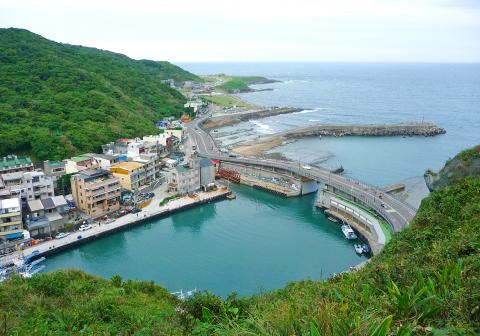
Photo: Steven Crook
The railway was built to serve the mining industry, but gold and copper extraction dwindled after World War II. However, its closure in 1962 turned out to be temporary. The authorities bored a pair of short tunnels so part of the branch line could be connected to Ruifang (瑞芳), and in 1965 coal-carrying trains began rolling between Ruifang and the Shenao Power Plant (深澳發電廠). Lauded at the time as a state-of-the-art power station, the plant met more than a third of Taiwan’s electricity needs throughout the late 1960s.
Passenger trains used this railroad until 1989, and trains continued to deliver coal until the power station was shut down in 2007. But none of this need concern the average person hoping to see some enticing scenery without investing a lot of physical or mental effort. One way to begin the trip is by taking the regular 1061 or 1062 bus from Zhongxiao-Fuxing MRT in central Taipei to Ruifang (瑞芳). Yilan-bound express trains are a quicker alternative.
From Ruifang TRA Station, a three-car diesel-electric train sets off for Badouzi eight times daily on weekdays. On Saturdays and Sundays, there are 10 services per day. Each train actually starts out from Jingtong (菁桐), the western terminus of the Pingxi Branch Railway, halting at Shifen (十分) and Houtong (猴硐) before pausing at Ruifang.
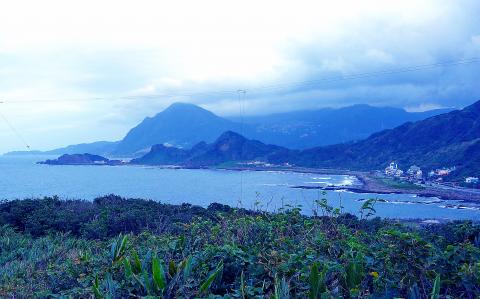
Photo: Steven Crook
I’ve taken the Shenao Branch Railway twice in the past few months. On the first occasion, I rode it all the way to the coastal terminus, Badouzi TRA Station (八斗子火車站). This station straddles the boundary between Keelung and New Taipei City, and from the platform there are fine views of a bay that’s 2.3km across at its widest. The promontory to the east includes Shenao Elephant Trunk Rock (深澳象鼻岩).
Each train halts for about half an hour at Badouzi TRA Station before returning to Ruifang, giving those aboard plenty of time to take snaps, or dash down to the water’s edge, before reboarding. And this is what the vast majority of passengers do; the station’s location means it’s of no use to commuters. To reach the busier parts of Badouzi, one has to walk at least 1.5km. Nor is the station very convenient for those who plan to head further east by public bus, the nearest bus stops being more than 200m away.
When I had an opportunity to return to this corner of Taiwan for a few hours, I took the train from Ruifang to Haikeguan (海科館), the only other stop on the Shenao Branch Railway. Haikeguan is 4.2km and a mere nine minutes from Ruifang; Badouzi is 500m (two minutes’ travel time) further down the line.
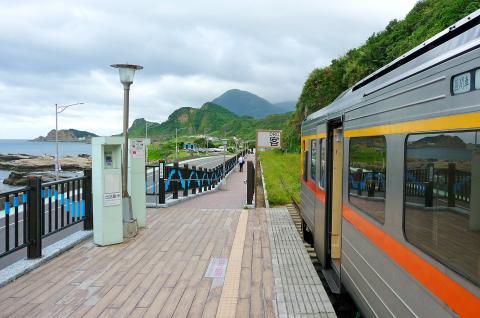
Photo: Steven Crook
There are two good reasons to disembark at Haikeguan. One is to visit the landmark after which the station is named, the National Museum of Marine Science and Technology (國立海洋科技博物館). The museum is open Tuesday to Friday from 9am to 5pm, and until 6pm on weekends. For those aged over 12 but under 65, admission is NT$200; 6 to 12-year-olds pay NT$140; kids under six enter for free.
The other attraction is a hiking trail that’ll please anyone in a “minimum effort, maximum return” mood. The Rongxuan Trail (容軒步道) connects the station to a hilltop less than 10 minutes’ away. From it, the 360-degree view includes the marine museum, Keelung’s Heping Island (和平島) and Jiufen to the southeast.
At the top, I not only enjoyed the panorama, but also learned a fair bit from bilingual information panels. I had no idea that the rugged headland immediately north of me was an island until the 1930s. The Japanese colonial authorities filled in the trench between the island and the “mainland” so they could build a power station. The plant burned coal until 1981. Much later, its shell was repurposed into part of the marine museum.
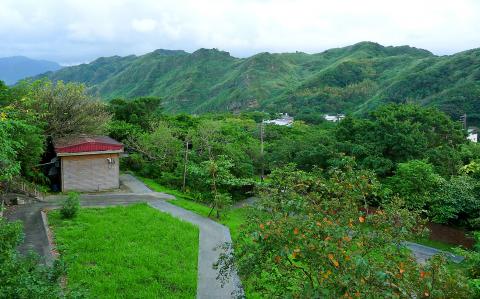
Photo: Steven Crook
Another panel explains past and present toponyms in the area, the most memorable being Huanfan (換番, “exchange with savages”). Long ago, it was a no-man’s land where members of the lowland Ketagalan tribe would meet and barter with Han merchants.
Here, as elsewhere, Ketagalan culture lies buried beneath layers of Han settlement, industrialization and modernization. Their name at least lives on in school textbooks and official publications like the panels along Rongxuan Trail. Reminders that Taiwan has for hundreds of years been a multiethnic society now seem to be everywhere. I, for one, think this is a good thing.
Steven Crook has been writing about travel, culture, and business in Taiwan since 1996. Having recently co-authored A Culinary History of Taipei: Beyond Pork and Ponlai, he is now updating Taiwan: The Bradt Travel Guide.

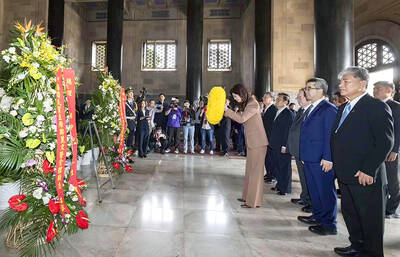
The problem with Marx’s famous remark that history repeats itself, first as tragedy, the second time as farce, is that the first time is usually farce as well. This week Chinese Nationalist Party (KMT) Chair Cheng Li-wun (鄭麗文) made a pilgrimage to the People’s Republic of China (PRC) “to confer, converse and otherwise hob-nob” with Chinese Communist Party (CCP) officials. The visit was an instant international media hit, with major media reporting almost entirely shorn of context. “Taiwan’s main opposition leader landed in China Tuesday for a rare visit aimed at cross-strait ‘peace’”, crowed Agence-France Presse (AFP) from Shanghai. Rare!

What is the importance within the Chinese Nationalist Party (KMT) of the meeting between Xi Jinping (習近平), the leader Chinese Communist Party (CCP), and Cheng Li-wun (鄭麗文), the leader of the KMT? Local media is an excellent guide to determine how important — or unimportant — a news event is to the public. Taiwan has a vast online media ecosystem, and if a news item is gaining traction among readers, editors shift resources in near real time to boost coverage to meet the demand and drive up traffic. Cheng’s China trip is among the top headlines, but by no means
A recent report from the Environmental Management Administration of the Ministry of Environment highlights a perennial problem: illegal dumping of construction waste. In Taoyuan’s Yangmei District (楊梅) and Hsinchu’s Longtan District (龍潭) criminals leased 10,000 square meters of farmland, saying they were going to engage in horticulture. They then accepted between 40,000 and 50,000 cubic meters of construction waste from sites in northern Taiwan, charging less than the going rate for disposal, and dumped the waste concrete, tile, metal and glass onto the leased land. Taoyuan District prosecutors charged 33 individuals from seven companies with numerous violations of the law. This

Sunflower movement superstar Lin Fei-fan (林飛帆) once quipped that the Democratic Progressive Party (DPP) could nominate a watermelon to run for Tainan mayor and win. Conversely, the DPP could run a living saint for mayor in Taipei and still lose. In 2022, the DPP ran with the closest thing to a living saint they could find: former Minister of Health and Welfare Chen Shih-chung (陳時中). During the pandemic, his polling was astronomically high, with the approval of his performance reaching as high as 91 percent in one TVBS poll. He was such a phenomenon that people printed out pop-up cartoon


 RSS
RSS