


He is 83 and was never exactly movie star material, but Jose “Pepe” Mujica, the former president of Uruguay, is the undisputed star of the Venice film festival.
“El Pepe” — dubbed “the world’s humblest head of state” for giving away 90 percent of his salary to good causes — is the hero of two films, attracting just as many autograph hunters and selfie seekers as some Hollywood stars.
“Pepe! Pepe! Pepe!” shouted a group of teenagers who spotted him arrive Monday.
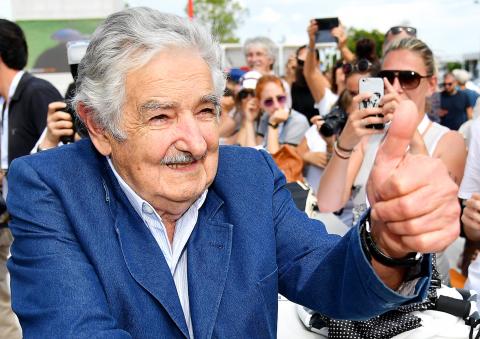
Photo: EPA
“I am not a star,” said the rather embarrassed veteran left-winger, sporting one of two suits he owns, after the premiere of El Pepe, a Supreme Life by the cigar-chomping Serbian director Emir Kusturica.
“I am only here because my friend Kusturica asked me,” said the man who chose to stay in his tiny farmhouse outside Montevideo growing his own vegetables rather than move into Uruguay’s presidential palace when he was elected in 2010.
Five years later on the day he left office Kusturica filmed tens of thousands of people lining the streets of the capital to cheer the man they credited with cutting the country’s poverty rate from 40 to 12 percent.

Photo: EPA
“Usually people take to the streets to get rid of politicians,” said the flamboyant Sarajevo-born film-maker, who previously shot a portrait of Argentina football legend Maradona.
ROBBING BANKS
“We are not used to politicians who are an inspiration.”
Kusturica — one of the few directors ever to win the Palme d’Or twice — said he had to meet “this president who drives a tractor and even fixes it himself. And when I arrived at his farm, he was on it!”
His documentary was screened hot on the heels of a feature film in Venice which tells how Mujica and his comrades survived 12 years of torture and solitary confinement for resisting Uruguay’s two-decade military dictatorship.
The former guerrilla was shot six times during his time as a leader of the armed Tupamaros movement.
“The greatest feeling in the world is walking into a bank with a 45 (Colt automatic pistol),” he joked in the documentary. “Everybody respects you.”
Yet the flower-grower-turned-revolutionary said the torture and deprivation depicted in A Twelve-Year Night helped forge him.
“How do we know what we are capable of if we’re not placed in the worst circumstances? I would not be who I am if it wasn’t for the time I spent being myself,” he said.
Today the jail he was held in by the generals who ruled Uruguay from 1973 to 1985 is a shopping mall.
CHE GUEVARA AND THE POPE
The movie’s director Alvaro Brechner said the most impressive thing was not just how El Pepe and his friends “survived solitary confinement, but the way in which they did it — with no thought of vengeance.”
The films come after yet another documentary featuring El Pepe, Fragile Balance, has been a big hit in Spain. In it Mujica is a prophetic figure warning how the survival of the planet is inextricably linked to improving the lot of the poor.
Kusturica said El Pepe had become such a hero for millions because his austere lifestyle, sincerity and pragmatic idealism provide an antidote to the “fake left” in Europe “who have betrayed the poor and lost their way”.
“He is clean when so much is corrupt. He believes that if you are chosen by the majority you cannot then live like the minority. He gives all of us who are seekers for a just society hope,” he added.
Mujica, who keeps twin pictures of Che Guevara and Pope Francis on his mantelpiece, has taken to his new role as elder socialist sage with amused relish and not a little self-deprecation.
“I am not a star but I was kissed by one,” he admitted in Venice. “All I’ve done is that one day I decided to try to sort out the world. It was my choice to be poor. I am a neo-Stoic, I suppose. I think it is better to have fewer commitments. Having lots of money and material commitments stops you living — and life disappears in the meantime. You have to dedicate time to the people you love.”

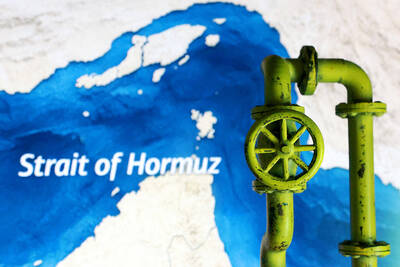
The US war on Iran has illuminated the deep interdependence of Asia on flows of oil and related items as raw materials that become the basis of modern human civilization. Australians and New Zealanders had a wake up call. The crisis also emphasizes how the Philippines is a swatch of islands linked by jet fuel. These revelations have deep implications for an invasion of Taiwan. Much of the commentary on the Taiwan scenario has looked at the disruptions to world trade, which will be in the trillions. However, the Iran war offers additional specific lessons for a Taiwan scenario. An insightful
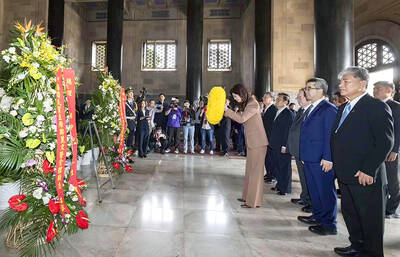
The problem with Marx’s famous remark that history repeats itself, first as tragedy, the second time as farce, is that the first time is usually farce as well. This week Chinese Nationalist Party (KMT) Chair Cheng Li-wun (鄭麗文) made a pilgrimage to the People’s Republic of China (PRC) “to confer, converse and otherwise hob-nob” with Chinese Communist Party (CCP) officials. The visit was an instant international media hit, with major media reporting almost entirely shorn of context. “Taiwan’s main opposition leader landed in China Tuesday for a rare visit aimed at cross-strait ‘peace’”, crowed Agence-France Presse (AFP) from Shanghai. Rare!

April 6 to April 13 Few expected a Japanese manga adaptation featuring four tall, long-haired heartthrobs and a plucky heroine to transform Taiwan’s television industry. But Meteor Garden (流星花園) took the nation by storm after premiering on April 12, 2001, single-handedly creating the “idol drama” (偶像劇) craze that captivated young viewers across Asia. The show was so successful that Japan produced its own remake in 2005, followed by South Korea, China and Thailand. Other channels quickly followed suit, with more than 50 such shows appearing over the following two years. Departing from the melodramatic

Sunflower movement superstar Lin Fei-fan (林飛帆) once quipped that the Democratic Progressive Party (DPP) could nominate a watermelon to run for Tainan mayor and win. Conversely, the DPP could run a living saint for mayor in Taipei and still lose. In 2022, the DPP ran with the closest thing to a living saint they could find: former Minister of Health and Welfare Chen Shih-chung (陳時中). During the pandemic, his polling was astronomically high, with the approval of his performance reaching as high as 91 percent in one TVBS poll. He was such a phenomenon that people printed out pop-up cartoon


 RSS
RSS