


If it’s Wednesday night you’re likely to find Arlan Bonwick saddled up to the bar with his usual after work meal: barbecue chicken wings and a locally-brewed pale ale the color of the sunset.
“I like drinking craft-brewed beer,” said Bonwick, a regular at Delicatesses Desmarais in Taichung. “It’s got a really unique flavor.”
Customers such as Bonwick are exactly what local brewers are hoping for in Taichung’s burgeoning craft beer market.
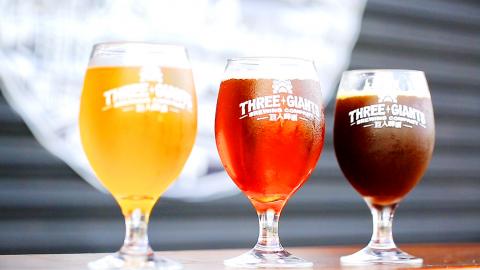
Photo courtesy of Casper Willemse
Warning: Excessive consumption of alcohol can damage your health.
The source of Bonwick’s pale ale lies in Taichung’s Fengyuan District (豐原) at Three Giants Brewing Company. The small brewery produces five varieties of beer, mostly in keg form.
Compared to Taipei’s already booming craft beer market, Taichung has only recently emerged onto the scene.
MORE SUDS
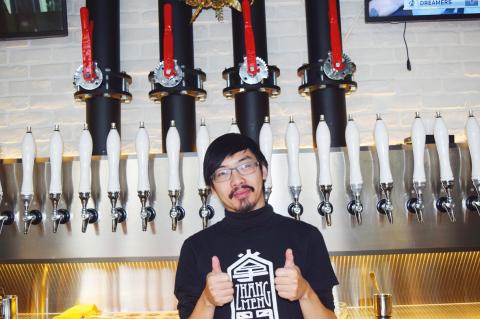
Photo by John Evans
As craft beer consumption has risen, so too has the number of breweries. Up from just one a breweries. Up from just one a decade ago, there are currently four craft breweries operating in Taichung. And those in the industry expect that number to grow.
While sales of craft beer have taken off, the nation’s most popular beer by far is Taiwan Beer, produced by Taiwan Tobacco & Liquor Corp, which once had a monopoly on the industry.
“It’s still a niche market,” said Casper Willemse, co-owner of Three Giants brewery. “But to be a cool bar, you have to have craft beer on tap.”
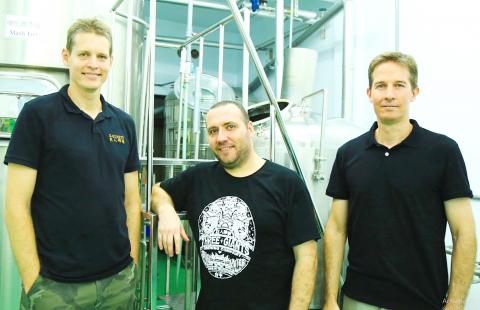
Photo courtesy of Casper Willemse
What began with Willemse and two coworkers making homebrew in plastic tubs on a rooftop three years ago, has turned in an actual brewery. In less than a year since opening, Three Giants brewery supplies nearly 40 bars and restaurants nationwide, up from just a few businesses three months ago.
Willemse and his partners are hopeful that Taiwanese palates for craft beer will continue to expand. Optimistically, they point to the popularity of recent craft beer festivals where beer enthusiasts and brewers come together.
TAIWAN BEER
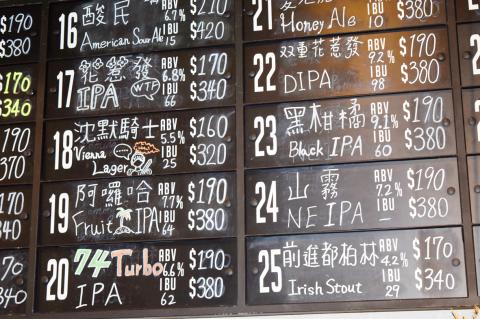
Photo by John Evans
The challenge, Willemse said, is how to entice long-time drinkers of Taiwan Beer and other lighter lagers to try their bolder, more flavorful beer.
“At first people come out of curiosity,” he said. “You have to slowly ween them off the lager and then show them the ale.”
To help with this transition, Three Giants Indian Pale Ale is less bitter than traditionally found, Willemse said.
“We try to tailor our beer to local tastes.”
“Long-term I can see the feeling is changing in Taiwan,” Willemse added.
As an example he points out the demand for high-end coffee, a national trend over the past decade.
BITTERNESS SCALE
At Zhang Men Brewing Company (掌門精釀啤酒) each beer is rated on a bitterness scale. For instance, a honey ale, low in bitterness, has a 10, while a double IPA has a 98. With 32 beers on tap, customers can sample beers of varying flavors, from fruity to hoppy.
“You work your way up to the stout,” said Oscar Lee (李奕德), an employee and beer aficionado at Taichung’s Zhang Men brewery, one of the company’s nine taprooms in the nation.
Lee’s advice to those new to drinking craft beer is to lose the ice, which is traditionally dropped into small glasses of lighter beers.
“I tell them if it’s too cold you can’t smell it,” said Lee, whose appreciation for craft beer started by making homebrew in college. “I’ve learned how to taste the differences in beer, like there is in whiskey.”
His other tip: “You don’t ganbei (drain the glass, 乾杯) craft beer.”
First-time customer Weng Shou-de (翁守德) listened to Lee’s advice on bitterness and alcohol content before ordering a beer flight, small samples of six varieties.
“We just wanted to try something new,” said Weng, who brought his family to the Zhang Men taproom.
It was the smoothness of the German wheat beer that caught Weng’s attention. Intrigued by the subtle differences in craft beers, Weng said he’d return to try other varieties.
HIPSTER BEER CULTURE
Aside from offering drinkers new options, craft beer has a certain hipness in Taiwanese culture.
“People treat craft beer like a cocktail,” said Brian Desmarais, whose deli has benefited from offering four kinds of Three Giants beer on tap. Since switching from European bottled beer to locally-brewed craft beer nine months ago he estimates his beer sales have doubled.
Beer drinkers want a distinct flavor, he added, and they patronize places that offer that product.
“Neighbors come in and try one, then come back with a friend,” Desmarais said. “It’s their treat for the week. They have a sandwich and a couple of lagers.”
Desmarais and others have welcomed the change in drinking culture from a few years ago when it was more common to see people drinking outside convenient stores.
But some wonder whether there are too many restaurants and bars jumping on the craft beer bandwagon.
“They need to attract more and more customers,” said Ray Huang (黃晁偉), who operates Wuller Homebrew Supply in Taichung County’s Wufeng District (霧峰).
While most glasses of craft beer are in the NT$150 range, some brands go for more than double that amount. Huang points to this high price as a hurdle for attracting younger customers.
“I really wish the price was cheaper,” Huang said.
As a way to enjoy craft beer, but at a lower cost, Huang said he would like to see more people making their own beer.
With a surge in craft beer sales in the last two years, most say the trend is here to stay.
“The industry is growing and everyone wants to get involved,” said Weng Yi-chung (翁詒君), owner of ChangeX Beer in Taichung, which offers 300 varieties of craft beer.
An early player in the city’s craft beer market, Weng said he anticipates larger businesses to push their way into the market.
Taking a philosophical approach to craft beer’s evolution from being obscure to stylish, Weng said, everything changes, even people’s appreciation for craft beer.

The Directorate-General of Budget, Accounting and Statistics (DGBAS) told legislators last week that because the Chinese Nationalist Party (KMT) and Taiwan People’s Party (TPP) are continuing to block next year’s budget from passing, the nation could lose 1.5 percent of its GDP growth next year. According to the DGBAS report, officials presented to the legislature, the 2026 budget proposal includes NT$299.2 billion in funding for new projects and funding increases for various government functions. This funding only becomes available when the legislature approves it. The DGBAS estimates that every NT$10 billion in government money not spent shaves 0.05 percent off
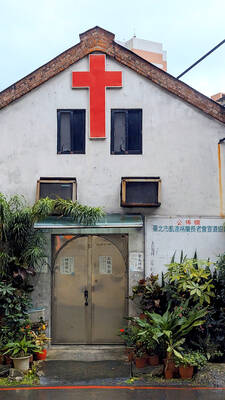
Dec. 29 to Jan. 4 Like the Taoist Baode Temple (保德宮) featured in last week’s column, there’s little at first glance to suggest that Taipei’s Independence Presbyterian Church in Xinbeitou (自立長老會新北投教會) has Indigenous roots. One hint is a small sign on the facade reading “Ketagalan Presbyterian Mission Association” — Ketagalan being an collective term for the Pingpu (plains Indigenous) groups who once inhabited much of northern Taiwan. Inside, a display on the back wall introduces the congregation’s founder Pan Shui-tu (潘水土), a member of the Pingpu settlement of Kipatauw, and provides information about the Ketagalan and their early involvement with Christianity. Most

The People’s Republic of China (PRC) was out in force in the Taiwan Strait this week, threatening Taiwan with live-fire exercises, aircraft incursions and tedious claims to ownership. The reaction to the PRC’s blockade and decapitation strike exercises offer numerous lessons, if only we are willing to be taught. Reading the commentary on PRC behavior is like reading Bible interpretation across a range of Christian denominations: the text is recast to mean what the interpreter wants it to mean. Many PRC believers contended that the drills, obviously scheduled in advance, were aimed at the recent arms offer to Taiwan by the

Like many retirement communities, The Terraces serves as a tranquil refuge for a nucleus of older people who no longer can travel to faraway places or engage in bold adventures. But they can still be thrust back to their days of wanderlust and thrill-seeking whenever caretakers at the community in Los Gatos, California, schedule a date for residents — many of whom are in their 80s and 90s — to take turns donning virtual reality headsets. Within a matter of minutes, the headsets can transport them to Europe, immerse them in the ocean depths or send them soaring on breathtaking hang-gliding expeditions


 RSS
RSS