


Zilven Chang doesn’t need a full moon to transform into a silver-maned wolf-man. Once he puts on his “fursuit,” he loses the ability to speak but assumes a newfound cool-and-collected demeanor.
“When I’m a wolf, I’m still myself,” he says. “It’s just a part that I don’t normally display. But I don’t have to act. It comes naturally once the suit is on.”
Chang is one of about 1,000 “furries” (獸迷) in Taiwan who are fascinated with anthropomorphic animals. Many of them don fursuits and adopt a “fursona,” while others are only interested in creative endeavors such as designing their own characters. Chang does both, as he and fellow furry J.C. Lan run Beast Fantasia (奇獸幻響), a studio that makes a variety of furry products — including an illustrated novel titled The Starry Wolves.
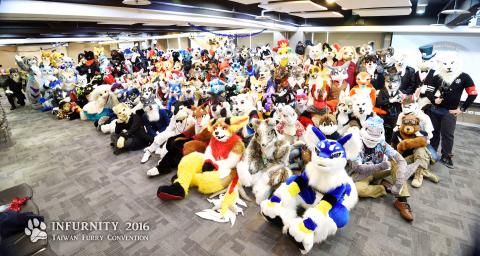
Photo courtesy of Infurnity
This “furry fandom” subculture has only emerged in Taiwan in the past few years. Last month, almost 100 wolves, lions, bears, rabbits and mythical animals attended the second annual “Infurnity” convention organized by Chang, Lan and Gary Pai. The country’s first furry trade show, Furrymosa, is scheduled for May.
BECOMING A FURRY
Even though the phenomenon is relatively new, Lan says he’s had an affinity for anthropomorphic animals since he was a child.
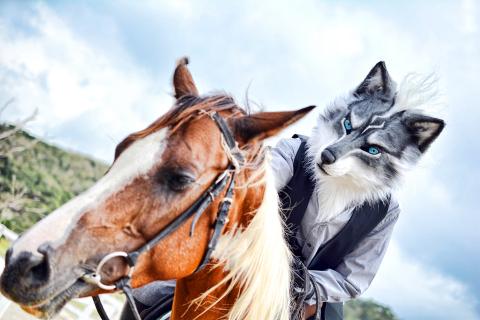
Photo courtesy of Zilven Chang
“I’ve always been a furry,” he says. “I watched animal programs and cartoons. I thought they were so cool. I liked their style. It’s just like how some people like cars and watching sports. It’s a natural instinct — I can’t really explain it.”
Lan was described as cat-like in school, and from this trait he developed his fursona as a majestic yellow feline.
Pai’s fascination began with the mascots he saw when he visited Disneyland as a child.
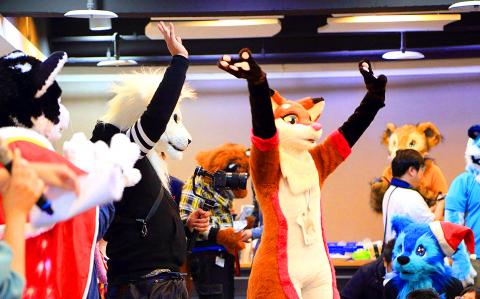
Photo courtesy of J.C. Lan
“I thought they were adorable and approachable, and I liked how they brought people joy,” he says.
As a result, his fursuits lean toward the cartoonish, cutesy type and he adjusts his personality as such. Like Chang, he believes that he’s not acting.
“It’s just how I would act if I became an adorable animal,” he says. “I don’t even think about it.”
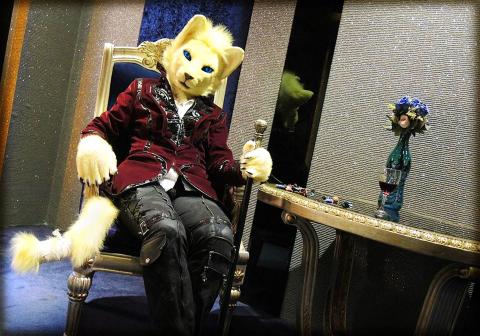
Photo courtesy of infurnity
You can have as many fursonas as you want, but the fursuits are expensive — a decent one can cost up to NT$300,000 Lan says.
There are no set rules, and unlike cosplay, there are no existing characters to model after. Some have the ability to talk, while others only communicate through gestures. Lan says his fursona was originally mute, but as an organizer he found it necessary to start speaking.
Some see their fursonas as extensions or alternate versions of themselves, while others create a separate entity with its own name and backstory. Sometimes people show up at gatherings with just a tail or ears, and that’s okay too.
IN THE REAL WORLD
Chang and Lan exclusively interact with the furry community as their fursonas, and reveal their human identities to only a select few (hence the omission of their Chinese names). Some clues to their furry identity can be found while in human form, as both like to wear shirts with wolves printed on them and have furry accessories on their bags.
Outside of furry gatherings, they only wear their fursuits in public during photo shoots, often scaring the children around them because of how realistic they look.
“I heard one mother say, ‘Don’t be afraid, there’s a person inside,’” Lan says. “That actually upset me because I wanted to be a cat at that moment.”
The ones with cartoonish suits are often received warmly, and some enjoy walking around and taking photos with people. But as furry fandom is still obscure in Taiwan, most people don’t know the true connotation behind the suits.
“People just see our exterior and assume that we’re advertising something as a mascot or shooting a film,” Lan says. “But this is something that goes to the core of who we are.”

Institutions signalling a fresh beginning and new spirit often adopt new slogans, symbols and marketing materials, and the Chinese Nationalist Party (KMT) is no exception. Cheng Li-wun (鄭麗文), soon after taking office as KMT chair, released a new slogan that plays on the party’s acronym: “Kind Mindfulness Team.” The party recently released a graphic prominently featuring the red, white and blue of the flag with a Chinese slogan “establishing peace, blessings and fortune marching forth” (締造和平,幸福前行). One part of the graphic also features two hands in blue and white grasping olive branches in a stylized shape of Taiwan. Bonus points for
Recently the Chinese Nationalist Party (KMT) and its Mini-Me partner in the legislature, the Taiwan People’s Party (TPP), have been arguing that construction of chip fabs in the US by Taiwan Semiconductor Manufacturing Co (TSMC, 台積電) is little more than stripping Taiwan of its assets. For example, KMT Deputy Secretary-General Lin Pei-hsiang (林沛祥) in January said that “This is not ‘reciprocal cooperation’ ... but a substantial hollowing out of our country.” Similarly, former TPP Chair Ko Wen-je (柯文哲) contended it constitutes “selling Taiwan out to the United States.” The two pro-China parties are proposing a bill that would limit semiconductor

“M yeolgong jajangmyeon (anti-communism zhajiangmian, 滅共炸醬麵), let’s all shout together — myeolgong!” a chef at a Chinese restaurant in Dongtan, located about 35km south of Seoul, South Korea, calls out before serving a bowl of Korean-style zhajiangmian —black bean noodles. Diners repeat the phrase before tucking in. This political-themed restaurant, named Myeolgong Banjeom (滅共飯館, “anti-communism restaurant”), is operated by a single person and does not take reservations; therefore long queues form regularly outside, and most customers appear sympathetic to its political theme. Photos of conservative public figures hang on the walls, alongside political slogans and poems written in Chinese characters; South
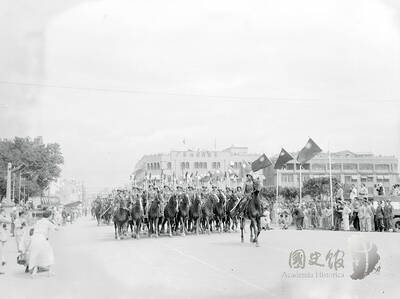
March 9 to March 15 “This land produced no horses,” Qing Dynasty envoy Yu Yung-ho (郁永河) observed when he visited Taiwan in 1697. He didn’t mean that there were no horses at all; it was just difficult to transport them across the sea and raise them in the hot and humid climate. “Although 10,000 soldiers were stationed here, the camps had fewer than 1,000 horses,” Yu added. Starting from the Dutch in the 1600s, each foreign regime brought horses to Taiwan. But they remained rare animals, typically only owned by the government or


 RSS
RSS