


Still can’t find a Halloween costume for your weekend bash? Head to Taipei’s Da-an Forest Park tomorrow to have your face painted into a “sugar skull” or other images of your fancy at one of Taipei’s few dia de los muertos, or Day of the Dead celebrations.
While the iconic sugar skull is the one element of the Mexican festival that has entered popular culture, the real meaning of the two-day event, which falls on Tuesday and Wednesday, is for family and friends to gather and remember the deceased.
The face painting, done by abstract portrait artist Mark O’Connell, is the only part of the celebration that will cost money at about NT$250 depending on the design. In addition to other related activities, there will be a limited amount of free Mexican dishes and tequila as well as a parade around the park.
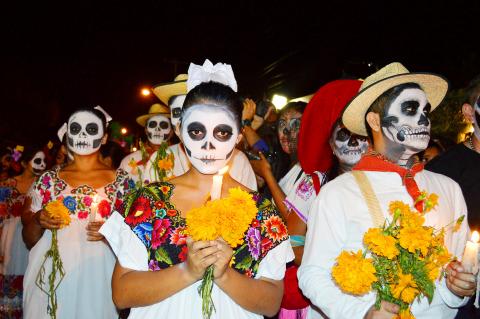
Photo courtesy of Darvin Santos
■ The celebration can be found near the Da-an Forest Park’s Xinyi Rd (信義路) and Jianguo S Rd (建國南路) entrance, and takes places tomorrow from 5pm to midnight.

This month the government ordered a one-year block of Xiaohongshu (小紅書) or Rednote, a Chinese social media platform with more than 3 million users in Taiwan. The government pointed to widespread fraud activity on the platform, along with cybersecurity failures. Officials said that they had reached out to the company and asked it to change. However, they received no response. The pro-China parties, the Chinese Nationalist Party (KMT) and Taiwan People’s Party (TPP), immediately swung into action, denouncing the ban as an attack on free speech. This “free speech” claim was then echoed by the People’s Republic of China (PRC),

Most heroes are remembered for the battles they fought. Taiwan’s Black Bat Squadron is remembered for flying into Chinese airspace 838 times between 1953 and 1967, and for the 148 men whose sacrifice bought the intelligence that kept Taiwan secure. Two-thirds of the squadron died carrying out missions most people wouldn’t learn about for another 40 years. The squadron lost 15 aircraft and 148 crew members over those 14 years, making it the deadliest unit in Taiwan’s military history by casualty rate. They flew at night, often at low altitudes, straight into some of the most heavily defended airspace in Asia.
Many people in Taiwan first learned about universal basic income (UBI) — the idea that the government should provide regular, no-strings-attached payments to each citizen — in 2019. While seeking the Democratic nomination for the 2020 US presidential election, Andrew Yang, a politician of Taiwanese descent, said that, if elected, he’d institute a UBI of US$1,000 per month to “get the economic boot off of people’s throats, allowing them to lift their heads up, breathe, and get excited for the future.” His campaign petered out, but the concept of UBI hasn’t gone away. Throughout the industrialized world, there are fears that

The Democratic Progressive Party (DPP) controlled Executive Yuan (often called the Cabinet) finally fired back at the opposition-controlled Legislative Yuan in their ongoing struggle for control. The opposition Chinese Nationalist Party (KMT) and Taiwan People’s Party (TPP) acted surprised and outraged, but they should have seen it coming. Taiwan is now in a full-blown constitutional crisis. There are still peaceful ways out of this conflict, but with the KMT and TPP leadership in the hands of hardliners and the DPP having lost all patience, there is an alarming chance things could spiral out of control, threatening Taiwan’s democracy. This is no


 RSS
RSS