


When artist Ho Chia-hsin (何佳信) started to mass produce a raptor bust he created for an art studio to use as an example in a sculpting class, he noticed that the factory had placed each piece into a basket.
“It felt like the pieces were fruit,” he says.
Fruit has been a significant part of Ho’s life, as his grandmother is a sugar apple farmer and he spent his working holiday in Australia picking fruit. He now lives and works in a traditional three-section compound in rural Taichung with a yard full of fruit trees. He was also a huge Jurassic Park fan growing up — and as an artist who draws his creativity from his surroundings and experiences, it all hit home and his Jurassic Orchard (龍夫果園) series of collectible toys was born.
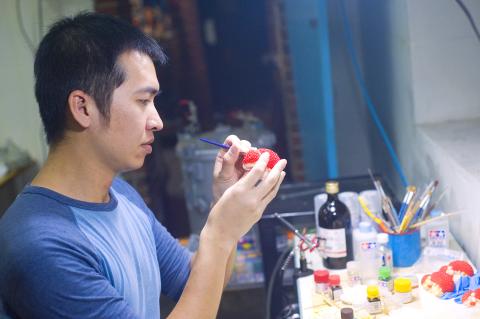
Photo: Han Cheung, Taipei TImes
Ho would hang dinosaur busts in trees — as though they were fruit — photograph them and package them in “Raptor Fruit” boxes. For another creation, he decided to take the fruit element a step further by combining Taiwanese fruit products and dinosaurs — an idea inspired by the genetic engineering featured in Jurassic Park.
Ho has two such products so far: a sleeping lychee Ankylosaurus and, because his house is surrounded by betel nut stands, a betel nut raptor fetus. He even bought plastic bags and boxes adorned with scantily clad women from the vendors for the packaging.
The original idea was to time each creation in accordance to the actual fruit’s season so Ho could partner with various fruit farmers. However, by the time he finished the lychee dinosaur, lychee season was over. Instead, he worked with an orchard that made preserves and provided a bag of dried lychee to the first 30 buyers.
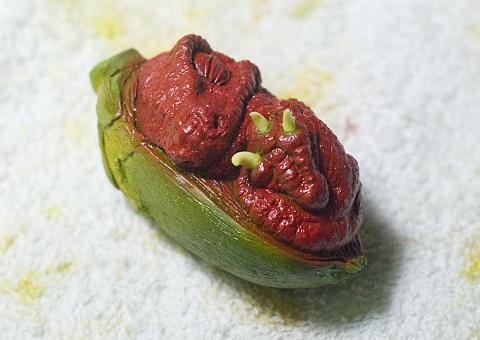
Photo: Han Cheung, Taipei TImes
“There can be different modes of partnership,” Ho says. “In this case, I purchased the dried lychees to give away because I wanted to promote the product. They really are delicious.”
He eventually hopes to make a sugar apple dinosaur and partner with his grandmother, but he says her crop was destroyed in the recent typhoon and will not recover until next year.
COLLABORATING AND COLLECTING
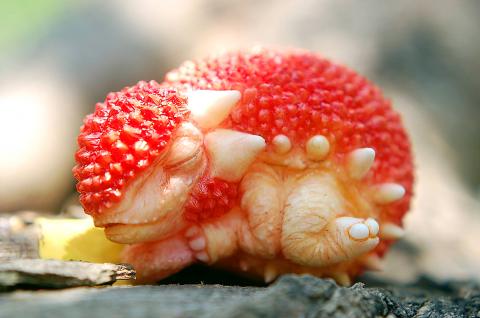
Photo courtesy of Ho Chia-hsin
Ho says the development of his art has been a process, starting with simply creating his own take of his favorite characters or toys while studying plastic arts at Dayeh University (大葉大學). Later, he tried to give new meaning to existing things, such as molding a collectable figurine package out of pottery.
He first worked for Lin Chien-jung (林建榮), best known for his “light bulb man” series, before deciding to stake out on his own. Since then, Ho has mostly focused on similar fusion products, such as his his bat-dog fusion sculpture for Chinese New Year.
“It’s like turning a spring couplet into animal form,” he says. “The bat represents good fortune, while the dog guards the house.”
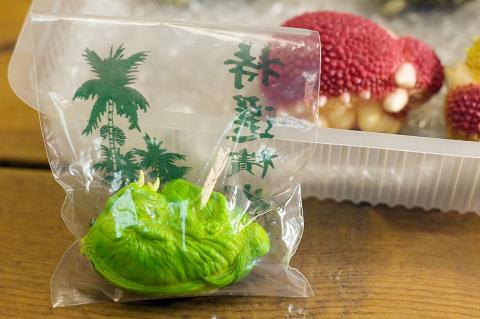
Photo: Han Cheung, Taipei TImes
And he continues his penchant for collaboration, working with a designer to produce actual spring couplets to go with the piece. Other artworks include a fusion of the Kewpie doll and a three-faced Indian deity (Ho visits the country frequently) and real false teeth carved into Darth Vader and Stormtrooper shapes.
“I like to create using existing objects,” he says. “I don’t make originals, but I fuse original concepts things to make something new,” he says.
Ho will be a first-time participant at the Taipei Toy Festival this weekend, and the current batch of dinosaurs he is making will be geared to the toy collector’s market, with the products made using resin casting and hand painted in different colors. The lychee has two varieties — the common red color and the yuhebao (玉荷包) variety which contains shades of yellow and green.
The hand-painted resin lychee dinosaur sells for NT$1,780, which Ho says may be too expensive for students but too cheap for serious art collectors. So he created a higher-end bronze version and also an unpainted white variety.
“I hope everyone can be able to own one,” he says.
Ho feels fortunate to be selected to the Toy Festival, as he says there is a strict selection process for newcomers. Now in its 13th year, the event will feature 108 booths featuring international artists, two exhibitions and a toy auction along with various events such as live painting, autograph sessions and clay molding demonstrations. This year’s theme is “The World Only Monsters Know,” with the main visuals by South Korea’s Sticky Monster Lab.
For more information on Ho’s work, visit www.facebook.com/Art-of-Hsin-Ho-836432829784797.
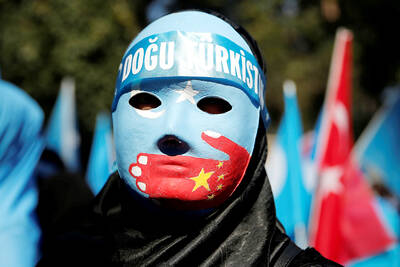
It seems every few days one bumps into one of those “real man” comments in which Taiwan is urged to “face reality” or similar, and “make a deal,” with the speaker implying that soon it will be too late. “Deal” advocates always present themselves as having a superior grip on reality, and the manly ability to make the “hard choice.” Their testosterone-laden language often echoes that of Taiwan sellout advocates. Note that such commentary always specifies a process (“make a deal, work with, make progress”), never the end state of what occupation by a violent authoritarian colonialist state will entail. In
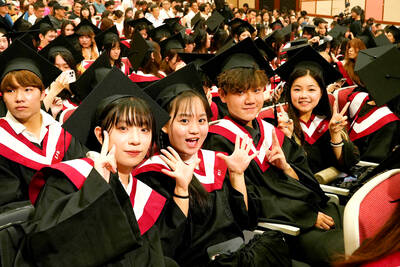
Taiwan’s English education system is being pulled apart by three opposing forces. Bilingual Nation 2030 pulls students toward English and global communication. Artificial Intelligence (AI) readiness pulls them toward digital judgment, verification and AI-mediated work. But Taiwan’s old exam culture pulls them back toward memorization, grammar drills, timed reading and correct answers. If the education system keeps using old exams to define success, it risks producing graduates who are neither genuinely bilingual nor genuinely AI-ready, but trained for tasks machines can already perform. The first force is Bilingual Nation 2030. Launched in 2018, the policy aimed to “help Taiwan’s workforce connect
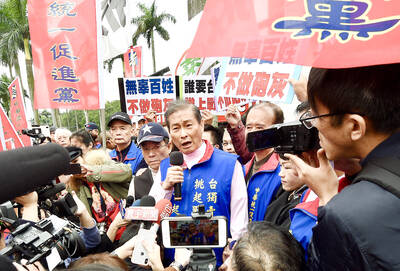
There are shadowy cabals plotting to sell out Taiwan to be annexed by China, by invasion if necessary. Fortunately, they are buffoons. In 2019, former Bamboo Union gangster and founder of the China Unification Promotion Party (CUPP), Chang An-le (張安樂, colorfully known as “White Wolf”), led a protest at the Legislative Yuan against comments made by then-premier Su Tseng-chang (蘇貞昌) that in the event of an attack by China, he would never surrender, but would protect the nation by fighting to the end, even if he only had a broom. Chang had party members bring a wooden casket that they
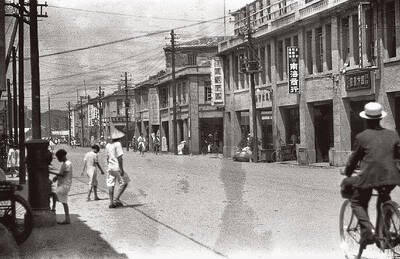
June 1 to June 7 "If all Taiwanese were as afraid of dying as you, then what would happen?” Physician Shih Chiang-nan (施江南) reportedly said this to his wife Chen Chiao-tung (陳焦桐) after she urged him to stop intervening on behalf of Taiwanese soldiers stranded overseas after serving in the Japanese Army during World War II. Shih had clashed with high-ranking officials over the issue, engaged in several heated arguments with Taiwan governor-general Chen Yi (陳儀) and allegedly shouted at general Ko Yuan-fen (柯遠芬), chief of staff of the Taiwan Garrison Command, over


 RSS
RSS