


Mohammad Ali sits before a painting of a semi-naked man and declares that his work has never been censored in conservative Muslim Pakistan, where an artistic vanguard are challenging taboos in the chaotic city of Karachi.
“I have done some pretty bold and risky works but luckily I did not face any,” says the 27-year-old, a rising star who paints figurative, contemporary images exploring gender, politics and sex.
Ali has a theory about why, in a developing country where women are traditionally veiled and even unproven allegations of blasphemy can stir mob violence, he has been so free.
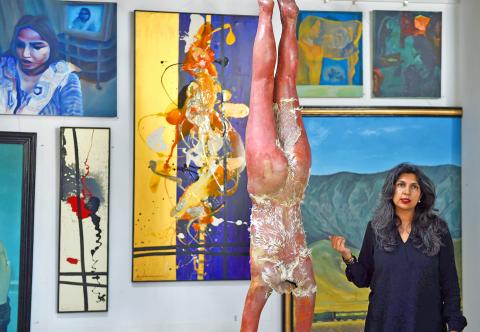
Photo: Asif Hassan, AFP
“People, a lot of them don’t have access to even a decent meal, and if they are starving you cannot make them interested in art instead of food,” he says.
Pakistan remains deeply bound to strict religious norms, although art bursts from unexpected places, such as the acid-trip trucks wild with bells and bright, elaborate images that traverse the country.
But in recent years, Karachi’s concrete sprawl has become home to a rush of galleries and dealerships bullish on the country’s art market as a new generation challenges constraints that date back to the Islamization of the 1980s.
In the port city’s trendy Canvass Gallery, owner Sameera Raja takes AFP on a tour of the nude and homosexual art on display.
“These are not the things which are taboos in our society, at least not in the art-related population,” she says.
“Having said that, it doesn’t that mean I am going to socially risk the artist by putting it up on a the public platform. Absolutely not,” she swiftly adds.
RISK OF PUBLIC EXPOSURE
Raja is all too aware that, despite the confidence of artists such as Ali — whose paintings have so far been confined to galleries and private spaces — such art only finds safe haven in showrooms like hers and in the bedrooms of the Pakistani elite.
Her caution is echoed by other artists, such as third-year visual arts student Hadiqa Asif at the state-run Karachi University.
“If we want to make a sculpture so we must be aware that it should not cause any harm to the society,” she says, chiselling at a piece of wood.
Some artists point to the Islamization of Pakistan by military dictator Zia ul-Haq in the 1980s as a ground zero of sorts for conservative taboos, and other forms of art that flourished because of them, such as calligraphy.
“During the regime of Zia ul-Haq there was much noise of imposition of Islamic government in the country,” prominent Pakistani artist Mashkoor Raza, famous for his abstract images of women and horses, recalls. “Our seniors would draw nudes, but fearing their arrest they started calligraphy of the religious verses and Sufi poetry.”
He said he found himself unable to earn a living, and worked in a textile mill as a designer for nearly a decade, using his savings to buy brushes, paints and canvas. But Zia was assassinated in 1988, and the 1990s saw galleries and art shops mushroom in urban centers like Karachi.
“After the 90s, I became the owner of my own home, car and whatnot,” says Raza, who now lives in a posh neighbourhood fanned by the city’s sea breezes.
Estimates by gallery owners and art critics put the number of galleries, framers and dealers in Karachi alone in the hundreds. “They are growing exponentially, it’s a huge market, I think,” Raja comments.
NO NUDES ARE GOOD NUDES?
This fresh dynamism is having a potent effect, says Munwar Ali Syed, an art professor at Karachi University.
“Of course, we are very cautious here to censor human body parts,” he says. “There are some limitations.”
But the squeezing of liberal thought does not stifle creativity, he claims — rather it spurs his students in new directions.
“When you realize that there are some limits and boundaries which you can not cross, you work more creatively,” he says, citing a sculptor named Mohammad Ismail. Eight years ago, Ismail fell from the second story of a building where he was supervising construction and broke his back, leaving him confined him to a wheelchair for life.
Now the 35-year-old crafts twisted, skeletal sculptures from metal.
“My own skeleton got distorted so I focus on it,” he tells AFP, seated next to a work table as he puts the finishing touches on a new piece. “I searched the intricacies of the skeleton, I drew my strength from it and I tried to support myself through this.”
Despite the shift and the brimming confidence of artists like Ali, change, already decades in the making, remains slow. For many, sex — contrary to the received wisdom — still doesn’t sell.
“I don’t think that there is a room for the nude in Pakistan other than what an artist makes privately for themselves,” Durriya Kazi, head of the visual arts department at Karachi University, told AFP. “I don’t think it is relevant to our society.”
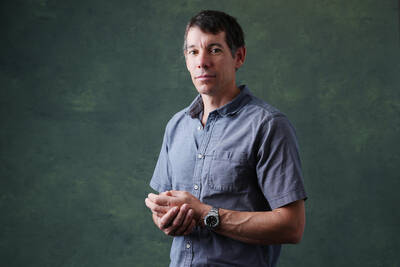
Towering high above Taiwan’s capital city at 508 meters, Taipei 101 dominates the skyline. The earthquake-proof skyscraper of steel and glass has captured the imagination of professional rock climber Alex Honnold for more than a decade. Tomorrow morning, he will climb it in his signature free solo style — without ropes or protective equipment. And Netflix will broadcast it — live. The event’s announcement has drawn both excitement and trepidation, as well as some concerns over the ethical implications of attempting such a high-risk endeavor on live broadcast. Many have questioned Honnold’s desire to continues his free-solo climbs now that he’s a
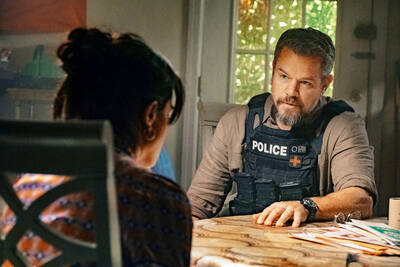
Lines between cop and criminal get murky in Joe Carnahan’s The Rip, a crime thriller set across one foggy Miami night, starring Matt Damon and Ben Affleck. Damon and Affleck, of course, are so closely associated with Boston — most recently they produced the 2024 heist movie The Instigators there — that a detour to South Florida puts them, a little awkwardly, in an entirely different movie landscape. This is Miami Vice territory or Elmore Leonard Land, not Southie or The Town. In The Rip, they play Miami narcotics officers who come upon a cartel stash house that Lt. Dane Dumars (Damon)
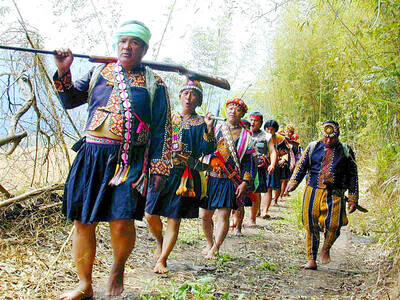
Francis William White, an Englishman who late in the 1860s served as Commissioner of the Imperial Customs Service in Tainan, published the tale of a jaunt he took one winter in 1868: A visit to the interior of south Formosa (1870). White’s journey took him into the mountains, where he mused on the difficult terrain and the ease with which his little group could be ambushed in the crags and dense vegetation. At one point he stays at the house of a local near a stream on the border of indigenous territory: “Their matchlocks, which were kept in excellent order,
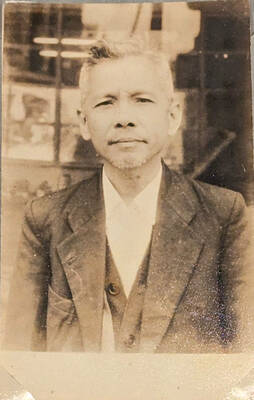
Jan. 19 to Jan. 25 In 1933, an all-star team of musicians and lyricists began shaping a new sound. The person who brought them together was Chen Chun-yu (陳君玉), head of Columbia Records’ arts department. Tasked with creating Taiwanese “pop music,” they released hit after hit that year, with Chen contributing lyrics to several of the songs himself. Many figures from that group, including composer Teng Yu-hsien (鄧雨賢), vocalist Chun-chun (純純, Sun-sun in Taiwanese) and lyricist Lee Lin-chiu (李臨秋) remain well-known today, particularly for the famous classic Longing for the Spring Breeze (望春風). Chen, however, is not a name


 RSS
RSS