


A year ago, a member of a private tea society in Shanghai presented Kathy YL Chan with a small box as slender as a cigarette case. Inside were four tiles of highly prized pu-erh tea, conjoined like a chocolate bar and almost black, twined with green and ocher.
Chan, 29, who writes about tea and advises restaurants, hotels and companies on tea offerings, had mostly encountered pu-erh in the form of dense, mulchy rounds (bing cha in Mandarin), each with a crater at the center, like flattened volcanoes. The delicate box seemed a secret missive from “a darker, cooler world,” she said — what she calls, only half jokingly, the “underbelly” of tea.
The pu-erh within, from Menghai in China’s southwestern Yunnan province, near the Burmese border, was too precious to drink, Chan decided. And so she safeguards it in the kitchen of her East Village apartment, amid her considerable arsenal of teaware, including fine-spined whisks; long, skinny bamboo scoops and short, hand-hammered brass ones curved like thumbnails; a Korean teapot with a straight side handle; a ceramic bowl, or chawan, for frothing matcha, a Japanese green tea; and a paring-size knife for breaking off pieces of pu-erh, should she one day feel that she can wait no longer.
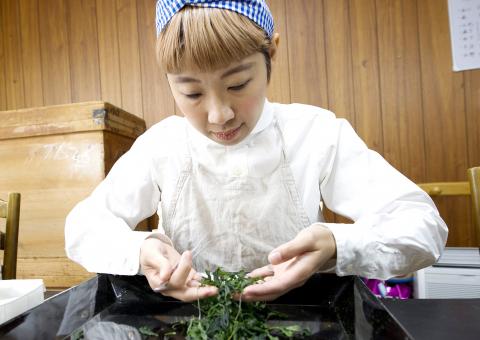
Photos: EPA
When Chan was growing up in Honolulu, tea was “not a big deal,” she said — just something that everyone in her family drank “all day, all night.” Her parents heeded the traditional Chinese belief that cold water is bad for the body and always kept an electric thermos of hot water on hand. Chan dutifully has one, too.
From her family she learned to drink tea “grandpa style:” loose leaves in a glass, into which you keep pouring water. “Your teeth are the filter,” she said. Now she supplies tea to restaurants like Eleven Madison Park, where one of her finds, ‘A’a black tea from the Big Island of Hawaii, is priced at US$65 for a rarefied, ritual Chinese tableside preparation. (This was the most expensive tea on the menu until it was recently outstripped by a vintage 1960s pu-erh.)
Sometimes Chan slips the box of pu-erh into her suitcase as a good-luck charm when she travels. The last year has taken her from the hillsides of Haleakala on Maui to the tea fields of Uji outside Kyoto, Japan. In the winter, she braved a landslide to ascend Kunlu Mountain in Yunnan, paying homage to wild pu-erh trees, some nearly a millennium old.
Like Champagne, pu-erh is a protected geographical designation; the Chinese government has mandated that only tea grown in Yunnan can be labeled pu-erh. Like Bordeaux, the longer it ages, the more coveted it is, eliciting up to tens of thousands of dollars at auction. Chan once met a collector who stood his tea cakes upright, unbrewed and undrunk, in a china cabinet, like Delft china.
Of her own untouched pu-erh, Chan admitted, “I want to drink it.” She smiled. “But I’d rather keep it as a reminder of how deep the world of tea is.”

Taiwan’s overtaking of South Korea in GDP per capita is not a temporary anomaly, but the result of deeper structural problems in the South Korean economy says Chang Young-chul, the former CEO of Korea Asset Management Corp. Chang says that while it reflects Taiwan’s own gains, it also highlights weakening growth momentum in South Korea. As design and foundry capabilities become more important in the AI era, Seoul risks losing competitiveness if it relies too heavily on memory chips. IMF forecasts showing Taiwan widening its lead over South Korea have fueled debate in Seoul over memory chip dependence, industrial policy and

And so, in the wake of US President Donald Trump’s trip to the People’s Republic of China (PRC), all the experts on the Strait of Hormuz suddenly became experts on US-China-Taiwan relations. The Internet has certainly expanded human knowledge. Lots of these sudden experts made noise this week about Trump’s words after the meeting with PRC dictator Xi Jin-ping (習近平). Trump is going to sell out Taiwan! Longtime Taiwan commentator J. Michael Cole summed the situation up neatly in the Guardian: “We need to keep in mind that he has a tendency to say many things — sometimes contradicting himself within
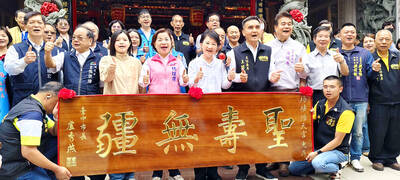
There is considerable frustration and confusion among many, both in Taiwan and abroad — including in Washington — as to why the Chinese Nationalist Party (KMT) seems so dead set on using their legislative leverage to slash defense spending and disrupt the ability of the ruling Democratic Progressive Party (DPP) administration to function. Are they pawns of the Chinese Communist Party (CCP)? Are they traitors? In reality, there are multiple reasons. In the first column in this series on this subject, “Donovan’s Deep Dives: How and why the TPP and KMT help Beijing” (Sat May 16, page 12), we examined three

It took 12 years and months of standing in the same mountain location for director Liang Chieh-te (梁皆得) to capture a few seconds of footage: Taiwan’s largest resident raptor locking talons with its mate and spinning through the air in a courtship ritual. With only about 1,000 left in the wild and very short flight windows, the mountain hawk-eagle remains among Taiwan’s most elusive birds. The species generally produces only one offspring per year. Using forest cameras, the film crew and research teams document the arduous process the monogamous pairs go through for the chick to hatch and grow up, weathering


 RSS
RSS