


Cloud Gate Dance Theatre (雲門舞集) and Cathay Financial Holdings are celebrating 20 years of collaboration this month and Cloud Gate fans nationwide should be celebrating right along with them.
Cathay Financial began sponsoring the company’s annual summertime outdoor performances two decades ago, allowing the troupe — or Cloud Gate 2 (雲門2) — to entertain and thrill tens of thousands of people who might never have the chance to see the companies perform on stage.
The venues for the summer show almost always include Taipei and then one or two places either in the center or south of the nation, or occasionally one of the offshore islands.

photo Courtesy of Cloud Gate Dance Theatre
Cathay Financial chairman Tsai Hong-tu (蔡宏圖) told a news conference in Taipei on Thursday last week that the company plans to continue underwriting Cloud Gate’s outdoor shows so that even more people could have the chance to enjoy the troupe.
This year, residents of Taipei, Kaohsiung and Hualien will be able to see the free shows, the first of which is on Saturday night in the capital’s Liberty Plaza. The next two Saturdays will see the troupe heading south and then to the east coast.
The company will be performing founder and artistic director Lin Hwai-min’s (林懷民) Rice (稻禾), which premiered at the National Theater on Nov. 22, 2013, with thousands of people packed into the plaza behind the theater to watch a simulcast of the sold-out show as part of Cloud Gate’s celebrations of its 40th anniversary.
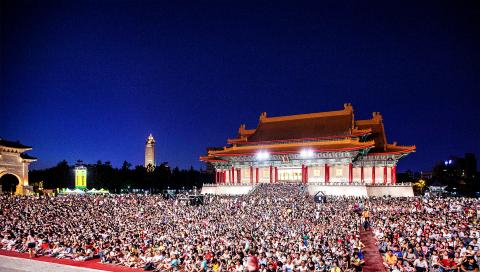
photo Courtesy of Cloud Gate Dance Theatre
Rice is a beautiful work that celebrates both the grain that is an essential part of so many people’s everyday lives, the natural world around us and the beauty of Taiwan’s East Rift Valley. Rice takes the audience through a cycle of seasons, and the cycle of life for rice farmers.
Central to the piece is Chang Hao-jan’s (張皓然) videography and Ethan Wang’s (王奕盛) projection design in which video clips of paddies, seedlings, ripened grains and burning husks — filled with gleaming greens, sunburst yellows, luscious sky blues and ethereal cloud whites — provide a constantly shifting backdrop to the dancers.
It will be interesting to see how those projections work on the temporary stage set up behind the National Theater and the two large screens on either side of the stage. At the premiere I found them almost too beautiful, making it hard to concentrate on the dancers. Perhaps the outdoor staging — not to mention the focus of the crane camera feeding the big screens — will make them less of a distraction.
Veterans of Cloud Gate’s outdoor shows know to come equipped with a cloth or pillow to sit on, cool drinks and paper fans — and to show up at least an hour or more ahead of the 7:30pm start time to get a good spot.
A smoothly efficient mix of Cloud Gate employees and volunteers maintain order and clear walkways amid the several thousand people anxious for a free viewing of a show by one of the world’s premiere dance troupes, and ensure an efficient and speedy departure and clean-up process afterwards.

Taiwan’s overtaking of South Korea in GDP per capita is not a temporary anomaly, but the result of deeper structural problems in the South Korean economy says Chang Young-chul, the former CEO of Korea Asset Management Corp. Chang says that while it reflects Taiwan’s own gains, it also highlights weakening growth momentum in South Korea. As design and foundry capabilities become more important in the AI era, Seoul risks losing competitiveness if it relies too heavily on memory chips. IMF forecasts showing Taiwan widening its lead over South Korea have fueled debate in Seoul over memory chip dependence, industrial policy and

“China wants to unify with Taiwan at the lowest possible cost, and it currently believes that unification will become easier and less costly as time passes,” wrote Amanda Hsiao (蕭嫣然) and Bonnie Glaser in Foreign Affairs (“Why China Waits”) this month, describing how the People’s Republic of China (PRC) is playing the long game in its quest to seize Taiwan. This has been a favorite claim of many writers over the years, easy to argue because it is so trite. Very obviously, if the PRC isn’t attacking Taiwan, it is waiting. But for what? Hsiao and Glaser’s main point is trivial,
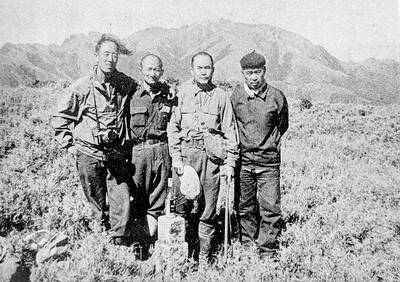
May 18 to May 24 Gathered on Yangtou Mountain (羊頭山) on Dec. 5, 1972, Taiwan’s hiking enthusiasts formally declared the formation of the “100 Peaks Club” (百岳俱樂部) and unveiled the final list of mountains. Famed mountaineer Lin Wen-an (林文安) led this effort for the Chinese Alpine Association (中華山岳協會). Working with other experienced climbers, he chose 100 peaks above 10,000 feet (3,048m) that featured triangulation points and varied in difficulty and character. The list sparked an alpine hiking craze, inspiring many to take up mountaineering and competing to “conquer” the summits. A common misconception is that the 100 Peaks represent Taiwan’s 100 tallest

And so, in the wake of US President Donald Trump’s trip to the People’s Republic of China (PRC), all the experts on the Strait of Hormuz suddenly became experts on US-China-Taiwan relations. The Internet has certainly expanded human knowledge. Lots of these sudden experts made noise this week about Trump’s words after the meeting with PRC dictator Xi Jin-ping (習近平). Trump is going to sell out Taiwan! Longtime Taiwan commentator J. Michael Cole summed the situation up neatly in the Guardian: “We need to keep in mind that he has a tendency to say many things — sometimes contradicting himself within


 RSS
RSS