


Something about Stuart Perlman’s paintings makes it almost impossible not to stop and look. The vivid portraits of chronically homeless people from the Venice Beach area of Los Angeles feature faces as striking as they are diverse. Exhibiting them in public venues such as cinemas, all accompanied by short sensitively written biographies, it seems to encourage people to linger and learn more.
Perlman, a clinical psychologist who has specialized in trauma for three decades, began painting five years ago after the death of his father prompted him to do something creative. Having come to know some of long-term homeless people in his local area he knew immediately it was their faces he wanted to capture. What he didn’t foresee was that getting to know people more intimately would result in his using portraits — more than 130 so far — to raise awareness of the plight of chronic homelessness generally or that he would become passionately vocal about what has been an entrenched issue for a number of US cities for decades.
“They had the true intensity of life writ large across them,” Perlman says of his initial inspiration. “It broke my heart. Their stories were heart-wrenching. So many of these people feel mistreated, unseen and demeaned. We are throwing these people away.”
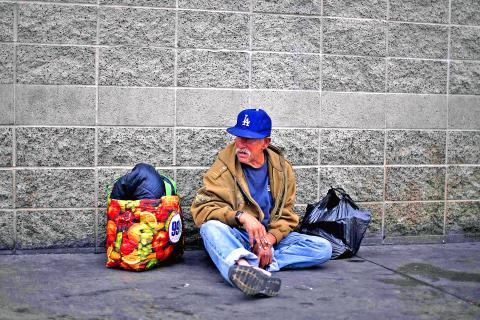
Photo: Reuters
Despite being a trauma specialist, he found it an eye-opener to discover how tough the lives of people living on the streets were. “They are some of the most traumatized people I’ve ever met and I have never seen that displayed in the political literature or the public domain. They are some of the most interesting, talented people,” he adds. “I’ve met PhDs, stockbrokers, architects ... but they’ve gone through horrors.
“People who are run over by cars are usually taken to hospitals — these people have in essence been emotionally run over by a car and they need help, and we are discarding them and blaming them. Each of us is one thin experience away from being traumatized and not being able to function.”
A lack of understanding of homelessness among the public, quickness to blame people for their predicament and the seeming inability of policymakers to address the problem spurred Perlman to use art to “humanize” people living on the streets. He began arranging the Faces of Homelessness exhibition in southern California with the help of the local charity United Way of Greater Los Angeles, which curates the events, and he has spent US$40,000 of his own money on the project. If even in a small way raising awareness makes people think differently about homelessness, Perlman believes it is worth the hours he and the charity volunteers who assist him, put in.
Policymakers in cities such as LA and San Francisco where homeless “encampments” are a common sight have made multiple efforts over the years to tackle chronic street homelessness including investing in housing and resettlement. There have been some successes along the way too. According to the national State of Homelessness in America 2014 report, while there are considerable problems, such as a shortage of affordable housing, homelessness overall, as well as chronic street homelessness, has been falling for the past few years.
Steve Berg, vice president of the National Alliance to End Homelessness, says investment from successive federal governments (there could be more funds to come from the Obama administration soon) over the past decade has been “chipping away” at the problem. Berg points in particular to additional efforts to reduce homelessness among war veterans, a group that has traditionally made up a large proportion of the people who end up on the streets many of whom are grappling with serious mental health issues.
For all of this though, the visibility of people living on the streets can be shocking and it makes Perlman’s dismay wholly understandable. To witness the extent of the problem, be it people wheeling shopping trolleys stacked with junk or those forced to use bushes as toilets, all you have to do is take a short stroll in Venice Beach or MacArthur Park in LA, or in downtown San Francisco.
As Perlman puts it, “It’s a sin upon the soul of our nation, I believe, and our society, that we are allowing people to go through this.” If only chronic homelessness was as impossible for society to ignore as it is for the people who encounter Perlman’s paintings to turn their heads away.

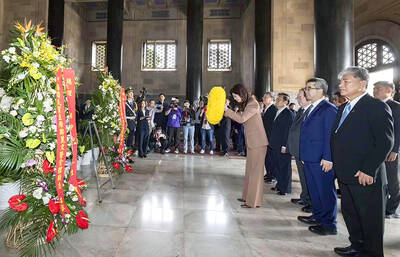
The problem with Marx’s famous remark that history repeats itself, first as tragedy, the second time as farce, is that the first time is usually farce as well. This week Chinese Nationalist Party (KMT) Chair Cheng Li-wun (鄭麗文) made a pilgrimage to the People’s Republic of China (PRC) “to confer, converse and otherwise hob-nob” with Chinese Communist Party (CCP) officials. The visit was an instant international media hit, with major media reporting almost entirely shorn of context. “Taiwan’s main opposition leader landed in China Tuesday for a rare visit aimed at cross-strait ‘peace’”, crowed Agence-France Presse (AFP) from Shanghai. Rare!

What is the importance within the Chinese Nationalist Party (KMT) of the meeting between Xi Jinping (習近平), the leader Chinese Communist Party (CCP), and Cheng Li-wun (鄭麗文), the leader of the KMT? Local media is an excellent guide to determine how important — or unimportant — a news event is to the public. Taiwan has a vast online media ecosystem, and if a news item is gaining traction among readers, editors shift resources in near real time to boost coverage to meet the demand and drive up traffic. Cheng’s China trip is among the top headlines, but by no means

A recent report from the Environmental Management Administration of the Ministry of Environment highlights a perennial problem: illegal dumping of construction waste. In Taoyuan’s Yangmei District (楊梅) and Hsinchu’s Longtan District (龍潭) criminals leased 10,000 square meters of farmland, saying they were going to engage in horticulture. They then accepted between 40,000 and 50,000 cubic meters of construction waste from sites in northern Taiwan, charging less than the going rate for disposal, and dumped the waste concrete, tile, metal and glass onto the leased land. Taoyuan District prosecutors charged 33 individuals from seven companies with numerous violations of the law. This

Sunflower movement superstar Lin Fei-fan (林飛帆) once quipped that the Democratic Progressive Party (DPP) could nominate a watermelon to run for Tainan mayor and win. Conversely, the DPP could run a living saint for mayor in Taipei and still lose. In 2022, the DPP ran with the closest thing to a living saint they could find: former Minister of Health and Welfare Chen Shih-chung (陳時中). During the pandemic, his polling was astronomically high, with the approval of his performance reaching as high as 91 percent in one TVBS poll. He was such a phenomenon that people printed out pop-up cartoon


 RSS
RSS