


In the previous column, Taipei Watcher questioned the attempts by some Christian extremists to use the public school system to “correct” homosexual students’ sexual orientation. The pseudo-scientific “conversion (or reparative) therapy” (性傾向治療) — treatments that aim to change a person from homosexual to heterosexual — is highly controversial. Numerous cases have shown that such forced conversion is unethical, and can lead to a number of negative consequences, such as delayed acceptance of self-identity, depression and even suicide.
The notorious case of John Paulk serves as an example. Paulk was a leading advocate of the Ex-Gay Movement that actively promotes conversion therapy. Both he and his wife claimed that they overcame homosexuality following their conversion to Christianity. For some years, his autobiography Not Afraid to Change was seen as a bible for such therapy and had encouraged countless gays and lesbians to force themselves to change their sexual orientation. But he confessed to PQ Monthly last year that he had never actually converted, urging the public not to buy his best-seller anymore. The couple later divorced.
The American Psychiatric Association (APA) removed homosexuality as a mental disorder from its manual in 1973, and it issued a statement against conversion therapy in 1998. “Homosexuality is not a disorder, and it requires no correction,” said attending physician Chang Shen-chieh (張勝傑) in the Department of Psychiatry at Taipei Municipal Wan Fang Hospital.
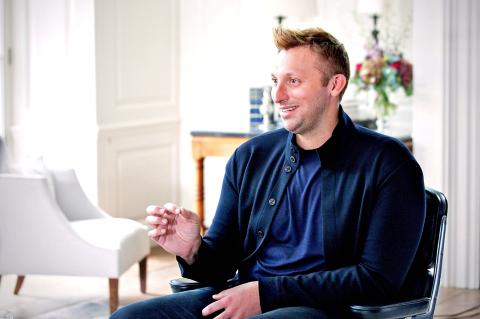
Photo: EPA
“On the contrary, if their parents or teachers constantly pressure them to change their sexual orientation, some homosexuals may suffer depression and other emotional disorders and therefore need to receive treatment,” Chang told Taipei Watcher.
In 2005, Taiwan’s society was shocked by the death of a 17-year-old girl who suffered depression and committed suicide after her mother kept forcing her to change her sexual orientation. Her mother even demanded that the doctor “cure” her homosexuality first and her depression later, because homosexuality was worse than depression in the mother’s eyes.
Australian Olympic gold medalist Ian Thorpe is another living example. Earlier this month, the swimming superstar admitted that he is gay after years of struggle. He has battled depression while keeping his homosexuality from the world. Despite having dated women, he was unable to change his sexual orientation and was extremely frustrated by the constant self-denial. Unfortunately, some religious activists in Taiwan are still brainwashing our students that homosexuality can and must be changed. Are they trying to create more tragedies?
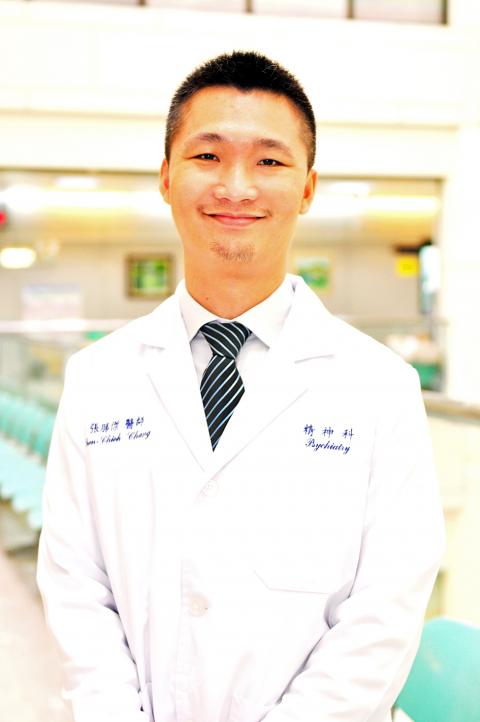
Photo courtesy of Wan Fang Hospital
More seriously, they even collude with politicians to oppress homosexuality. According to the Storm Media Group (風傳媒), Control Yuan member Gau Fehng-shian (高鳳仙) established the Christian Communities Coalition for Human Rights (教會人權促進協會) in March last year, and the group’s secretary-general, Pastor Chen Chih-hung (陳志宏), is an activist against same-sex marriage.
Between August and September last year, Gau invited Chen and the leaders of Christian, Buddhist and Taoist groups for a meal to discuss the draft bill for marriage equality, where they allegedly formed the Alliance of Religious Groups for the Love of Families Taiwan (台灣宗教團體愛護家庭大聯盟), which led to a large anti-gay campaign and demonstration in November last year.
With her power as a Control Yuan member, Gau also issued a “correction” before the large campaign to the Ministry of Education (MOE), claiming that the content of the MOE’s three leaflets about gender equality for students was inappropriate because homosexuality was mentioned. Surprisingly, despite her anti-gay stance, she was re-nominated for a second term as a Control Yuan member by President Ma Ying-jeou (馬英九). Is Ma unaware of her stance? Or doesn’t he care?
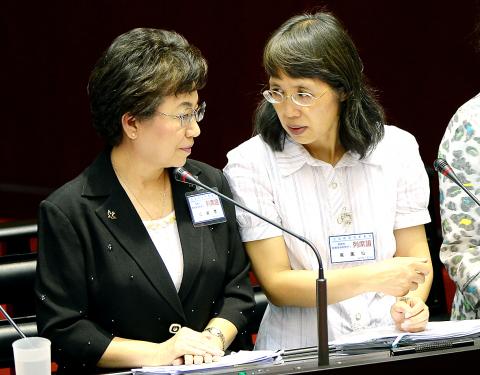
Photo: Lin Cheng-kung, Taipei Times
As an initiator of the Domestic Violence Prevention Act (家庭暴力防治法), Gau often fights to protect women’s and children’s rights. Does she not know that many women and adolescents are homosexual? Promoting the rights of some groups while abusing the rights of others is a double standard.
According to an Apple Daily (蘋果日報) online poll, 75.7 percent of respondents say that Gau is unqualified for the post. Currently, the Legislative Yuan is holding an extra session to vote on Ma’s Control Yuan nominees, and the legislature approved her nomination against mainstream opinion. Shame on Ma for nominating Gau, and shame on the Legislative Yuan for approving her nomination.

If a leisurely afternoon of high-end dining and watching the scenery roll by from the comfort of a plush armchair sounds like a good time to you, consider a trip on the Sea Breeze (海風號). This culinary, cultural and scenic experience is the perfect setting for a date, a celebratory outing with a small group of friends or a relaxing solo ride. The price tag is steep, especially if you consider the short distance the train actually covers over the 3.5-hour journey. But what you’re paying for on the Sea Breeze isn’t transportation; it’s the comfort, the service, the exclusivity, the

June 15 to June 21 According to legend, a giant from Orchid Island (Lanyu, 蘭嶼) named Si Mangangavang once built a large tatala canoe capable of carrying 16 people. He set sail southward to the Batanes in the Philippines, where he traded with the local Ivatan people. One of the goods they coveted was cowhide, which the Tao people of Orchid Island used to make armor. Through continued trade, the Tao and Ivatan forged close ties, and Si Mangangavang became good friends with a Batanes giant named Si Vakag. This story, collected in a 1998 book by ethnologist Yu Guang-hong (余光弘)

Taiwan’s renewable shortfall is a problem of execution, not resources. Japan’s long-cycle, joined-up energy planning is the model worth studying — but what Taiwan can borrow is the institutional machinery, not the politics. When Nvidia CEO Jensen Huang (黃仁勳) used his visit to Taipei last month to warn that the country needs far more electricity, he was naming a constraint its own planners already know well: Taiwan Power Co (Taipower, 台電) expects demand from the semiconductor and artificial intelligence (AI) sector alone to exceed 5 gigawatts (GW) by 2030. The harder question is not whether to build more capacity but which

One of the wildest things about the reception of Chinese Nationalist Party (KMT) Chair Cheng Li-wun (鄭麗文) in the international media is the way her words are presented without being contextualized, let alone challenged. The Financial Times, for example, interviewing her during her visit to New York, said that she blamed the halt to exchanges between Taiwan and the People’s Republic of China (PRC) for raising tensions. “There has been no dialogue, so you can see that the situation is almost on the brink of war,” the Financial Times quoted her as saying, without any hint that the PRC, not


 RSS
RSS