


As so often happens with dance in Taiwan, fans suffer through periods of feast and famine, though luckily the former is usually the problem. Contemporary dance fans have an even tougher choice this weekend with performances by two legends — but at either end of the country.
French ballerina-turned-modern dancer Sylvie Guillem has brought her show, 6000 Miles Away, to Taipei for two performances at the National Theater, while Greater Kaohsiung is playing host to the Bill T. Jones/Arnie Zane Dance Company, which is performing Jones’ latest work, Story/Time at the Chihteh Hall in the Kaohsiung Cultural Center tonight and tomorrow afternoon.
Dance lovers in southern Taiwan owe a huge debt of gratitude to the programmers of the annual Kaohsiung Spring Arts Festival (高雄春天藝術節) for managing to arrange an appearance by Jones’ company, only the second time it has visited Taiwan.
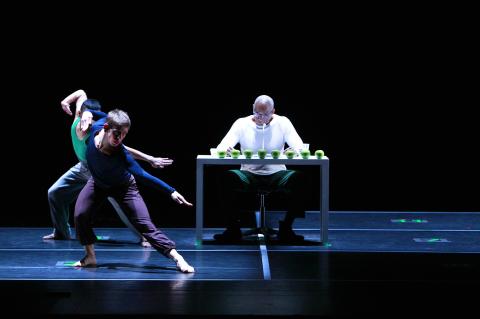
Credit: Courtesy of Paul B Goode
The troupe’s first trip was almost seven years ago, in September 2007, when it performed Jones’ Blind Date at the National Theater in Taipei.
Of great interest to the local media at that time was Taiwanese dancer Lin Wen-chung (林文中), who had been with the company for seven years and was in his final weeks with Jones, having decided to move back home to strike out on his own.
This time around, another dancer is happy to be returning to Taiwan to show family and friends what she has been doing in New York City. Taipei National University of the Arts dance program-graduate Liu I-ying (劉奕伶) has performed with several local troupes, including Ku and Dancers (古名伸舞蹈團) and the Neo-Classic Dance Company (新古典舞團). She joined Jones’ group the year after Lin left, in 2008, although she had served as an apprentice the previous year.
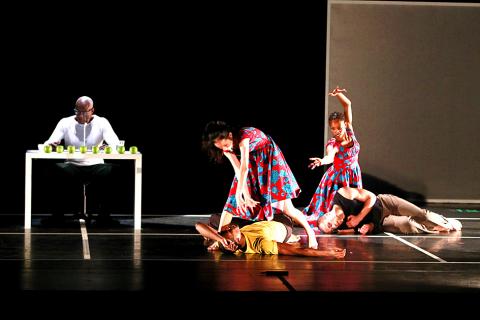
Credit: Courtesy of Paul B Goode
The Bill T. Jones/Arnie Zane Dance Company is now in its 31st year, and luckily the 62-year-old Jones shows no signs of slowing down. In addition to being a dancer and prize/fellowship-winning choreographer, Jones is a writer and a theater director, having co-written and directed the Tony-award winning musical Fela about Nigerian composer and activist Fela Anikulapo Kuti, which premiered on Broadway in 2009.
Early on in his works he began incorporating both text and video, breaking down the walls between a purely “dance” piece and theater. Text plays a key role in Story/Time, which premiered in 2012.
Story/Time was inspired by avant-garde US composer John Cage, whose professional life became inextricably linked with another modern dance great, Merce Cunningham. Cage released an album in 1958 called Indeterminancy, in which he read a series of short stories as David Tudor improvised musical passages on a piano in another room. The trick was that neither man could hear what the other was doing. Cage also performed the piece on stage.
Jones took that idea of mixing narrative with another art form, yet not deliberately connecting them. He wrote about 170 largely autobiographical stories, each a minute or so long. For each show, he chooses 70 of the stories to tell, reading them out in his beautiful, melodious voice while seated behind a simple desk — behind a row of eight green apples — as his dancers perform snippets of choreography that he either created fresh for this piece or assembled from past works along with his long-time associate artistic director Janet Wong.
Like Indeterminancy, the confluence of stories and dances in Story/Times is a matter of chance, not design, but the show is no less spellbinding for it.
It is hard to begrudge the Kaohsiung festival for managing to snare Jones’ and company, given that Taipei usually scores all the big-name performances, but I hope Taipei-area fans do not have to wait another seven years to see the troupe again.
This story has been corrected since it was first published to amend the photographer's credit.

Michael slides a sequin glove over the pop star’s tarnished legacy, shrouding Michael Jackson’s complications with a conventional biopic that, if you cover your ears, sounds great. Antoine Fuqua’s movie is sanctioned by Jackson’s estate and its producers include the estate’s executors. So it is, by its nature, a narrow, authorized perspective on Jackson. The film ends before the flood of allegations of sexual abuse of children, or Jackson’s own acknowledgment of sleeping alongside kids. Jackson and his estate have long maintained his innocence. In his only criminal trial, in 2005, Jackson was acquitted. Michael doesn’t even subtly nod to these facts.

The March/April volume of Foreign Affairs, long a purveyor of pro-China pablum, offered up another irksome Beijing-speak on the issues and solutions for the problems vexing the People’s Republic of China (PRC) and the US: “America and China at the Edge of Ruin: A Last Chance to Step Back From the Brink” rang the provocative title, by David M. Lampton and Wang Jisi (王緝思). If one ever wants to describe what went wrong with US-PRC relations, the career of Wang Jisi is a good place to start. Wang has extensive experience in the US and the West. He was a visiting

The January 2028 presidential election is already stirring to life. In seven or eight months, the primary season will kick into high gear following this November’s local elections. By this point next year, we will likely know the Democratic Progressive Party (DPP) candidate and whether the Taiwan People’s Party (TPP) will be fielding a candidate. Also around this time, the Chinese Nationalist Party (KMT) will either have already completed their primary, or it will be heading into the final stretch. By next summer, the presidential race will be in high gear. The big question is who will be the KMT’s

One of the challenges with the sheer availability of food in today’s world is that lots of us end up spending many of our waking hours eating. Whether it’s full meals, snacks or desserts, scientists have found that it’s not uncommon for us to be mindlessly grazing at some point during all of our 16 or so waking hours. The problem? As soon as this food hits the bloodstream in the form of glucose, it initiates the release of the hormone insulin. This in turn activates a switch present in every one of our cells, which is responsible for driving cell


 RSS
RSS