


No public memorial marks the former Shanghai internment camp made famous by JG Ballard’s novel Empire of the Sun, where more than 1,800 foreigners were held by the Japanese during World War II.
Ballard’s fictionalized version of his experiences in the Lunghwa camp was published 30 years ago, followed in 1987 by the Steven Spielberg film starring a young Christian Bale as Jim Graham, a boy who comes of age on his own in the facility.
The site is now an elite government-run school in Shanghai’s southern suburbs, where Chinese students are unaware internees once slept in their grey classroom buildings.
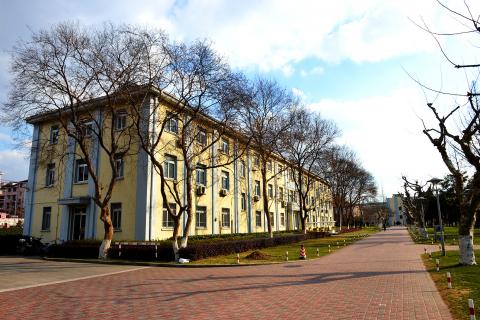
Photo: AFP
The only reminder is a small, easily-ignored display in a private campus museum.
“When I studied here, I was not aware of this part of history. It was not mentioned in class,” said Shanghai High School graduate Lucy Zhang.
The Chinese government, embroiled in a territorial dispute with Tokyo, regularly publicizes Japanese atrocities against its people from the 1930s to the end of World War II.
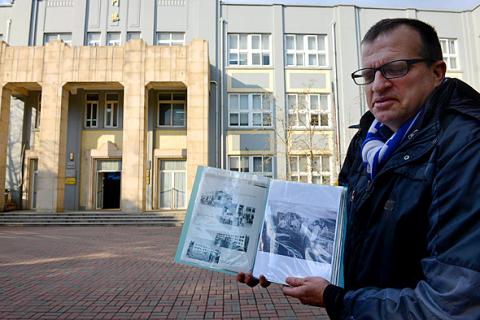
Photo: AFP
A far smaller number of foreigners lived in China at the time, but their sufferings have gone largely ignored.
An American teacher at the school, Sven Serrano, is trying to change that, lecturing on the history of the camp to foreign students in the school’s international section, showing visitors around and developing an online app about the site.
The school demolished the former G Block, where Ballard lived with his family, to make space for a swimming pool, but eight other buildings still stand, including the dining hall and assembly center, Serrano said.
“I’m always concerned that I’ll wake up one morning and the wrecking ball has been taken to one of our precious old buildings,” he told AFP.
“I don’t see any way how we’re going to have any memorial plaque. They just don’t want to make a really big deal of it,” he said — adding one reason for the sensitivity was Japanese students attending the school.
Former internee Betty Barr entered the Lunghwa camp in 1943 at the age of 10 with her Scottish missionary father, American mother and older brother.
Her most vivid memories are blistering summers, freezing winters and an obsession with food.
“I was old enough to know what was happening. I didn’t think it was a picnic,” said Barr, 80, during a return visit.
She still guiltily recalls taking a sip of milk produced by the camp’s only cow from a mug she was taking to her brother in the hospital.
“My father rose to be the manager of the kitchen, though he could not boil an egg, because he could be trusted not to steal vegetables,” she said.
A TIME TO REMEMBER
Japan set up more than 20 internment camps holding around 14,000 people in China and Hong Kong, then a British colony, according to Greg Leck, author of Captives of Empire about the Japanese internment of Allied civilians from 1941 to 1945.
Shanghai, an international commercial city where overseas citizens enjoyed legal privileges and comfortable lifestyles in foreign “concessions,” had 12 camps.
“Hunger and malnutrition, more than anything else, made conditions more severe,” he said. “Medical service personnel were confronted with every type of ailment … aggravated by lack of clothing, poor housing, poor sanitation, over-crowding and the stresses associated with captivity.”
On a vastly larger scale, Japan held both civilians and prisoners of war in 176 camps in its own country and 500 in occupied territories during the war. Japan was also responsible for the deaths of as many as 30 million Asians, including Chinese, his research showed.
Many former China internees have taken issue with Empire of the Sun over factual inaccuracies, uncomplimentary portrayals of recognizable people and the feeling that Ballard appropriated a story belonging to them.
“What upset many former inmates was that his hero, Jim, admired the Japanese,” said Barr, who knew Ballard. “I didn’t mind that but felt that some of what he wrote was not related to the reality. The film was even further removed.”
Ballard, who died in 2009, said his best-known novel was based on memories.
“Some of the events that I described are imaginary, but ... Empire of the Sun is a novel that is firmly based on true experiences, either my own or those told to me by other internees,” he wrote in his autobiography Miracles of Life.
The novel came out 40 years after the events it depicted, but the writer explained: “It took me 20 years to forget Shanghai and 20 years to remember.”
Recently the Chinese Nationalist Party (KMT) and its Mini-Me partner in the legislature, the Taiwan People’s Party (TPP), have been arguing that construction of chip fabs in the US by Taiwan Semiconductor Manufacturing Co (TSMC, 台積電) is little more than stripping Taiwan of its assets. For example, KMT Legislative Caucus First Deputy Secretary-General Lin Pei-hsiang (林沛祥) in January said that “This is not ‘reciprocal cooperation’ ... but a substantial hollowing out of our country.” Similarly, former TPP Chair Ko Wen-je (柯文哲) contended it constitutes “selling Taiwan out to the United States.” The two pro-China parties are proposing a bill that

Institutions signalling a fresh beginning and new spirit often adopt new slogans, symbols and marketing materials, and the Chinese Nationalist Party (KMT) is no exception. Cheng Li-wun (鄭麗文), soon after taking office as KMT chair, released a new slogan that plays on the party’s acronym: “Kind Mindfulness Team.” The party recently released a graphic prominently featuring the red, white and blue of the flag with a Chinese slogan “establishing peace, blessings and fortune marching forth” (締造和平,幸福前行). One part of the graphic also features two hands in blue and white grasping olive branches in a stylized shape of Taiwan. Bonus points for
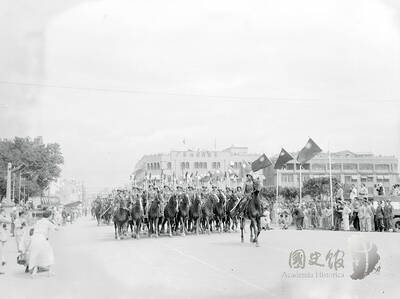
March 9 to March 15 “This land produced no horses,” Qing Dynasty envoy Yu Yung-ho (郁永河) observed when he visited Taiwan in 1697. He didn’t mean that there were no horses at all; it was just difficult to transport them across the sea and raise them in the hot and humid climate. “Although 10,000 soldiers were stationed here, the camps had fewer than 1,000 horses,” Yu added. Starting from the Dutch in the 1600s, each foreign regime brought horses to Taiwan. But they remained rare animals, typically only owned by the government or
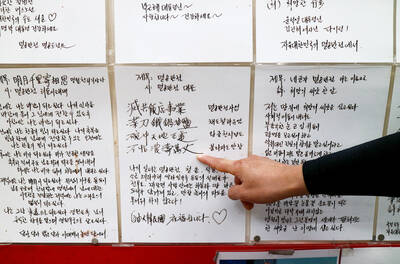
“M yeolgong jajangmyeon (anti-communism zhajiangmian, 滅共炸醬麵), let’s all shout together — myeolgong!” a chef at a Chinese restaurant in Dongtan, located about 35km south of Seoul, South Korea, calls out before serving a bowl of Korean-style zhajiangmian —black bean noodles. Diners repeat the phrase before tucking in. This political-themed restaurant, named Myeolgong Banjeom (滅共飯館, “anti-communism restaurant”), is operated by a single person and does not take reservations; therefore long queues form regularly outside, and most customers appear sympathetic to its political theme. Photos of conservative public figures hang on the walls, alongside political slogans and poems written in Chinese characters; South


 RSS
RSS