


Roads might appear perfectly flat when you drive down them in the comfort of your car. But they’re not. Almost every road angles either up or down, and when in the midst of a long-term cycling trip, you notice every minute degree. Even the slightest downward slope elicits a feeling of pure euphoria, while the smallest rise in elevation can be enough to crush your soul.
All of this became clear to me during my first long-distance bicycle trip, the Formosa 900 (騎遇福爾摩沙), a 900-kilometer-plus, nine-day, two-wheel trek around Taiwan designed to cultivate a cycling culture on the island from the ground up.
Giant Bicycles CEO Tony Lo (羅祥安) took part in the trip, doing his fifth ride around the island. Also along in my riding group were politicians and bike industry representatives, each looking to curry favor with the other in the interest of boosting tourist numbers, increasing the sales of Taiwan-made bikes and related components, getting more locals to see Taiwan from the seat of a bike and ostensibly helping the environment.
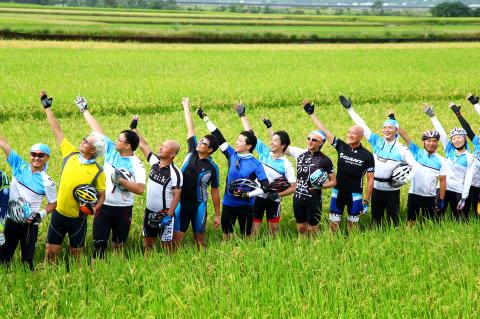
Photo courtesy of the Cycling Lifestyle Foundation
TALE OF TWO ENVIRONMENTS
Cycling in Taiwan is really a tale of two environments, those of the eastern and western halves of the island. The only thing the two have in common is that they’re both in Taiwan, though biking through them you would be forgiven for thinking they are two different worlds: one an idyllic place of uncommon natural beauty, the other the former’s unregulated dumping ground.
My team’s journey from north to south would take us down the eastern side of Taiwan, mostly via the valley between the Central and Coastal Mountain Ranges, from Taipei City all the way to the town of Checheng (車城) in Pingtung County. After a few words of encouragement from Taipei City Mayor Hau Lung-bin (郝龍斌) on the morning of Nov. 9, we were on our way, with Hau himself leading us partway through the city on a uBike, a public bike program put forth to get the city pedaling.
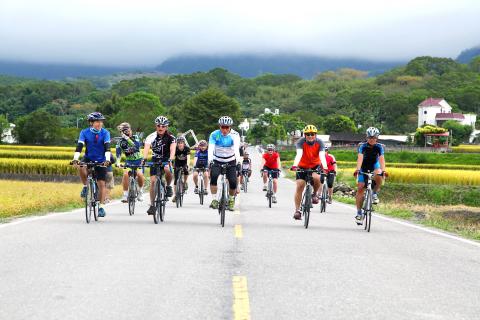
Photo courtesy of the Cycling Lifestyle Foundation
From the outset, a gradual climb of nearly 1,000 meters as we moved from New Taipei City toward Yilan County had my legs pumping battery acid. By the time we reached the Shipai (石牌) Barrier, a thick fog had settled over the peak and a bitter late-fall cold had set in. A murderous headwind did little to ease the feeling that I might have to do the train ride of shame back home to Taipei. But after a few hours we reached the summit, and the climb gave way to a blissful downhill roll. The flooded rice paddies and whitecap surf of Yilan County came into view, and we coasted down the steep, smooth switchback toward the hot spring town of Jiaoxi (礁溪).
The beautiful scenery of the eastern half of Taiwan would continue through Hualien County, on to Taitung and finally to Pingtung before we would make the swing northward. At times my legs were as stiff as two-by-fours as we covered an average of 100 kilometers daily, but the sights always made the pain worthwhile. The ride to the town of Zhiben (知本) passed through bucolic fields and verdant valley scenery, with farmers bringing in their crops as we rolled by.
THE LOST WEST
Unfortunately, the inspirational sight would be the last thing of beauty we would see for quite some time. The trip from south to north along the western coast of the island is largely urban and industrial blight, kilometer after mind-numbing lung-blackening kilometer.
On the ride to Kaohsiung, my white cycling jersey turned a sickly shade of gray, and later that night I watched a day’s worth of chemical grit and exhaust fumes trickle down the shower drain. Kaohsiung has made a much publicized effort to clean up its act in recent years, but a paradise for cyclists its surrounding environs definitely is not. What few riders there were who dared to bike past the region’s collection of factories and warehouses were forced to share busy roads clogged with smoke blasting eighteen-wheelers and all manner of other vehicles rushing by. By the time we reached Taichung, we were growing tired of chewing up kilometer after kilometer of flat highway between interchangeable urban centers, and nighttime beverages with touring mates took on a grim, funerary fugue. But the camaraderie we built during these times was real, and if it was the dreariness of our surroundings that brought this out, I guess we have that to thank for it.
Will cycling become a lasting passion in Taiwan? The bike industry certainly seems to have the government’s ear, and vice versa, and the yearly Taiwan Cycling Festival (臺灣自行車節) held each November is a good start. What’s more, the bicycle business in Taiwan couldn’t hope for a more able and charismatic spokesman than Tony Lo. At every stop along the way, it was as though we were traveling with a rock star—a bicycle evangelist out to convert the masses. Groups of cyclists spotted his trademark shaved head and flashy smile and jaunted over for a kind word, and he was all too happy to oblige.
The main barrier to drawing foreign tourists is the fact that there are simply some parts of Taiwan that you couldn’t pay your average European cycling enthusiast to bike through. There are only a few stretches along the western side of the island on the route following the main highways and county roads we took on the Formosa 900 that are even remotely interesting from a visual perspective. Much of it is downright unsightly. During the ride to Kaohsiung, a comment from a member of the European press corps summed up the western portion of the trip accurately when he said, “At least they’re not hiding the ugly parts.”
Conversely, there are areas on the eastern side of Taiwan offering scenery the likes of which the rest of the world would find difficult to top. Perhaps the answer is to promote those places that already have that visual appeal, while trying to find a way to clean up areas which aren’t there yet. In any case, the cycling paths of Taipei were jam-packed on our ride through the city on that final day. Taiwan is in the formative stages of getting on two non-mechanized wheels, and increasing sales from the likes of Giant prove it. But steps will have to be taken in order to keep them there. You can only pass over the same old paths so many times before the next fad comes along to steal your attention away.

It seems every few days one bumps into one of those “real man” comments in which Taiwan is urged to “face reality” or similar, and “make a deal,” with the speaker implying that soon it will be too late. “Deal” advocates always present themselves as having a superior grip on reality, and the manly ability to make the “hard choice.” Their testosterone-laden language often echoes that of Taiwan sellout advocates. Note that such commentary always specifies a process (“make a deal, work with, make progress”), never the end state of what occupation by a violent authoritarian colonialist state will entail. In

There are shadowy cabals plotting to sell out Taiwan to be annexed by China, by invasion if necessary. Fortunately, they are buffoons. In 2019, former Bamboo Union gangster and founder of the China Unification Promotion Party (CUPP), Chang An-le (張安樂, colorfully known as “White Wolf”), led a protest at the Legislative Yuan against comments made by then-premier Su Tseng-chang (蘇貞昌) that in the event of an attack by China, he would never surrender, but would protect the nation by fighting to the end, even if he only had a broom. Chang had party members bring a wooden casket that they
June 1 to June 7 "If all Taiwanese were as afraid of dying as you, then what would happen?” Physician Shih Chiang-nan (施江南) reportedly said this to his wife Chen Chiao-tung (陳焦桐) after she urged him to stop intervening on behalf of Taiwanese soldiers stranded overseas after serving in the Japanese Army during World War II. Shih had clashed with high-ranking officials over the issue, engaged in several heated arguments with Taiwan governor-general Chen Yi (陳儀) and allegedly shouted at general Ko Yuan-fen (柯遠芬), chief of staff of the Taiwan Garrison Command, over
Food prices have often played a major role in Taiwan’s history. The first major wave of migration from China occurred in 1628. A moderate drought, the Ming Dynasty maritime ban that prohibited fishing and trading (intended to reduce piracy) and a temporary tax, conspired to exhaust local resources, leading to famine in Fujian Province. The famed pirate and trader Zheng Zhilong (鄭芝龍), scooped up starving people from Fujian and transported them across the Taiwan Strait, where they settled under the Dutch. Two factors enabled Zheng. First, by 1624 he had settlements around today’s Beigang (北港) in Yunlin County with a small


 RSS
RSS