


Every October, hundreds of South Korean teachers and professors are sequestered — like jurors in a mafia trial — in a secret, guarded compound: prisoners of their country’s obsession with education.
For one month, they are kept in complete isolation under conditions that resemble house arrest, with everything down to their food waste subject to rigorous examination.
Their sole task is to compile the annual college entrance exam — the importance of which in the minds of stressed-out students and their often equally stressed-out parents is almost impossible to exaggerate.
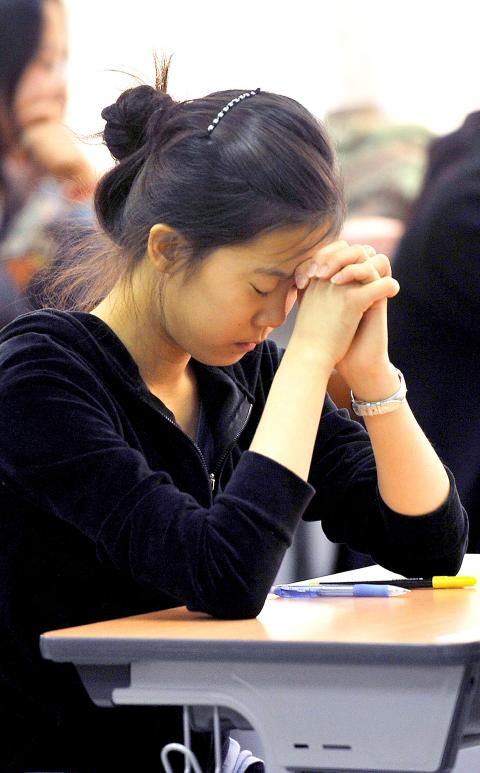
Photo: AFP
Success in the exam — meaning a secured place in one of South Korea’s elite universities — is seen as the key in a hyper-competitive society to everything from future careers to marriage prospects.
“The stakes are simply too high ... and that’s why we have to eliminate any possibility of a leak,” an official at the state-run Korea Institute for Curriculum and Evaluation (KICE) told AFP. Altogether, some 700 people are secluded away in an undisclosed location every year to put the test-paper together.
As well as the compilers, there is a sizeable support staff of domestic and medical personnel, whose main role is to ensure that the question writers have no reason to leave the compound.
The process begins in mid-September, when state education authorities handpick prominent college professors and school teachers in subjects from maths to English across the country.
Participation is voluntary, and there is a financial incentive with the average compiler paid around US$10,000 for their efforts.
‘Security is paramount’
But those who have taken part in previous years say the experience can be stressful and isolating, despite the feeling of camaraderie that develops among the “inmates”.
Nobody is allowed to leave the compound, which is ringed by fences, monitored by surveillance cameras and guarded by police and private security staff.
All mobile phones are confiscated at the outset and there is no phone or Internet access in the building, meaning no contact with friends or family for the duration.
“This is a test that determines the lives of 600,000 youngsters every year and is closely watched by their parents ... so all question makers understand that security is paramount,” said Kwon Oryang, a professor at Seoul National University who headed the exam-setting committee in 2012. Kwon declined to discuss any details of the committee’s work but stressed that all the teachers and professors had been aware of the “immense responsibility” on their shoulders.
“The whole thing may look bizarre to those outside the country, but this is part of our culture that values education above all,” Kwon said.
Such is the level of secrecy that Kwon, as chair of the committee, is one of the few not bound by a mandatory confidentiality agreement that prohibits participants from ever revealing they helped compile the exam.
Recent examples of pre-examination skullduggery — although not involving the college entrance test — suggest that the precautions are not wholly unjustified.
Earlier this year, the US administrator of the SAT — the most widely used test for applying to US colleges — scrapped the scheduled May 4 exams in South Korea after discovering questions were already circulating among some test-preparation schools in Seoul.
The incident followed a similar scandal in 2007 when hundreds of South Korean students had their SAT scores annulled after it had emerged that a number had seen the questions in advance. In 2010, a teacher at a Seoul cram school was arrested for smuggling SAT questionnaires out of a test held in Thailand, and sending them to his pupils who were scheduled to take the same exam hours afterwards. A Seoul law school teacher was charged in May this year with helping applicants cheat on the TOEIC (Test of English for International Communication), using high-tech gear including micro cameras and earpieces.
Security escorts for hospital visits, funerals
The KICE official who spoke to AFP had a special responsibility for security during the compilation period and declined to be identified due to the “importance and sensitivity” of the issue.
According to the official, nothing is let out of the question writers’ residence lest any information — even a scribble on a paper slip — should leak. The only exception is food waste, but even that is scoured by security officials before being disposed of.
Tiny pieces of paper, or any “suspicious materials” found in the food waste are picked out and torched, the official said.
General medical problems are dealt with in-house. Anyone who falls seriously ill is taken to a nearby hospital, but with an escort who will ensure there is no “unnecessary conversation” with doctors or nurses.
The only other exception is in the event of the death of an immediate family member — but again an escort would be required.
Otherwise, those wishing to contact family members have to submit a brief list of questions to security officials who will make phone calls on their behalf and report back.
Once the questions have been compiled, the exam proofs are sent to another secret, high-security location to be printed.
The teachers and professors, however, must remain in isolation until the actual day of the exam.
“The stress level peaks after the questionnaires are finalized and sent for printing, because you have little to do and nowhere to go,” one former question maker told AFP. He declined to be named, citing the confidentiality agreement.
“Many kill time playing chess or ping pong, or simply walking up and down the stairs for hours to exercise,” he said.
An unacceptable financial and social cost?
For most of their school lives, South Korean students supplement their regular education with evening and weekend tuition — averaging five hours sleep a night as the college exam approaches.
According to the Education Ministry, South Korean parents spent the equivalent of US$17.5 billion on extra classes for their children last year — roughly 1.5 percent of the national GDP.
The intense parental expectation and pressure is blamed for dozens of suicides, especially around the time of the exam itself.
The 2013 test will be held across the country on Nov. 7 and, as is the case each year, that one day will run on a unique schedule.
Public offices and major businesses — including stock markets — open late to clear morning traffic for exam takers, while police cars and motorbikes are put on standby to help those making a late dash to test centers.
Flights and military artillery drills are rescheduled to cut noise during language listening tests in the morning and afternoon, while throngs of parents gather outside test centers or visit Buddhist temples and churches to pray for good scores.
News networks, meanwhile, offer recipes for special lunches that are easily digestible and contain ingredients supposed to boost mental concentration.
Taiwan’s overtaking of South Korea in GDP per capita is not a temporary anomaly, but the result of deeper structural problems in the South Korean economy says Chang Young-chul, the former CEO of Korea Asset Management Corp. Chang says that while it reflects Taiwan’s own gains, it also highlights weakening growth momentum in South Korea. As design and foundry capabilities become more important in the AI era, Seoul risks losing competitiveness if it relies too heavily on memory chips. IMF forecasts showing Taiwan widening its lead over South Korea have fueled debate in Seoul over memory chip dependence, industrial policy and
“China wants to unify with Taiwan at the lowest possible cost, and it currently believes that unification will become easier and less costly as time passes,” wrote Amanda Hsiao (蕭嫣然) and Bonnie Glaser in Foreign Affairs (“Why China Waits”) this month, describing how the People’s Republic of China (PRC) is playing the long game in its quest to seize Taiwan. This has been a favorite claim of many writers over the years, easy to argue because it is so trite. Very obviously, if the PRC isn’t attacking Taiwan, it is waiting. But for what? Hsiao and Glaser’s main point is trivial,
May 18 to May 24 Gathered on Yangtou Mountain (羊頭山) on Dec. 5, 1972, Taiwan’s hiking enthusiasts formally declared the formation of the “100 Peaks Club” (百岳俱樂部) and unveiled the final list of mountains. Famed mountaineer Lin Wen-an (林文安) led this effort for the Chinese Alpine Association (中華山岳協會). Working with other experienced climbers, he chose 100 peaks above 10,000 feet (3,048m) that featured triangulation points and varied in difficulty and character. The list sparked an alpine hiking craze, inspiring many to take up mountaineering and competing to “conquer” the summits. A common misconception is that the 100 Peaks represent Taiwan’s 100 tallest
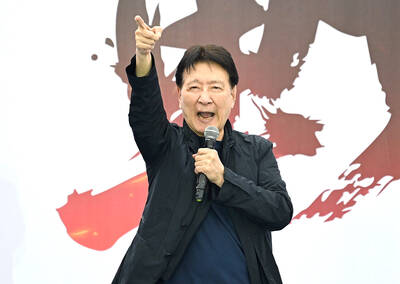
In a sudden move last week, opposition lawmakers of the Chinese Nationalist Party (KMT) and Taiwan People’s Party (TPP) passed a NT$780 billion special defense budget as a preemptive measure to stop either Chinese leader Xi Jinping (習近平) or US President Donald Trump from blocking US arms sales to Taiwan at their summit in Beijing, said KMT heavyweight Jaw Shaw-kong (趙少康), speaking to the Taipei Foreign Correspondents Club on Wednesday night in Taipei. The 76-year-old Jaw, a political talk show host who ran as the KMT’s vice presidential candidate in 2024, says that he personally brokered the deal to resolve


 RSS
RSS