


Encountering Andrew Huang (黃學正) is like meeting a kung-fu master. Only this master’s uncontested prowess is of a gastronomic kind, manifested through his creative compositions that are the exuberant synthesis of distinctive flavors and aromas. And instead of setting up a school to procure fame and disciples, the martial artist chooses to live among us, in an unostentatious residential neighborhood near Taipei’s Xingtian Temple (行天宮).
Huang’s Dolce & Crepes is literally in his home, with his two elementary school-aged daughters often seen doing homework on a round table in the living room that doubles as the dining area, where patrons eagerly await the feast they ordered from the menu scribbled on the wall.
It is under this domestic veneer that Huang works his magic. Using nothing more than the usual pots and pans, he produces dishes of a culinary refinement on a par with that of Taipei’s top fine dining establishments.
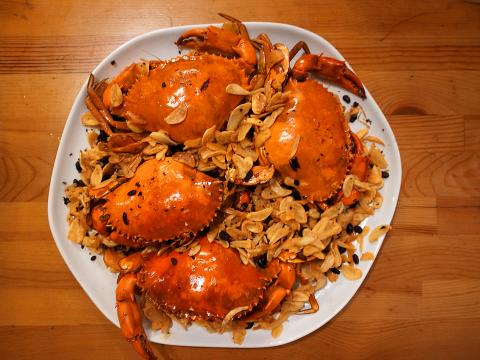
Photo: Ho Yi, Taipei Times
Patrons are given full attention upon entering the simply decorated room. Huang takes the time to give a detailed explanation of how the food is prepared and cooked and to suggest wine and drinks to accompany the meal. The owner and chef seems to have a natural ability to describe the nuance of flavors and his luscious combinations of ingredients in a very vivid way, luring diners into an epicurean fantasy that preludes the banquet to come.
Huang’s menu contains only around a dozen dishes, but each is hard to resist. The chocolate duck leg confit (油封鴨腿, NT$380), for example, consists of lean meat cooked to tender perfection and seasoned in an appetizing vinegar-based sauce, while the aroma of cocoa delivers an exciting punch to the meat. Huang says the duck leg is marinated and roasted in extra-virgin olive oil instead of duck or goose oil so as to give the French specialty a fruity and less cloying flavor.
The lamb shoulder stewed with figs and apricots (無花果杏桃燉羊肩, NT$680) is another delicate composition which sees the divine match of fresh figs and succulent lamb exploding in the mouth, smoothened by the sweetness of apricots and sauteed vegetables.
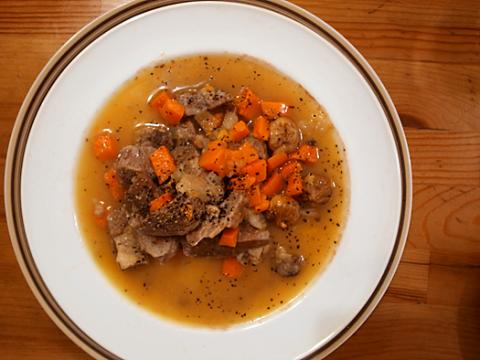
Photo: Ho Yi, Taipei Times
The Chinese culinary influences also have a strong presence on Huang’s menu. The Sichuan-style spicy chicken (川麻口水雞, NT$580) and king oyster mushroom (川麻杏鮑菇, NT$580) use various types of Sichuan pepper to create an enticing, tongue-numbing sensation, and the homemade pepper oil and sauce taste so good that it is almost a crime not to lick the bowl clean.
For seafood lovers, Huang’s popular plate of crabs with deep-fried garlic chips (NT$2,000 or NT$1,000 depending on the types of crab) is definitely a high point of a visit to Dolce & Crepes. Though we weren’t there during crab season, the crustaceans Huang picked for my dining companions and me last month were satisfactorily plump and sweet, buried under the savory layers of garlic chips and doushi (豆鼓), or fermented black soybean, that are fried using olive oil till they are crispy.
Vegetarians are also in for a surprise. Fun to look at and pleasant to taste, the roasted balloon with mushroom juice (菌汁烤氣球, NT$220) is a specially sauced bean curd that puffs up when roasted and contracts after cooling down. The end result is a large piece of bean curd that is firm on the outside but retains a fine, soft texture on the inside.
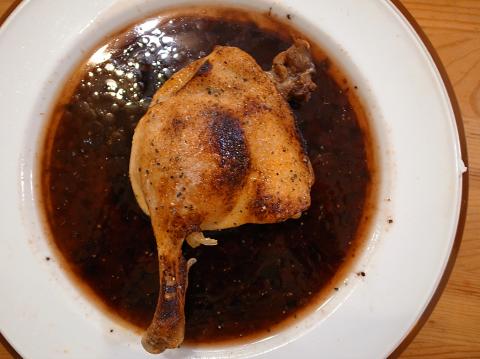
Photo: Ho Yi, Taipei Times
Affable and well-informed, Huang appears to be a versatile master with hidden talents and skills. Those interested in renewable energy may want to raise related topics with their host. Huang is also the chief executive of Advanced Power and Energy Transportation, a company that’s developing a green car running on zinc-oxygen energy fuel cells.
A word of reminder: Please leave smelly socks at home because diners are required to take off their shoes before entering Huang’s home-cum-restaurant.
Photo: Ho Yi, Taipei Times
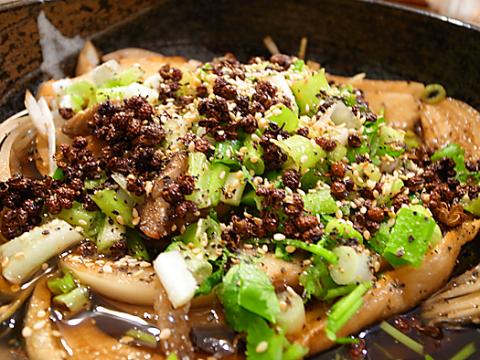
Photo: Ho Yi, Taipei Times

A recent report from the Environmental Management Administration of the Ministry of Environment highlights a perennial problem: illegal dumping of construction waste. In Taoyuan’s Yangmei District (楊梅) and Hsinchu’s Longtan District (龍潭) criminals leased 10,000 square meters of farmland, saying they were going to engage in horticulture. They then accepted between 40,000 and 50,000 cubic meters of construction waste from sites in northern Taiwan, charging less than the going rate for disposal, and dumped the waste concrete, tile, metal and glass onto the leased land. Taoyuan District prosecutors charged 33 individuals from seven companies with numerous violations of the law. This
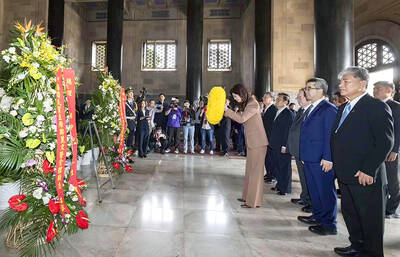
The problem with Marx’s famous remark that history repeats itself, first as tragedy, the second time as farce, is that the first time is usually farce as well. This week Chinese Nationalist Party (KMT) Chair Cheng Li-wun (鄭麗文) made a pilgrimage to the People’s Republic of China (PRC) “to confer, converse and otherwise hob-nob” with Chinese Communist Party (CCP) officials. The visit was an instant international media hit, with major media reporting almost entirely shorn of context. “Taiwan’s main opposition leader landed in China Tuesday for a rare visit aimed at cross-strait ‘peace’”, crowed Agence-France Presse (AFP) from Shanghai. Rare!

What is the importance within the Chinese Nationalist Party (KMT) of the meeting between Xi Jinping (習近平), the leader Chinese Communist Party (CCP), and Cheng Li-wun (鄭麗文), the leader of the KMT? Local media is an excellent guide to determine how important — or unimportant — a news event is to the public. Taiwan has a vast online media ecosystem, and if a news item is gaining traction among readers, editors shift resources in near real time to boost coverage to meet the demand and drive up traffic. Cheng’s China trip is among the top headlines, but by no means

As mega K-pop group BTS returns to the stage after a hiatus of more than three years, one major market is conspicuously missing from its 12-month world tour: China. The omission of one of the group’s biggest fan bases comes as no surprise. In fact, just the opposite would have been huge news. China has blocked most South Korean entertainment since 2016 under an unofficial ban that also restricts movies and the country’s popular TV dramas. For some Chinese, that means flying to Seoul to see their favorite groups perform — as many were expected to do for three shows opening


 RSS
RSS