


When Arnold Schwarzenegger was governor of California, a reporter asked about the Cohiba label on the cigar Schwarzenegger was smoking.
“That’s a Cuban cigar,” the reporter said. “You’re the governor. How can you flout the law?”
The answer was as good a one-sentence encapsulation of the bodybuilder/entrepreneur/movie star/politician/braggart’s philosophy as all of Total Recall, his 646-page memoir, provides.
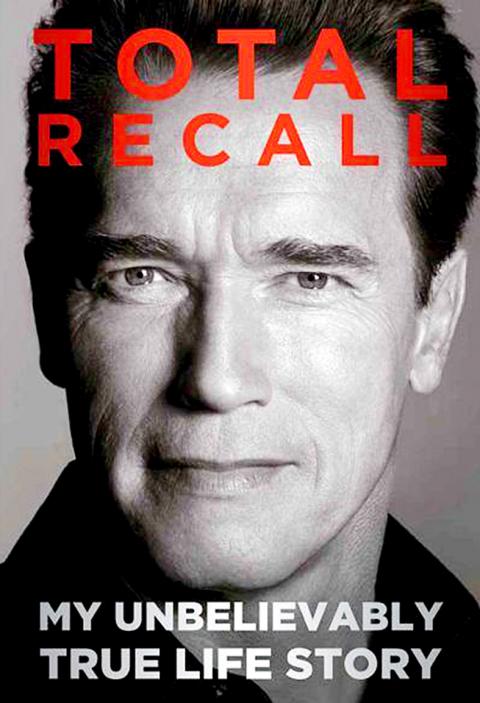
“I smoke it because it’s a great cigar,” he said.
This is only one of countless ways Schwarzenegger has prized self-interest throughout his long, glory-stalking and (as he loves pointing out) extremely lucrative career. Total Recall contains nonstop illustrations of how he aims high, tramples on competitors, breaks barriers and savors every victory, be it large or small. Those who mistake Total Recall for a salacious tell-all may not be that interested in how many Mr. Olympia contests he won (seven) or who he beat for a Golden Globe in 1977 (Truman Capote and the kid who played Damien in The Omen).
Let’s get the scandalous stuff out of the way, because Schwarzenegger certainly wants to. About the son he conceived with the family housekeeper, Mildred Baena, in 1996, he says only this: that he had always promised himself not to fool around with the help. That once, “all of a sudden,” he and Baena “were alone in the guesthouse.” And immediately after that: “When Mildred gave birth the following August . . . ”
What Total Recall actually turns out to be is a puffy portrait of the author as master conniver. Nothing in his upward progress seems to have happened in an innocent way.
The book begins with the obligatory description of his Austrian childhood and the fact that he and his brother were forced to do situps to earn their breakfast. He also explains how the bodybuilder photos he pinned up in his room made his mother seek a doctor’s advice. The doctor assured her that these were surrogate father figures, so there was nothing “wrong” with her red-blooded, heterosexual boy.
The book moves on to describe a hair-raising stint in an Austrian army tank unit, where antics included driving one tank into water and trying to drag-race with another. This earned him an early release from service. He went on to win bodybuilding titles in Europe, move to the US, garner the attention of the filmmakers who would feature him in Pumping Iron and land the Hollywood acting role he coveted in Stay Hungry.
When told by an acting coach to summon a sense memory of victory, he says, “I had to explain that actually I was not especially exhilarated when I won, because to me, winning was a given.”
And so it goes, through progress from pedestal to pedestal, until Conan the Barbarian makes him an action star. Schwarzenegger and his co-writer, Peter Petre, had to brush up on the details of his acting career by reading biographies and movie journals; his memory for slights, triumphs and salaries seems more reliable than his memory for work. But one way or another, we learn how raw meat was sewn into his Conan costume for a scene in which he is attacked by wolves. (Sadly, the audio version of Total Recall is not fully read by him. You would have to re-watch the film to hear him say: “Hither came I, Conan, a thief, a reaver, a slayer, to tread jeweled thrones of the earth beneath my feet.” But it might be worth it.)
In 1977 he met Maria Shriver, who would become his wife and enthusiastic helpmate until the matter of Baena and her son came to light. Although Schwarzenegger says that others wrongly imagined that to “marry a Kennedy” was one of his goals, he, too, speaks of their union as an accomplishment. Among many noxious references to his wife are a buddy’s pre-wedding quip (“Oh boy, wait until she hits menopause”) and his way of commissioning an Andy Warhol portrait of her.
“You know how you always do the paintings of stars?” he says he asked Warhol. “Well, when Maria marries me, she will be a star!”
He does not appear to be joking.
When Schwarzenegger was at the height of his movie career, he thought of quip-making as one of his strong suits. (In Commando, about a man whose neck he has just broken: “Don’t disturb my friend, he’s dead tired.”) But he was personable enough to cultivate his Democratic Kennedy in-laws and also grow close to the Republican circle of President George H.W. Bush. He claims to have been included in a decision-making meeting about the initial Gulf War invasion of Iraq.
His account of his own political career is, of course, careful to accentuate the positive. He ran for governor of California in 2003’s recall election even after Karl Rove told him that Condoleezza Rice was being groomed as a future candidate of choice. He emphasizes his centrist credentials as a Republican favoring a social safety net, solar energy and stem cell research but also facing down his state’s three most powerful public employee unions. He claims to have done his best to grapple with the state’s dire budget woes. But he atypically keeps the crowing minimal: “I do not deny that being governor was more complex and challenging than I had imagined.”
This book ends with a not-great list of “Arnold’s Rules.” They are basic (“Reps, reps, reps”), boorish (“No matter what you do in life, selling is part of it”), big on denial (“When someone tells you no, you should hear yes”) and only borderline helpful. When he met Pope John Paul II in 1983, they talked about workouts. The pope rose daily at 5am in order to stick to his regimen. If he could do it, this book says, you can do it, too.

Taiwan’s English education system is being pulled apart by three opposing forces. Bilingual Nation 2030 pulls students toward English and global communication. Artificial Intelligence (AI) readiness pulls them toward digital judgment, verification and AI-mediated work. But Taiwan’s old exam culture pulls them back toward memorization, grammar drills, timed reading and correct answers. If the education system keeps using old exams to define success, it risks producing graduates who are neither genuinely bilingual nor genuinely AI-ready, but trained for tasks machines can already perform. The first force is Bilingual Nation 2030. Launched in 2018, the policy aimed to “help Taiwan’s workforce connect
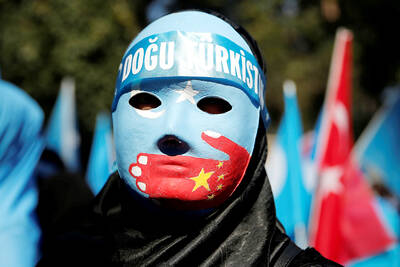
It seems every few days one bumps into one of those “real man” comments in which Taiwan is urged to “face reality” or similar, and “make a deal,” with the speaker implying that soon it will be too late. “Deal” advocates always present themselves as having a superior grip on reality, and the manly ability to make the “hard choice.” Their testosterone-laden language often echoes that of Taiwan sellout advocates. Note that such commentary always specifies a process (“make a deal, work with, make progress”), never the end state of what occupation by a violent authoritarian colonialist state will entail. In
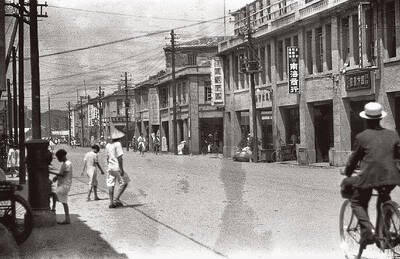
June 1 to June 7 "If all Taiwanese were as afraid of dying as you, then what would happen?” Physician Shih Chiang-nan (施江南) reportedly said this to his wife Chen Chiao-tung (陳焦桐) after she urged him to stop intervening on behalf of Taiwanese soldiers stranded overseas after serving in the Japanese Army during World War II. Shih had clashed with high-ranking officials over the issue, engaged in several heated arguments with Taiwan governor-general Chen Yi (陳儀) and allegedly shouted at general Ko Yuan-fen (柯遠芬), chief of staff of the Taiwan Garrison Command, over

“Taiwan’s Opposition Leader Comes to US With a Message Straight Out of Beijing” read a May 31 headline in the Wall Street Journal. Top US administration officials and members of Congress almost certainly read the WSJ, and if there was a bullet point takeaway that people in Washington should absorb ahead of Chinese Nationalist Party (KMT) Chair Cheng Li-wun’s (鄭麗文) arrival in DC on June 9, that headline is it. The last few columns have discussed this very topic, and the timing is not coincidental. While those top officials likely do not read the Taipei Times, judging by the number


 RSS
RSS