


It’s been four years since Edison Chen (陳冠希) first became embroiled in the sex photo scandal that cost him his career, but the erstwhile pop star and singer just can’t seem to shake off gossip reporters. Or rather, some would argue, the media can’t get rid of him. Pop Stop readers will remember that Chen recently played a part in the breakup of Cecilia Cheung’s (張柏芝) marriage after the former lovers took snapshots of each other on a plane last summer. Cheung had featured prominently (and nakedly) in Chen’s leaked photos and her husband Nicholas Tse (謝霆鋒) was reportedly enraged over her lack of discretion.
The most recent scandal launched when Chen was supposedly caught on a “secret date” with actress Michelle Chen (陳妍希). A photo posted online purported to show the duo on their outing, but the male figure’s face was not visible. Despite the lack of conclusive evidence, Internet discussion boards lit up with speculation. Fans even gave the couple a nickname: “Double Happiness” (雙喜), a saucy nod to the identical second characters in their given names.
Michelle’s supposed love interest, singer Alan Ko (柯有倫), was reportedly heartbroken and vowed to join forces with other entertainers to destroy whatever is left of Edison’s reputation once and for all. But the starlet issued a statement through her manager: “I don’t know Edison Chen and I have never met him.”

Photo: Taipei Times
Her manager jokingly implored paparazzi “to please not mistake every woman with a ponytail for Michelle” before adding that reading online reports of her supposed secret date with Edison had caused his client to burst into laughter.
Though their divorce became official just two months ago, Cheung and Tse have been beset with rumors that they are already eager for a reunion. Cheung may have helped put the speculation to rest, however, by going out to dinner with rock singer Frankie Gao (高凌風), affectionately known as the “frog prince”(青蛙王子) to his fans. The two were recently spotted sharing a meal on the terrace of a Shanghai restaurant.
Gao also recently divorced after his wife dumped him via a text message. The 62-year-old was the subject of some mockery after it was discovered that he had tried to cover up the separation for months. Cheung has also suffered on the gossip pages recently — she’s been dubbed “box office poison” after her latest movies bombed.
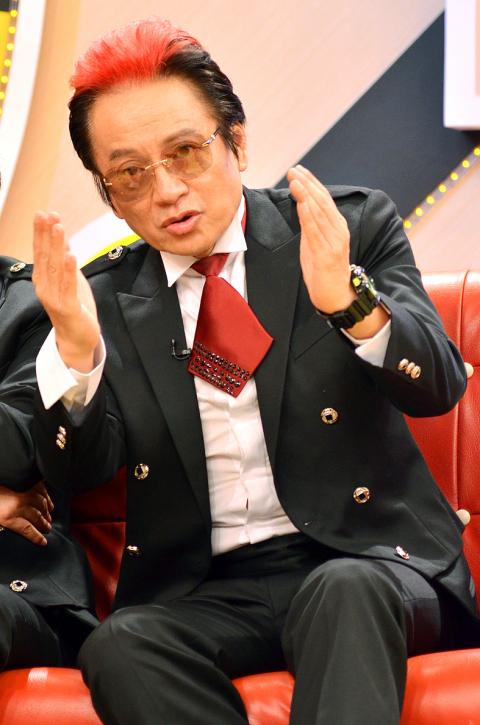
Photo: Taipei Times
The pair denied that they were on a romantic date, even though they were spotted leaving the restaurant at midnight, arm-in-arm and looking tipsy. It remains to be seen whether Cheung did indeed kiss her frog prince.
Then again, maybe the two just needed to commiserate after their recent woes. “Maybe misery loves company,” commented The Liberty Times (自由時報), our sister newspaper.
Cheung’s fellow Hong Kong celebrity Andy Lau (劉德華), whose wife Carol Chu (朱麗倩) gave birth to their daughter Hanna in May, recently purchased a mansion for his new family. The residence is surrounded by a large garden, which is in turn enclosed by a 10-meter-tall wall and trees with dense foliage. Furthermore, a bodyguard patrols the estate and all visitors must first pass two security checkpoints. This is a vast improvement over the couple’s previous home, where they had to cross parking lane before darting into a side entrance in order to escape the paparazzi.
Hong Kong weekly Oriental Sunday (東方新地) reported that privacy was also foremost on Lau’s mind when he arranged for his daughter’s second-month celebration to be held in Kuala Lampur, with only his Malaysian wife’s family in attendance. According to the article, the two devout Buddhists held a “cradle ceremony” for their baby and prayed for her protection. The couple has already decided to send Hanna to a Malaysian school in order to protect her from the swarms of reporters that constantly surround them in Hong Kong.


Taiwan’s English education system is being pulled apart by three opposing forces. Bilingual Nation 2030 pulls students toward English and global communication. Artificial Intelligence (AI) readiness pulls them toward digital judgment, verification and AI-mediated work. But Taiwan’s old exam culture pulls them back toward memorization, grammar drills, timed reading and correct answers. If the education system keeps using old exams to define success, it risks producing graduates who are neither genuinely bilingual nor genuinely AI-ready, but trained for tasks machines can already perform. The first force is Bilingual Nation 2030. Launched in 2018, the policy aimed to “help Taiwan’s workforce connect

“Taiwan’s Opposition Leader Comes to US With a Message Straight Out of Beijing” read a May 31 headline in the Wall Street Journal. Top US administration officials and members of Congress almost certainly read the WSJ, and if there was a bullet point takeaway that people in Washington should absorb ahead of Chinese Nationalist Party (KMT) Chair Cheng Li-wun’s (鄭麗文) arrival in DC on June 9, that headline is it. The last few columns have discussed this very topic, and the timing is not coincidental. While those top officials likely do not read the Taipei Times, judging by the number
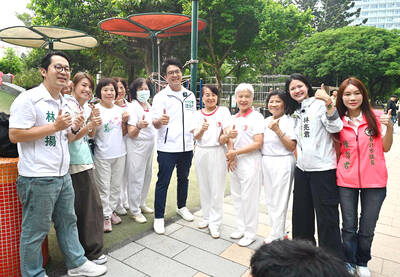
With weighty, anxiety-inducing geopolitical topics dominating the headlines, checking in on the wild and weird state of local politics can take some of the edge off. This November’s elections will determine who will be in charge of fixing potholes in your neighborhood, not the potholes in Taiwan’s complicated geopolitical space. Recently, after an online interview with a Taipei-based journalist, I commented that Taipei journalists never go further than the MRT can take them. He laughed and agreed. Naturally, the Taipei mayoral race is eating up much of the press attention. TAIPEI CITY Democratic Progressive Party (DPP) candidate Puma Shen (沈伯洋) has
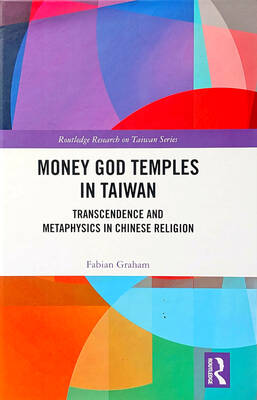
As someone who normally steers clear of books with “transcendence” or “metaphysics” in their subtitles, this reviewer — a casual observer of local belief systems since the 1990s — found Fabian Graham’s Money God Temples in Taiwan a challenging read. Those who’ve only dipped their toes into temple culture will likely need to parse several sections with special care if they’re to keep up with the author, a British ethnographic researcher whose previous books have investigated religious practices among ethnic Chinese in Southeast Asia. This scholarly volume examines a facet of Taiwan’s religious landscape that didn’t exist a century ago, and


 RSS
RSS