


Eric Mader is one of Taipei’s most lively and entertaining expatriates. He’s the author of a surreal novel, A Taipei Mutt (reviewed in the Taipei Times on Dec. 14, 2003) and a large number of anti-establishment online columns on US politics, most easily seen, together with a great deal else, on www.necessaryprose.com. In addition he’s a Christian, with a very individual take on his faith. It’s this topic to which he’s devoted much, but not all, of his new book, Heretic Days.
One extremely interesting chapter is on the Muggletonians, a 17th-century sect whose founders, two London tailors, believed they were the “two olive trees” mentioned as standing before God in the 11th chapter of Revelation. Once they’d escaped the authority of the established church, English nonconformists began to spawn a large number of sects of this kind, each with slightly different takes on, for instance, the ancient problem of how an omnipotent and benevolent God could have created wicked human beings. The Bible was believed to be literally true at all points, and the permutation of its texts allowed for almost any shade of belief.
Mader happened on the Muggletonians because he’s interested in the poet William Blake. Scholars had for decades struggled to find a philosophical system that would explain all Blake’s enigmatic verses, but without success. Then in 1994 a book appeared by the UK historian E.P. Thompson arguing that it wasn’t philosophical systems we should look at, but the beliefs of the London artisan class to which Blake belonged. Central to these, Thompson urged, were the creeds of the nonconformist sects, especially the Muggletonians. Thompson had tracked down the last surviving Muggletonian who’d given him the sect’s entire archive stretching back 300 years. Thompson handed this treasure trove over to the British Library, and its texts are now available online at www.muggletonian.org.uk.
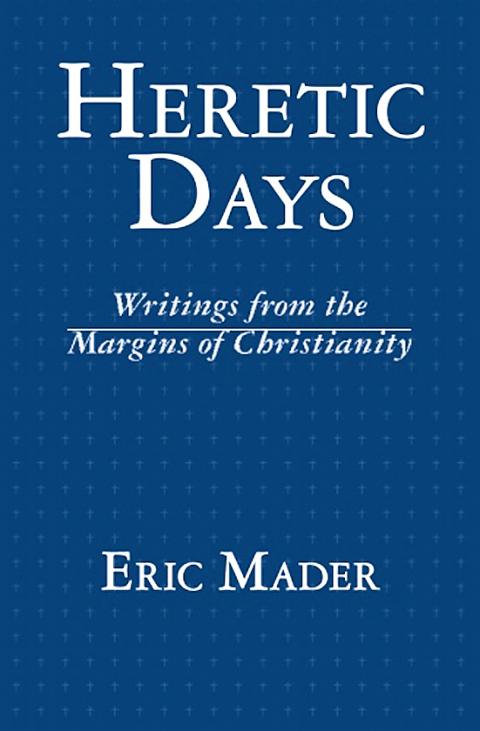
Mader is himself a kind of Muggletonian. He has an ingenious mind and a very honest heart, but the precise Christian position he’s worked out for himself, though he calls it, I’m unsure how seriously, Gnostic — in at least some senses of the word — is quite possibly unique to him. And it’s not surprising. Once you’re free from the tenets of the main Christian orthodoxies, and once you believe not all the Bible is literally true, and some of the more recently discovered texts such as the Gospel of Thomas probably contain much that is based on actual contact with Jesus of Nazareth, and if you then proceed to combine an unargued faith that Jesus was the Messiah with a whole range of highly intelligent opinions as to what is likely to be true in these ancient documents, Biblical or not, it won’t take long before you arrive at a position that is well-nigh exclusive to you alone.
There’s nothing wrong with this. I’m no believer in sacred revelation of any kind; by contrast, I could be called a scientific materialist with an eye for beauty. Mader’s belief in Jesus as Messiah simply has no meaning for me, and it would take at the very least a vision of angels playing trumpets to convince me otherwise. But that’s not the point. Mader has a right to his beliefs, bizarre as they seem to me, as I hope I have a right to mine. Millions believe far weirder creeds than he does, yet seem quite untroubled when encountered walking along the street.
I enjoyed a lot of this strange book, though other things in it made me laugh aloud at times Mader probably wasn’t planning on. One section I particularly relished is called “Rant in E Minor” (the precise significance of the key escapes me, unless it stands for Eric Mader). In it he replies to a mainstream US Christian who wrote to him accusing him of not seeing the wood for the trees, the fact that Jesus saves being all that matters, and so on. Mader replies brilliantly. Most orthodox US Christians have little idea what Jesus actually taught, he says. They aren’t pacifists, don’t hold their goods in common, and as for selling all they have and giving the proceeds to the poor, as Jesus told the rich man to do who asked him what he should do to be saved, they’d be no more likely to do that than vote Democrat.
This is jumping the gun somewhat, because some of Mader’s most telling arguments on this score come in a later section entitled “The GOP Gospel: If Jesus Were an American Republican.” Here he assaults his political enemies in the style that characterizes his magnificent online columns. “If a man asks for your coat, tell him to find a job. If he asks you to go with him a mile, tell him you don’t pick up hitchhikers … Consider the lilies of the field, then plow them under and drill for oil.” It’s as telling as the US TV program Young Turks.
A point at which I laughed when Mader probably didn’t was when he cited an eccentric US classicist, recently deceased, called Guy Davenport. Davenport co-authored a book looking at the likely authenticity of a variety of scriptural and quasi-scriptural texts, much to Mader’s approval. But I happened to have read a far older book by Davenport, a collection of short stories entitled Eclogues. Embarrassment prevents me from revealing its nature, but it was certainly more secular than divine.
But then unpredictability is Mader’s stock in trade as well. There are articles on “classic” writers here (including, I was astonished to see, Leonard Cohen), plus some barely comprehensible fragments, in one of which he muses on writing verses from Genesis on a lady’s inner thigh.
All this adds up to a totally unique mix. Much of Heretic Days may consist of thoughts on whether the betrayal by Judas was necessary to the divine plan, whether Creation was the work of an imperfect deity (as the Gnostics believed), and so on. But when you consider that the writer penning these sections also wrote the others, you quickly realize this isn’t theology as you’ve been led to expect it.
Mader, I’ve decided, is above all else an endlessly fascinating eccentric, and absolutely everything he puts his hand to is consequently very well worth reading, including this bizarre but intensely readable book, available both in print and Kindle versions.

If a leisurely afternoon of high-end dining and watching the scenery roll by from the comfort of a plush armchair sounds like a good time to you, consider a trip on the Sea Breeze (海風號). This culinary, cultural and scenic experience is the perfect setting for a date, a celebratory outing with a small group of friends or a relaxing solo ride. The price tag is steep, especially if you consider the short distance the train actually covers over the 3.5-hour journey. But what you’re paying for on the Sea Breeze isn’t transportation; it’s the comfort, the service, the exclusivity, the

June 15 to June 21 According to legend, a giant from Orchid Island (Lanyu, 蘭嶼) named Si Mangangavang once built a large tatala canoe capable of carrying 16 people. He set sail southward to the Batanes in the Philippines, where he traded with the local Ivatan people. One of the goods they coveted was cowhide, which the Tao people of Orchid Island used to make armor. Through continued trade, the Tao and Ivatan forged close ties, and Si Mangangavang became good friends with a Batanes giant named Si Vakag. This story, collected in a 1998 book by ethnologist Yu Guang-hong (余光弘)

Taiwan’s renewable shortfall is a problem of execution, not resources. Japan’s long-cycle, joined-up energy planning is the model worth studying — but what Taiwan can borrow is the institutional machinery, not the politics. When Nvidia CEO Jensen Huang (黃仁勳) used his visit to Taipei last month to warn that the country needs far more electricity, he was naming a constraint its own planners already know well: Taiwan Power Co (Taipower, 台電) expects demand from the semiconductor and artificial intelligence (AI) sector alone to exceed 5 gigawatts (GW) by 2030. The harder question is not whether to build more capacity but which

One of the wildest things about the reception of Chinese Nationalist Party (KMT) Chair Cheng Li-wun (鄭麗文) in the international media is the way her words are presented without being contextualized, let alone challenged. The Financial Times, for example, interviewing her during her visit to New York, said that she blamed the halt to exchanges between Taiwan and the People’s Republic of China (PRC) for raising tensions. “There has been no dialogue, so you can see that the situation is almost on the brink of war,” the Financial Times quoted her as saying, without any hint that the PRC, not


 RSS
RSS