


The big news this week was the opening on Wednesday of The Viral Factor (逆戰), the biggest and most expensive film by action/crime director Dante Lam (林超賢) starring Jay Chou (周杰倫) and Nicholas Tse (謝霆鋒). The two stars were in Hong Kong for the premiere earlier this week, and both expressed confidence that the film would be the big money spinner of the Lunar New Year vacation. Despite freezing temperatures, huge crowds gathered to catch the opening screening of the film in far away Manhattan, and the reception in Asia has been equally enthusiastic. Despite this, Chou told Hong Kong’s Ming Pao (明報) that shooting the high-octane action thriller had been really exhausting and he did not think it likely that he would sign up for a sequel. He said that he is better suited to romantic tales, and suggested that there could be a sequel to his schmaltzy 2007 film Secret (不能說的秘密).
Ming Pao reported that asked if he would cast the latest J-girl (a moniker that refers to female stars who have been romantically linked to Chou), teenage model Hannah Quinlivan (昆凌), to costar in this sequel, The Chairman came out with his most strongly worded rebuttal of rumors of a burgeoning relationship.
“I never costar with people I am rumored to be connected with romantically,” he said. “And my relationship [with Quinlivan] is nothing more than media speculation. We are just friends.”

Photo: Taipei Times
Internet rumors suggest that Chou was unhappy with the high profile that Quinlivan had given to the relationship and had been avoiding her recently. These rumors point to an interview in which Quinlivan was asked when she might marry Chou, in which she replied: “You better ask him.” For the press, this was as good as a marriage proposal, and may well have got up the nose of the notoriously private superstar.
Tse’s romantic life also came under the spotlight with the release of The Viral Factor, but when the media pressed him on the status of his relationship with his former wife Cecilia Cheung (張柏芝), he emphasized that though he would be spending the Lunar New Year holiday with his children, Cheung would not be present. He refused to comment on the poor showing of a string of recent films in which Cheung has starred (some media are already labeling her “box office poison”) and ended an interview saying that if reporters asked him any more questions about Cheung, he would jump off a tall building.
In other news, Chantel Liu (劉香慈) might be something of a new girl on the block, but she is doing very well, thank you. She has rocketed to stardom as a sexy sergeant in two seasons of the hugely popular TV soap Rookies’ Diary (新兵日記). Originally best known as the busty girl friend of Aboriginal singer Biung Tak-Banuaz (王宏恩), she ditched him for a bloke originally dubbed “Bentley Man” (賓利男) by Next Magazine, and has now moved on to a fellow most notable for owning a BMW. This hardly seems a step up. She has also recently purchased a NT$20 million house in Greater Taichung, where Next speculates she intends to get cozy over the New Year. Let’s hope the place has a nice garage.
Singer Wang Lee-hom (王力宏) is looking forward to a good Year of the Dragon, following in the footsteps of Asian performers like Takeshi Kaneshiro (金城武) and Tony Leung Chiu-wai (梁朝偉) toward Hollywood riches. According to the Liberty Times, a collaboration with hip-hop superstar Kanye West to endorse sports products will earn him NT$30 million, the largest such deal for an Asian star to date. Following on from an advertising collaboration with Usher last year, Wang’s career is heading for international stardom. Wang, born in 1976, was a Year of the Dragon baby and his success is certain to provide plenty of excitement for celebrity-conscious astrologers.


Taiwan’s English education system is being pulled apart by three opposing forces. Bilingual Nation 2030 pulls students toward English and global communication. Artificial Intelligence (AI) readiness pulls them toward digital judgment, verification and AI-mediated work. But Taiwan’s old exam culture pulls them back toward memorization, grammar drills, timed reading and correct answers. If the education system keeps using old exams to define success, it risks producing graduates who are neither genuinely bilingual nor genuinely AI-ready, but trained for tasks machines can already perform. The first force is Bilingual Nation 2030. Launched in 2018, the policy aimed to “help Taiwan’s workforce connect

“Taiwan’s Opposition Leader Comes to US With a Message Straight Out of Beijing” read a May 31 headline in the Wall Street Journal. Top US administration officials and members of Congress almost certainly read the WSJ, and if there was a bullet point takeaway that people in Washington should absorb ahead of Chinese Nationalist Party (KMT) Chair Cheng Li-wun’s (鄭麗文) arrival in DC on June 9, that headline is it. The last few columns have discussed this very topic, and the timing is not coincidental. While those top officials likely do not read the Taipei Times, judging by the number

With weighty, anxiety-inducing geopolitical topics dominating the headlines, checking in on the wild and weird state of local politics can take some of the edge off. This November’s elections will determine who will be in charge of fixing potholes in your neighborhood, not the potholes in Taiwan’s complicated geopolitical space. Recently, after an online interview with a Taipei-based journalist, I commented that Taipei journalists never go further than the MRT can take them. He laughed and agreed. Naturally, the Taipei mayoral race is eating up much of the press attention. TAIPEI CITY Democratic Progressive Party (DPP) candidate Puma Shen (沈伯洋) has
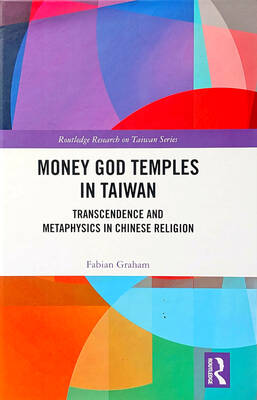
As someone who normally steers clear of books with “transcendence” or “metaphysics” in their subtitles, this reviewer — a casual observer of local belief systems since the 1990s — found Fabian Graham’s Money God Temples in Taiwan a challenging read. Those who’ve only dipped their toes into temple culture will likely need to parse several sections with special care if they’re to keep up with the author, a British ethnographic researcher whose previous books have investigated religious practices among ethnic Chinese in Southeast Asia. This scholarly volume examines a facet of Taiwan’s religious landscape that didn’t exist a century ago, and


 RSS
RSS