


Just who is Monica Yin’s (殷琦) multi-millionaire boyfriend? That’s the question buzzing through the blogosphere after writer-turned-host Kevin Tsai (蔡康永) broke the news of the relationship in an edition of Here Comes Kang and Xi (康熙來了) last month, in which Yi, one of the show’s guests, spent most of the time looking dumbfounded, while repeating, “I thought my mom and I were the only persons in the world who knew about it.”
For anyone who isn’t familiar with local showbiz tittle-tattle, Yin is a 28-year-old model from the Eelin Modeling Agency (伊林模特兒經紀公司). The starlet’s previous dalliances include a nine-month-long relationship with television producer and host Vincent Liang (梁赫群), which is often regarded as the highlight of her less-than-exciting entertainment career.
That is, until the rumored Mr Moneybags entered the picture. He is so rich, according to Kevin Tsai, that he could buy any television station he wanted, or take his model sweetheart out grocery shopping on his own aircraft.

Photo: Taipei Times
The dutiful paparazzi from the Apple Daily soon dug out tabloid rags published in July that reported on a “blind date” between Yin and Want Want China Broadband chairman Tsai Shao-chung (蔡紹中), the eldest son of Tsai Eng-ming (蔡衍明), who is the chairman of the Want Want Group (旺旺集團).
Fast-forward to Tuesday last week at the modeling agency’s weiya (尾牙), or year-end banquet. Both senior and junior Tsai attended the party, with the latter encircled by eager ladies. But Yin noticeably kept her distance.
“Do you really think Monica Yin lost the battle?” the Apple Daily quipped in an episode of News-in-Motion (動新聞) that featured Yin sitting next to Tsai Shao-chung at an afterparty at Spark.
However, the relationship may not all be smooth sailing for Yin if she wants to marry into her rumored sweetheart’s family. According to the Apple Daily, the 29-year-old Tsai has been going steady with a woman known as Vivi, and together they have a one-year-old son.
Yin denies her rumored affair with Tsai and has kept her mouth zipped after the revelation on Here Comes Kang and Xi. But gossip observers believe that if Tsai Shao-chung is really her latest lover, the model is not going to give him up without putting up a fight. After all, the man is an heir to a food and media empire that is reportedly worth more than NT$130 billion.
Speaking of dough, best-selling writer and film director Giddens Ko (柯景騰), better known as Jiubadao (九把刀 or “Nine Knives”), might have been quietly confident that his debut feature You Are the Apple of My Eye (那些年,我們一起追的女孩) would do well, but he probably didn’t foresee just how well.
On the last day of 2011, the romantic comedy broke box office records, previously held for seven years by Stephen Chow’s (周星馳) Kung Fu Hustle (功夫), to become the highest-grossing movie ever screened in Hong Kong, with ticket sales exceeding HK$61.2 million (NT$239 million). In China, the blockbuster grossed over NT$143 million three days after its theatrical release there on Friday last week.
But Jiubadao isn’t thrilled.
Thanks to China’s censors, several scenes that make up nine minutes of the movie were edited out. Apparently, things like masturbation and kissing are deemed unsuitable for general viewing in China. Also, the character Boner (勃起), has had his name changed to something more innocuous.
On his blog, the frustrated director said he was “a piece of shit who fails to keep promises” (一條爽約的大便).
“I always kept my promises,” he continued, “But this time, I didn’t. I am sorry ... I can’t promote a promise that I failed to keep, but I will calmly accept criticism.”
Ko was noticeably absent from a promotion event held in Shanghai earlier this month, but he flew into Beijing to meet fans on Monday. He said that he didn’t attend the event because he was upset about the deleted scenes.


Taiwan’s English education system is being pulled apart by three opposing forces. Bilingual Nation 2030 pulls students toward English and global communication. Artificial Intelligence (AI) readiness pulls them toward digital judgment, verification and AI-mediated work. But Taiwan’s old exam culture pulls them back toward memorization, grammar drills, timed reading and correct answers. If the education system keeps using old exams to define success, it risks producing graduates who are neither genuinely bilingual nor genuinely AI-ready, but trained for tasks machines can already perform. The first force is Bilingual Nation 2030. Launched in 2018, the policy aimed to “help Taiwan’s workforce connect

“Taiwan’s Opposition Leader Comes to US With a Message Straight Out of Beijing” read a May 31 headline in the Wall Street Journal. Top US administration officials and members of Congress almost certainly read the WSJ, and if there was a bullet point takeaway that people in Washington should absorb ahead of Chinese Nationalist Party (KMT) Chair Cheng Li-wun’s (鄭麗文) arrival in DC on June 9, that headline is it. The last few columns have discussed this very topic, and the timing is not coincidental. While those top officials likely do not read the Taipei Times, judging by the number
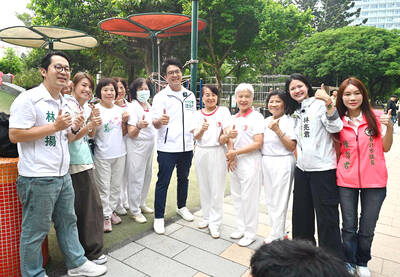
With weighty, anxiety-inducing geopolitical topics dominating the headlines, checking in on the wild and weird state of local politics can take some of the edge off. This November’s elections will determine who will be in charge of fixing potholes in your neighborhood, not the potholes in Taiwan’s complicated geopolitical space. Recently, after an online interview with a Taipei-based journalist, I commented that Taipei journalists never go further than the MRT can take them. He laughed and agreed. Naturally, the Taipei mayoral race is eating up much of the press attention. TAIPEI CITY Democratic Progressive Party (DPP) candidate Puma Shen (沈伯洋) has
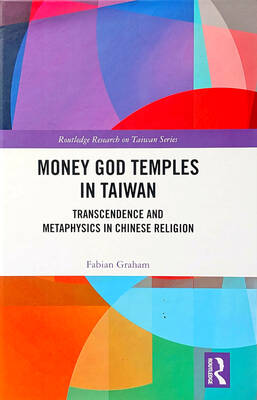
As someone who normally steers clear of books with “transcendence” or “metaphysics” in their subtitles, this reviewer — a casual observer of local belief systems since the 1990s — found Fabian Graham’s Money God Temples in Taiwan a challenging read. Those who’ve only dipped their toes into temple culture will likely need to parse several sections with special care if they’re to keep up with the author, a British ethnographic researcher whose previous books have investigated religious practices among ethnic Chinese in Southeast Asia. This scholarly volume examines a facet of Taiwan’s religious landscape that didn’t exist a century ago, and


 RSS
RSS