


It wasn’t actors and actresses grabbing headlines on this week’s entertainment pages, but rather Taiwanese films, which filled the nomination list for the 48th Golden Horse Awards.
Wei Te-sheng’s (魏德聖) Seediq Bale (賽德克‧巴萊) was at the top of the list with 11 nominations, including best picture and best director. The two-part Taiwanese epic has already raked in NT$470 million in ticket sales at the box office, according to the Apple Daily.
Two other homegrown hits, Jump Ashin! (翻滾吧!阿信) and You Are the Apple of My Eye (那些年,我們一起追的女孩) are also potential Golden Horse winners. Jump, whose lead actor Eddie Peng (彭于晏) is the only Taiwanese in the running for the best actor gong, picked up five nominations, while You Are the Apple bagged four.

Photo: Taipei Times
For the China Times, the nominations are heralding the “revival of the nation’s film industry” (國片復興). The paper noted that this year the Golden Horse axed its Most Outstanding Taiwanese Film Award because there is no longer any need. Locally produced movies these days are on a par with big-budget Hong Kong and Chinese movies, one Golden Horse judge was cited as saying.
And Taiwanese filmmakers are sticking to their guns when it comes to dealing with investors from China. According to the China Times, the producers of Seediq Bale decided to turn down funding from a Chinese investor who requested that Wei add the role of a journalist to the movie.
“I preferred to risk the NT$700 million, and besides, you can’t change history,” coproducer Huang Chih-ming (黃志明) told the China Times. “No compromises, that’s the Taiwanese spirit.”
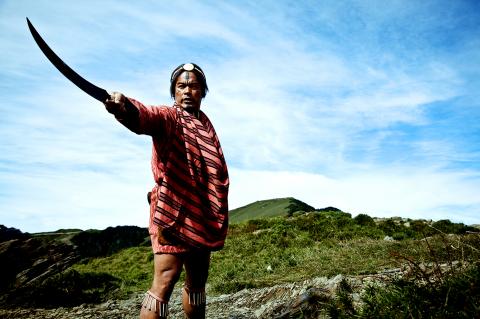
Photo: Taipei Times
Jump Ashin! director Lin Yu-hsien (林育賢) encountered a similar request from Chinese investors. Lin, whose movie is based on the life of his gymnast brother, was asked to change the story, in which Lin’s brother Ashin (林育信) flees his home in Yilan to hide in Taipei. The Chinese investor asked Lin to have his brother escape by boat to Xiamen instead.
Lin declined to make the change. “My brother would have killed me!” he said.
Another potential homegrown Golden Horse winner is actress Shu Qi (舒淇), who picked up a Best Actress Award nomination for her role in A Beautiful Life (不再讓你孤單).
According to the Apple Daily, she received the news on the phone from a gossip reporter, who greeted her by saying “Congratulations.” “What for?” she asked tartly. “I haven’t gotten married and I’m not pregnant.”
When the reporter broke the news of her nomination, she broke down in tears, and thanked director Andrew Lau (劉偉強). “I’m weeping bitter tears right now,” she said.
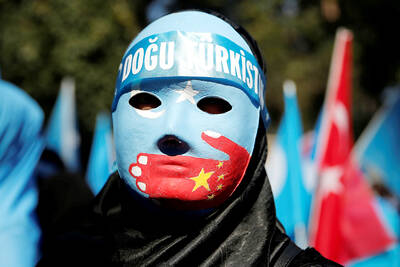
It seems every few days one bumps into one of those “real man” comments in which Taiwan is urged to “face reality” or similar, and “make a deal,” with the speaker implying that soon it will be too late. “Deal” advocates always present themselves as having a superior grip on reality, and the manly ability to make the “hard choice.” Their testosterone-laden language often echoes that of Taiwan sellout advocates. Note that such commentary always specifies a process (“make a deal, work with, make progress”), never the end state of what occupation by a violent authoritarian colonialist state will entail. In

There are shadowy cabals plotting to sell out Taiwan to be annexed by China, by invasion if necessary. Fortunately, they are buffoons. In 2019, former Bamboo Union gangster and founder of the China Unification Promotion Party (CUPP), Chang An-le (張安樂, colorfully known as “White Wolf”), led a protest at the Legislative Yuan against comments made by then-premier Su Tseng-chang (蘇貞昌) that in the event of an attack by China, he would never surrender, but would protect the nation by fighting to the end, even if he only had a broom. Chang had party members bring a wooden casket that they

Taiwan’s English education system is being pulled apart by three opposing forces. Bilingual Nation 2030 pulls students toward English and global communication. Artificial Intelligence (AI) readiness pulls them toward digital judgment, verification and AI-mediated work. But Taiwan’s old exam culture pulls them back toward memorization, grammar drills, timed reading and correct answers. If the education system keeps using old exams to define success, it risks producing graduates who are neither genuinely bilingual nor genuinely AI-ready, but trained for tasks machines can already perform. The first force is Bilingual Nation 2030. Launched in 2018, the policy aimed to “help Taiwan’s workforce connect
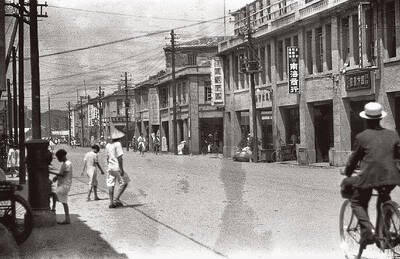
June 1 to June 7 "If all Taiwanese were as afraid of dying as you, then what would happen?” Physician Shih Chiang-nan (施江南) reportedly said this to his wife Chen Chiao-tung (陳焦桐) after she urged him to stop intervening on behalf of Taiwanese soldiers stranded overseas after serving in the Japanese Army during World War II. Shih had clashed with high-ranking officials over the issue, engaged in several heated arguments with Taiwan governor-general Chen Yi (陳儀) and allegedly shouted at general Ko Yuan-fen (柯遠芬), chief of staff of the Taiwan Garrison Command, over


 RSS
RSS