


Lee Chi-yuarn (李啟源) is a director who does not like to repeat himself. His Chocolate Rap (巧克力重擊, 2006) was a motivational hip-hop movie aimed at teens. In Beautiful Crazy (亂青春, 2008), he tried to capture the fluidity of time, memory and fleeting youth with non-chronological montages and enigmatic characters.
With Blowfish (河豚), Lee finally achieves a balance between style and content. Stripped down to a few dialogues and a seemingly effortless portrayal of everyday life, the love story between two lone souls is told through acute feelings and nuanced emotions, fine performances and a well-written script that Lee co-developed with the novice but talented actress Vicci Pan (潘之敏).
The story centers on Xiao-zhun (Pan), a young woman who works as an elevator operator at a department store. Like the service industry worker she is trained to be, Xiao-zhun is quiet, compliant and even manages to keep a polite smile on her face when catching her boyfriend in bed with another woman.
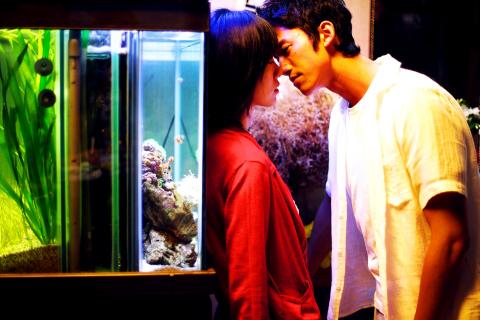
Photo Courtesy of Happy Pictures
Hoping to find a better home for her pet blowfish, Xiao-zhun sells it on an auction Web site. She delivers it herself and ends up having sex with the buyer (Wu Kang-jen, 吳慷仁) in his living room.
Xiao-zhun moves in with the stranger, a baseball coach in a small town who is waiting for the return of his wife, Flora (Angel Yao, 姚安琪), who has run away with another man. When the coach goes to work, Xiao-zhun likes to try on the colorful dresses that belong to Flora. She seems to enjoy her new life, even if she has to play the role of another woman.
The two live as husband and wife, and their feelings toward each other evolve. Finally one day, the coach wants to know the young woman’s real name.
Devoid of high-pitched drama and a narrative climax, the film often revolves around daily routines such as eating, sleeping and taking a bath. Camera movements are kept to a minimum, and the static cinematography by John Han (韓允中) helps to create a simple, pure space where the audience can enter the characters’ lives “without interruption,” to use the director’s words.
Lee uses the music of Yoshihiro Hanno, who first worked with the director on Beautiful Crazy, to similar ends as in the earlier film.
“His music is like natural elements,” the director told the Taipei Times. “They live around us, but we barely sense their existence. To me, it’s the best soundtrack ... I don’t want to tell the audience how to feel through music.”
The actors in Blowfish rely on body gestures and facial expressions to convey thoughts and feelings. Promising young actress Pan’s genuine portrayal of the taciturn and slightly odd Xiao-zhun belies the fact that this is her big-screen debut.
Lee’s confidence in his cast is apparent. Having taught acting classes at Taipei National University of the Arts (國立臺北藝術大學), the director is known for collaborating intensively with young actors. In the case of Xiao-zhun, Lee and Pan built the character together. They did not devise plots, but engaged in a game of role-playing, putting the character in different situations and imagining how she would react.
“It is a strange thing to say, but I don’t understand the characters I write. I don’t know which brand of toothpaste she uses. Is she a fast eater? Which hand does she use to eat noodles?” Lee said. “But if I work with an actor, I can understand the person well. I will know when she laughs or doesn’t laugh, the pitch of her voice and all kinds of details.”
Blowfish also approaches the characters’ amatory exploits in an intimate, tender manner that is rarely seen in Taiwanese cinema. Instead of flaunting flesh, the erotic scenes serve not only as a vehicle for sexual exploration but also as a medium through which changes in the characters’ relationship and attitude toward each other is manifested. To Lee, telling a story through sex scenes is much more challenging than merely exposing bodies.
“The actors didn’t cover themselves with anything during the shooting, because if they did, they would feel that they should be ashamed of their bodies,” the director said. “We shouldn’t waste energy on worrying about what things we can or cannot do. It is only after we throw away all these things that these two people can face each other truthfully.”
Lee doesn’t just want to explore what’s on the surface. With a master’s in psychology, he says he is interested in exploring what “is real on the inside.” This explains why the landscapes and settings in his films often assume a surreal, poetic significance like the atmospheric bathhouse in Blowfish or the junkyard next to a lotus pond in Beautiful Crazy.
When asked about his predilection for surrealism, Lee recalled his youthful days when he took photographs of his friends throwing petrol bombs on the streets during the Wild Lilies student movement (野百合學運) in 1990.
“There was chaos in the streets. I was running past the Lai Lai hotel [today’s Sheraton Taipei]. Inside, people enjoyed their afternoon tea in fancy dresses and suits. To me, that is how Taiwan is,” Lee said. “Two worlds exist in parallel but have no relevance to each other. People looking in from the outside find it absurd. But both worlds are real. Placing the two in juxtaposition makes them somewhat unreal.”
Real or unreal, Lee’s new film offers viewers the chance to look beyond the familiar and ordinary and glimpse the inner world of its quiet characters.
Ajay Verma, a consultant gastroenterologist at Kettering general hospital in Northamptonshire, says our gut is a “complex machine.” “It is constantly providing us with the nutrition we need, initially to grow and develop, and then for us to survive, thrive and repair from injury and illness.” How can we keep it functioning well? Put simply: “Make sure what you put into it is balanced, and that you clear out its waste products adequately,” Verma says. “In a general gastroenterology clinic, the most common conditions we see are irritable bowel syndrome (IBS), gastroesophageal reflux disease, inflammatory bowel disease and constipation,” says Nisha
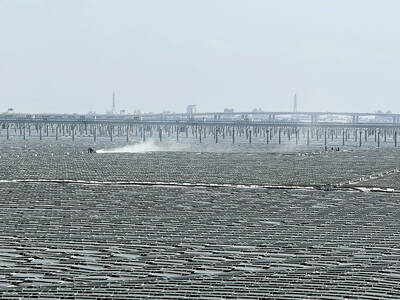
The arithmetic is straightforward and uncomfortable. By the end of 2025, Taiwan had committed itself to a 50-30-20 electricity mix — half natural gas, 30 per cent coal, 20 per cent renewables. The Ministry of Economic Affairs’s (MOEA) own monthly energy reports tell a different story. Natural gas reached 47.8 per cent of generation last year. Coal stood at 35.4 per cent, comfortably above its target ceiling. Renewables came in at 13.1 per cent, well short of the 20 per cent Taipei had pledged a decade earlier. Installed renewable capacity reached roughly half of the 12 gigawatts (GW) the government

Last week US President Donald Trump was asked by a reporter whether he would speak on the phone to the President of Taiwan. “l’ll speak to him. I speak to everybody. We have that situation very well in hand,” Trump said. This marked the second time in a couple of weeks he had said he would talk to the President of Taiwan. In 2016 he famously took a call from then-president Tsai Ing-wen (蔡英文), when he was president-elect. Despite warnings that the apocalypse was nigh because of a phone call, the world quickly forgot about the conversation between two democratically-elected presidents.

May 25 to May 31 Few believed that apples could be cultivated on a commercial scale in Taiwan’s high mountains. When horticulturalist Cheng Chao-hsiung (程兆熊) first proposed the idea in 1955, both American and Taiwanese colleagues dismissed it as implausible, arguing that temperate fruit could not be reliably grown on a subtropical island, especially on rugged terrain. However, it was this terrain in the Central Mountain Range where many Chinese Civil War veterans were resettled in the late 1950s. With limited job prospects and no family in Taiwan, they were placed on cooperative farms aimed toward self-sufficiency. Some say the conditions


 RSS
RSS