


Moments after sitting down at Jupin (聚品), which recently opened in a lane off Shida Road (師大路), our party of two realized that we should have heeded the first character, ju (聚), of the restaurant’s name. Meaning “to gather” or “to assemble,” the name hints at the fact the eatery is more suited to large parties than a lunch or dinner date.
We looked somewhat out of place with a three-generation family of nine chatting animatedly behind us and an office party of a dozen loudly guffawing in the semi-private back room. The menu features a number of reasonably priced set menus for large groups that averages out to roughly NT$300 per person.
For parties of fewer than four, Jupin has an extensive a la carte menu of cuisine hailing from Jiangsu Province (soft textures and light flavors) and Shanghai (stronger flavors and lots of sugar and alcohol).
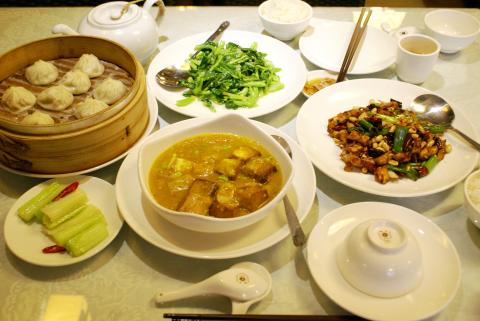
Photo: Noah Buchan, Taipei Times
Our on-the-house starter of celery marinated in rice vinegar, sesame oil, garlic and red chili peppers produced a tingling sensation on the taste buds and set a precedent for the interesting textures that were to follow. The Chinese kale stir-fry (芥藍菜, NT$150) was cooked in a delicious, light sauce, with generous portions of ginger and garlic offsetting the usual bitterness of the broccoli-like vegetable.
Diners who choose the stewed crab roe with soft tofu (蟹黃豆腐, NT$260) will not be disappointed. The large chunks of tofu are lightly seared before being added to the subtle crab roe stew. The side of rice I ordered specifically for this dish was not necessary, though I still added spoonfuls of the delicious stew to it anyway.
For those who like something a little spicy but don’t want to be too daring, the kungpao chicken (宮保雞丁, NT$260) is worth a try — its taste makes up for the small portion. Chunks of chicken, ginger, dried red chilies, peanuts and slices of leek aren’t so much cooked in a tasty XO sauce as they are caramelized in it.
The Shanghai-style soup dumplings (上海湯包, NT$120) were a little disappointing compared with those I’ve tried elsewhere. The filling consisted of pork and a little garlic. But rather than being savory, they were slightly sweet, and the flavor of the pork was a little too robust. Though perhaps an authentic Shanghai-style version of the dish, it could have used a little leek or cabbage. We should have listened to our server, who recommended the crab roe dumplings (蟹黃湯包, NT$160), which were sure to have been a hit if they are as delicious as the crab roe with soft tofu.
If you plan to visit Jupin, do so for dinner to best appreciate its artistically lit dining room. Black faux-lacquer walls and hanging lanterns with metal latticework designs lend the restaurant a traditional Chinese atmosphere.

Taiwan’s English education system is being pulled apart by three opposing forces. Bilingual Nation 2030 pulls students toward English and global communication. Artificial Intelligence (AI) readiness pulls them toward digital judgment, verification and AI-mediated work. But Taiwan’s old exam culture pulls them back toward memorization, grammar drills, timed reading and correct answers. If the education system keeps using old exams to define success, it risks producing graduates who are neither genuinely bilingual nor genuinely AI-ready, but trained for tasks machines can already perform. The first force is Bilingual Nation 2030. Launched in 2018, the policy aimed to “help Taiwan’s workforce connect

“Taiwan’s Opposition Leader Comes to US With a Message Straight Out of Beijing” read a May 31 headline in the Wall Street Journal. Top US administration officials and members of Congress almost certainly read the WSJ, and if there was a bullet point takeaway that people in Washington should absorb ahead of Chinese Nationalist Party (KMT) Chair Cheng Li-wun’s (鄭麗文) arrival in DC on June 9, that headline is it. The last few columns have discussed this very topic, and the timing is not coincidental. While those top officials likely do not read the Taipei Times, judging by the number
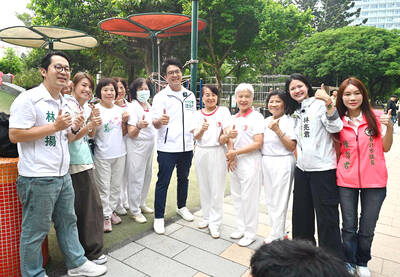
With weighty, anxiety-inducing geopolitical topics dominating the headlines, checking in on the wild and weird state of local politics can take some of the edge off. This November’s elections will determine who will be in charge of fixing potholes in your neighborhood, not the potholes in Taiwan’s complicated geopolitical space. Recently, after an online interview with a Taipei-based journalist, I commented that Taipei journalists never go further than the MRT can take them. He laughed and agreed. Naturally, the Taipei mayoral race is eating up much of the press attention. TAIPEI CITY Democratic Progressive Party (DPP) candidate Puma Shen (沈伯洋) has
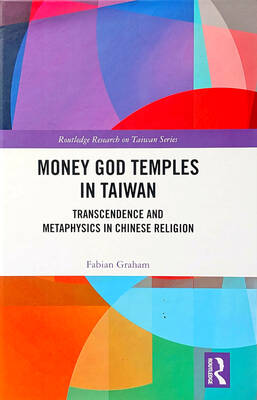
As someone who normally steers clear of books with “transcendence” or “metaphysics” in their subtitles, this reviewer — a casual observer of local belief systems since the 1990s — found Fabian Graham’s Money God Temples in Taiwan a challenging read. Those who’ve only dipped their toes into temple culture will likely need to parse several sections with special care if they’re to keep up with the author, a British ethnographic researcher whose previous books have investigated religious practices among ethnic Chinese in Southeast Asia. This scholarly volume examines a facet of Taiwan’s religious landscape that didn’t exist a century ago, and


 RSS
RSS