


Meeting Sofia Coppola is an enigmatic, opaque experience. As she discusses her new movie Somewhere, her first in four years, she is so level, so calm, with a gently modulated voice and that very American kind of untroubled socio-conversational gyroscope that stays on an absolute horizontal, imperceptibly humming through the conversation. Famously the daughter of Francis Ford Coppola, she already has an impressive body of work: The Virgin Suicides (1999), Lost in Translation (2003) and Marie-Antoinette (2006).
It was very much the second feature, a quirkily platonic, Tokyo-set romantic friendship between Scarlett Johansson and Bill Murray, which catapulted her into the big league, and established the Coppola name as a directing dynasty, in the way that Iran’s Samira Makhmalbaf carried on the reputation of her father, Mohsen. Her private life has not been without trouble: She married Spike Jonze in 1999; they were divorced four years later. Her partner now, with whom she has two children, is French musician Thomas Mars, front man of the band Phoenix. Her films, however, do appear to remind us more pointedly of that other important man in her life: her father.
This fourth film tells the story of a feckless, pampered movie star, Johnny Marco (played by Stephen Dorff), as he lives a luxurious, meaningless life in the Chateau Marmont hotel in Los Angeles; drifting as if on an inflatable in a Hockneyesque pool. Frequently boozing and womanizing, he is still often unhappily alone and, like a teenager in his bedroom, sometimes gets called down by the grownups to do publicity events for his latest action movie. In career and personal terms, he is on the verge of stagnation, but his life gets turned around when he has to look after Cleo (played by Elle Fanning), his 11-year-old daughter from a failed relationship.
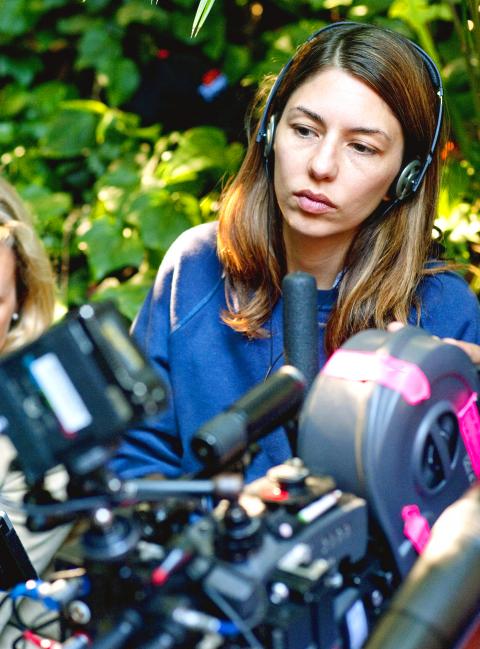
Photo: Bloomberg
When I meet Coppola during the Venice Film Festival, in a shady garden on the Lido, her untroubled gaze and easy, musical tone unmistakably reproduce the authorial tone of the film; she has a gentle, lilting tendency to uptalk and a semi-articulacy, like a super-intelligent version of Valley-girl speak. She is unjudging, pleasant, almost withdrawn, although cheerfully confesses to having a brain like “jelly” having gone through hour upon hour of interviews before I showed up.
I ask if doing things like this — exactly the kind of publicity junket experiences that she coleslaws together into ironic montages — feels like being inside her own film. Coppola smiles and laughs a little quizzically, as if at an unfamiliar thought: Throughout our conversation she affects to be surprised, albeit in the mildest possible way, by what seem to me the most screamingly obvious things. “Well, when I was watching the movie, I felt I was … in the movie!” she finally concedes, gently amused.
Coppola says that she wanted to make a film about celebrity and its alienated, alienating effects, because she had been away from the US, where the celeb cult is at its strongest. “I don’t feel it, because I’m not in public so much,” she says, “so it’s not something that I experience personally. There are all these problems in the press with all these actors having this party lifestyle …”
She continues: “I was living in Paris, and I was taking some time off after my daughter was born, and sometimes people would come over and bring these tabloids from the US. It’s not around in Paris, the way it is in America, this crazy obsession with celebrity, all these reality shows. I wanted to do something about this moment in our culture.”
Coppola adds that her film is not a satire, as such: “I wanted to be empathetic and not judgmental, not putting over a big message, but more thinking about what’s on the other side of all this?”
And how does she think Los Angeles comes across in the film? For example, that title, is it an allusion to Gertrude Stein’s remark about Oakland, California: “There is no ‘there’ there”? Coppola laughs, but says no. The title is inspired by the pop art paintings of Ed Ruscha, who produces billboard-style images of single words. Coppola now lives in New York, and has perhaps an East Coast detachment from California. “There are parts of it that I hate,” she shrugs, “all the strip malls; but there are nice parts. I lived in Los Angeles throughout my 20s; there wasn’t the same tabloid culture when I was there. Being famous now seems like a realistic goal for everybody. Everybody wants to be famous.”
I move the discussion on to the father-daughter relationship in Somewhere, and how it echoes the quasi-father-daughter relationship in Lost in Translation. How was it, making what was surely an obviously autobiographical movie? The question appears to disconcert Coppola, as if it had not occurred to her. For a moment I felt like the man in the Monty Python sketch who says to Mr Smoke-Too-Much that he must get jokes about his name all the time, and Mr Smoke-Too-Much replies that no one has ever done so before.
“Is this psychoanalysis?” she asks, smilingly. “Well, I didn’t think about that. The father relationship is an important relationship for girls and it figures in my work.” But is hanging out with her dad in hotels something that Sofia Coppola used to do, like Cleo in Somewhere?
“I definitely put a lot of memories of being around that age — from kid to teenager — and traveling with my dad, being in hotels and being in this adult world. He took us to places that kids don’t usually go. For example, when I was 16, we went to Cuba and met Fidel Castro. We went to Las Vegas and Reno. He usually wrote scripts in hotels there and I went with him. It’s your first important relationship as a girl and it shapes you, growing up; I wanted to show the importance of that relationship.”
And did her father have any advice or input into the work she did on Somewhere? Coppola nods. “I showed the final cut to him — I didn’t want to show the film to him before it was finished. I was happy that he really appreciated it. He told me that it felt like a movie that only I could have made. I used to show him rough cuts and get his advice. But now I have got more experience.”
She says that the filmmaker who inspires her most now is Gus van Sant — from whom she has taken ideas and also, importantly, the cinematographer Harris Savides, who works with Van Sant a good deal. Certainly, Coppola may be her father’s daughter in terms of confidence, but her filmmaking language has evolved a long way away from his; unlike a raft of male directors who have, consciously or not, imbibed his influence.
Somewhere may come to be seen as a minor, self-indulgent part of her body of work: an autobiographical jeu d’esprit, a mood piece, a movie conceived within a luxury hotel — a B-side to Lost in Translation that traces the charmed circle of celebrity without looking too deeply at what is within it. But her father is right. It could only have been made by her, and she is a distinctive individual film-making voice. In person, Coppola is charming, if disconcerting. As our conversation ended, and I was ushered away by her agent, that easy smile remained unchanged, its sphinxish reserve unchallenged.
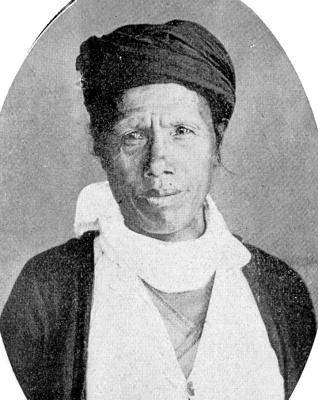
May 11 to May 17 Traversing the southern slopes of the Yushan Range in 1931, Japanese naturalist Tadao Kano knew he was approaching the last swath of Taiwan still beyond colonial control. The “vast, unknown territory,” protected by the “fierce” Bunun headman Dahu Ali, was “filled with an utterly endless jungle that choked the mountains and valleys,” Kano wrote. He noted how the group had “refused to submit to the measures of our authorities and entrenched themselves deep in these mountains … living a free existence spent chasing deer in the morning and seeking serow in the evening,” even describing them as

Yesterday, the Democratic Progressive Party (DPP) nominated legislator Puma Shen (沈伯洋) as their Taipei mayoral candidate, the Chinese Nationalist Party (KMT) put their stamp of approval on Wei Ping-cheng (魏平政) as their candidate for Changhua County commissioner and former legislator Tsai Pi-ru (蔡壁如) of the Taiwan People’s Party (TPP) has begun the process to also run in Changhua, though she has not yet been formally nominated. All three news items are bizarre. The DPP has struggled with settling on a Taipei nominee. The only candidate who declared interest was Enoch Wu (吳怡農), but the party seemed determined to nominate anyone
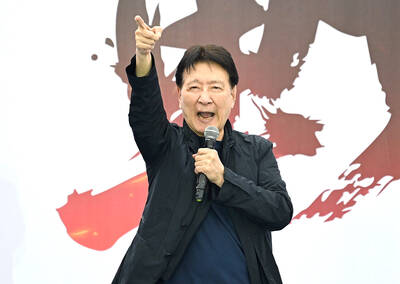
In a sudden move last week, opposition lawmakers of the Chinese Nationalist Party (KMT) and Taiwan People’s Party (TPP) passed a NT$780 billion special defense budget as a preemptive measure to stop either Chinese leader Xi Jinping (習近平) or US President Donald Trump from blocking US arms sales to Taiwan at their summit in Beijing, said KMT heavyweight Jaw Shaw-kong (趙少康), speaking to the Taipei Foreign Correspondents Club on Wednesday night in Taipei. The 76-year-old Jaw, a political talk show host who ran as the KMT’s vice presidential candidate in 2024, says that he personally brokered the deal to resolve
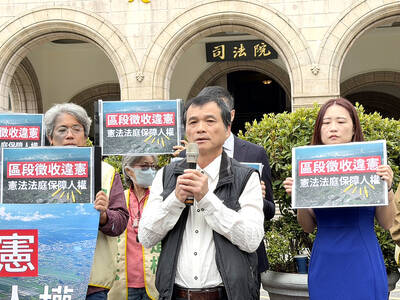
What government project has expropriated the most land in Taiwan? According to local media reports, it is the Taoyuan Aerotropolis, eating 2,500 hectares of land in its first phase, with more to come. Forty thousand people are expected to be displaced by the project. Naturally that enormous land grab is generating powerful pushback. Last week Chen Chien-ho (陳健和), a local resident of Jhuwei Borough (竹圍) in Taoyuan City’s Dayuan District (大園) filed a petition for constitutional review of the project after losing his case at the Taipei Administrative Court. The Administrative Court found in favor of nine other local landowners, but


 RSS
RSS