


Acclaimed for his Chinese ink paintings, which feature nude human forms set against scenes of sweeping landscapes, Yu Peng (于彭) is one of Taiwan’s most revered contemporary artists.
His latest exhibit, Yu Peng Painting and Calligraphy in Album Leaves: Solitariness in Mountain (于彭/冊頁書畫:獨坐孤山), runs until Aug. 8 at Taipei’s Chi-Wen Gallery (其玟畫廊).
It features seven new series of notebook-page-size ink paintings, a form known as “album leaves” (冊頁書). Album leaves are separate pages that can be assembled as a book with or without binding.
“I have painted in this format throughout my career, but this is the first exhibition to focus on my album leaves work,” Yu said at the show’s opening on July 3.
The exhibit is small in scope, but it features a medium rarely explored by other artists. It also showcases works created by an influential artist during some of his most relaxed moments on a portable canvas.
“I did these paintings everywhere, when I was at home and when I was out,” Yu said. “They were created at the spur of the moment, when I happened to be in a creative mood.”
The album leaves form of ink painting originated during the Tang Dynasty, when the “scroll book” form (捲軸書), a single long page that could be unfurled for viewing or rolled up for storage, was deemed too cumbersome.
Yu started out as a street artist at the age of 22 and taught himself woodblock painting, ceramics, watercolor and shadow puppetry.
When he was 26 he visited Greece.
“I went to Athens to see all the sculptures,” he said. “I didn’t see myself in those sculptures and decided to turn to China.”
He first visited China the same year, and this and subsequent visits influenced his painting style.
From 1997 to 2000, Yu worked in Shanghai, a period that resulted in his acclaimed Landscape of Desire (慾望山水) series. Yu calls it “an introspective series that reflects our desires. In contrast to the objective nudes in Western art, my nudes are a subjective contemplation of the inner world.”
In Yu’s art, what first looks like voyeurism becomes a Zen-like contemplation of basic human desires, a sensibility Yu says was influenced by his decades-long practice of meditation.
Whereas the nude in oil painting tends to celebrate the human body at its peak, Yu’s figures often include children and the elderly.
“I do nude paintings because I am, after all, a modern artist. Nudes are in the tradition of en plein air (in the open air, 寫生) paintings,” he said. “Being naked is a natural part of life. I want to depict humans in their most natural state.”


In late October of 1873 the government of Japan decided against sending a military expedition to Korea to force that nation to open trade relations. Across the government supporters of the expedition resigned immediately. The spectacle of revolt by disaffected samurai began to loom over Japanese politics. In January of 1874 disaffected samurai attacked a senior minister in Tokyo. A month later, a group of pro-Korea expedition and anti-foreign elements from Saga prefecture in Kyushu revolted, driven in part by high food prices stemming from poor harvests. Their leader, according to Edward Drea’s classic Japan’s Imperial Army, was a samurai

The following three paragraphs are just some of what the local Chinese-language press is reporting on breathlessly and following every twist and turn with the eagerness of a soap opera fan. For many English-language readers, it probably comes across as incomprehensibly opaque, so bear with me briefly dear reader: To the surprise of many, former pop singer and Democratic Progressive Party (DPP) ex-lawmaker Yu Tien (余天) of the Taiwan Normal Country Promotion Association (TNCPA) at the last minute dropped out of the running for committee chair of the DPP’s New Taipei City chapter, paving the way for DPP legislator Su
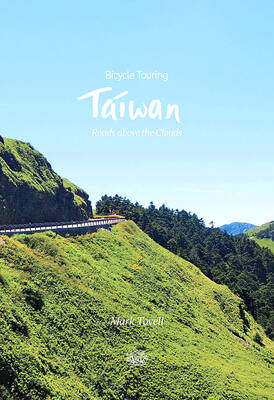
It’s hard to know where to begin with Mark Tovell’s Taiwan: Roads Above the Clouds. Having published a travelogue myself, as well as having contributed to several guidebooks, at first glance Tovell’s book appears to inhabit a middle ground — the kind of hard-to-sell nowheresville publishers detest. Leaf through the pages and you’ll find them suffuse with the purple prose best associated with travel literature: “When the sun is low on a warm, clear morning, and with the heat already rising, we stand at the riverside bike path leading south from Sanxia’s old cobble streets.” Hardly the stuff of your
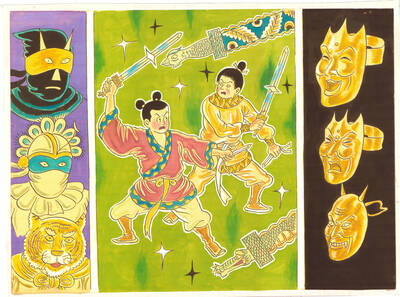
April 22 to April 28 The true identity of the mastermind behind the Demon Gang (魔鬼黨) was undoubtedly on the minds of countless schoolchildren in late 1958. In the days leading up to the big reveal, more than 10,000 guesses were sent to Ta Hwa Publishing Co (大華文化社) for a chance to win prizes. The smash success of the comic series Great Battle Against the Demon Gang (大戰魔鬼黨) came as a surprise to author Yeh Hung-chia (葉宏甲), who had long given up on his dream after being jailed for 10 months in 1947 over political cartoons. Protagonist




 RSS
RSS