


It would be harsh indeed to criticize Deutsche Grammophon for issuing in September what is in fact only a selection from the New York Metropolitan Opera’s 1983 Centennial Gala. The original event, starting in the early afternoon, lasted more than eight hours, and these two new DVDs are around half that length at 240 minutes. But the singers featured are so celebrated that it would be insanity to lament that this isn’t quite the whole original, massive undertaking.
The Met — as it’s called, even by itself — opened on Oct. 22, 1883. Exactly 100 years later, to the day, this extravaganza was staged, and telecast for anyone wanting to watch across North America. It’s hard to think of a top-rank opera soloist who didn’t take part — Birgit Nilsson, Montserrat Caballe, Joan Sutherland, Mirella Freni, Kiri Te Kanawa, Eva Marton, Leontyne Price, Marilyn Horne, Grace Bumbry, plus Pavarotti, Bruson, Carreras, Domingo, Kraus, Gedda, Raimondi, McCracken and very many others, all appeared. James Levine took the lion’s share of the conducting, but Leonard Bernstein also made a rare Met appearance to conduct a Beethoven overture.
So, what are the highlights, and what criticisms might be made? The only criticism really possible is that film of some of the famous older names, such as Caruso, might have been included, but no doubt this was considered and rejected on grounds of the time available. As for the highlights, there are almost too many to list.
Seeing Pavarotti billed as the last to appear, singing the love duet from Verdi’s Un Ballo in Maschera with Leontyne Price, I assumed this placing was on his insistence. It did feel like a climax, nonetheless, with both artists in resplendent voice. But there had been greatness before them — James McCracken returning to the Met to sing a devastating aria from Otello, Eva Marton with Turandot’s In Questa Reggia, but most of all Birgit Nilsson, by then aged 65, in a passage from Tristan und Isolde, followed by an unaccompanied Swedish folk song as a prepared encore.
Many of the singers were similarly close
to the end of illustrious careers, but who could possibly complain? What comparable talent would we have to show today? Very little. Those were the days, my friend, we thought they’d never end. But Pavarotti,
Nilsson, McCracken and Alfredo Kraus — all are now gone.
A collection of honorees appear sitting at the back of the stage halfway through the evening session. They’re American singers no longer able to participate, for the most part, and it might be instructive to note which of them applauds what, because some of them sit sternly with their hands in their laps at the conclusion of some of the items. Levine demonstrates his extraordinary involvement, visibly moved by Verdi, Puccini and Wagner.
This footage has been previously issued by Pioneer Classics, in a version castigated by at least one critic on Amazon.com. The content seems to be identical, but no one could now complain at the sound and visual quality of DGM’s magnificent offering.
It’s extraordinary what you can come across when casually browsing in a DVD store. I recently stumbled on a version of Mozart’s Die Zauberflote (The Magic Flute) from 1971, reissued by ArtHaus Musik in 2006. It was directed by the British author and TV personality of those days Peter Ustinov, and starred some exceptional soloists — Nicolai Gedda as Tamino, Hans Sotin as Sarastro, Dietrich Fischer-Dieskau in the small part of The Speaker, and Kurt Moll similarly hidden away as one of the Two Men in Armor.
The production is essentially a stage one, but adapted for a television studio. It’s colorful but simple, and heartfelt and lovable to a quite exceptional degree. Horst Stein conducts the Hamburg Philharmonic State Orchestra in a vivid accompaniment, and the chorus of the Hamburg State Opera completes the lineup.
Well, not quite completes. William Workman makes a memorably congenial Papageno, and, most remarkable of all, Cristina Deutekom is a very striking Queen of the Night. Her shining, razor-sharp tones are a wonder, and it’s no surprise to learn that she’d sung the same role at the Met three years earlier. The Mozart specialist Edith Mathis is Pamina.
This, in other words, was no hole-in-
the-corner, provincial production but a
major coming together of significant talents. Its reissue is typical of what dedicated European DVD publishers searching the archives can achieve.
The Newcastle-born superstar Sting has for a long time been incorporating music in the classical tradition into his music. His latest CD, If on a Winter’s Night ..., does indeed contain classically influenced tracks, notably an item from Purcell’s opera King Arthur, the last song from Schubert’s Winterreise and a song inspired by the Sarabande in Bach’s Sixth Cello Suite.
The essential ambiance, though, is of a group of friends playing acoustic instruments at Sting’s hidey-hole in Tuscany, accompanying songs celebrating winter. “There is something in winter that is primal, mysterious and profoundly beautiful,” Sting writes, “as if we need the darkness of the winter months to replenish our inner spirits as much as we need the light, energy and warmth of the summer.” The CD, incidentally, is manufactured in Taiwan.



In late October of 1873 the government of Japan decided against sending a military expedition to Korea to force that nation to open trade relations. Across the government supporters of the expedition resigned immediately. The spectacle of revolt by disaffected samurai began to loom over Japanese politics. In January of 1874 disaffected samurai attacked a senior minister in Tokyo. A month later, a group of pro-Korea expedition and anti-foreign elements from Saga prefecture in Kyushu revolted, driven in part by high food prices stemming from poor harvests. Their leader, according to Edward Drea’s classic Japan’s Imperial Army, was a samurai

The following three paragraphs are just some of what the local Chinese-language press is reporting on breathlessly and following every twist and turn with the eagerness of a soap opera fan. For many English-language readers, it probably comes across as incomprehensibly opaque, so bear with me briefly dear reader: To the surprise of many, former pop singer and Democratic Progressive Party (DPP) ex-lawmaker Yu Tien (余天) of the Taiwan Normal Country Promotion Association (TNCPA) at the last minute dropped out of the running for committee chair of the DPP’s New Taipei City chapter, paving the way for DPP legislator Su

It’s hard to know where to begin with Mark Tovell’s Taiwan: Roads Above the Clouds. Having published a travelogue myself, as well as having contributed to several guidebooks, at first glance Tovell’s book appears to inhabit a middle ground — the kind of hard-to-sell nowheresville publishers detest. Leaf through the pages and you’ll find them suffuse with the purple prose best associated with travel literature: “When the sun is low on a warm, clear morning, and with the heat already rising, we stand at the riverside bike path leading south from Sanxia’s old cobble streets.” Hardly the stuff of your
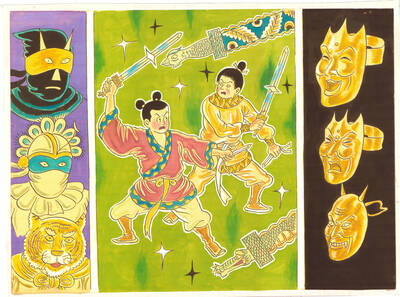
April 22 to April 28 The true identity of the mastermind behind the Demon Gang (魔鬼黨) was undoubtedly on the minds of countless schoolchildren in late 1958. In the days leading up to the big reveal, more than 10,000 guesses were sent to Ta Hwa Publishing Co (大華文化社) for a chance to win prizes. The smash success of the comic series Great Battle Against the Demon Gang (大戰魔鬼黨) came as a surprise to author Yeh Hung-chia (葉宏甲), who had long given up on his dream after being jailed for 10 months in 1947 over political cartoons. Protagonist


 RSS
RSS