


When Cai Guo-qiang (蔡國強) left his native China in 1986, he began a process of artistic development that would lead to his being recognized as one of world’s top artists.
Two years ago, he became the first living Chinese artist to be awarded a full retrospective at New York’s prestigious Guggenheim Museum, which later traveled to the Guggenheim in Bilbao, Spain, the two shows logging the considerable total of about 900,000 visitors between them.
Western critics have long lauded the 53-year-old artist for making art from traditional Chinese materials, especially gunpowder, which he’s used to create fireworks displays with a conceptual edge. His famous exploding oeuvre includes everything from an awe-inspiring circle of light that spun for half a minute 300m over New York’s Central Park in 2003, to tiny mushroom clouds at historical nuclear test sites throughout the western US in the mid-1990s and the celebratory footprint-shaped explosions that tracked across Beijing’s sky to open the 2008 Olympic Games.
At the Guggenheim exhibitions, these explosions were presented as videos and shown alongside a number of fantastical, large-scale installations — “exploding” cars suspended in midair, a work involving 100 taxidermy wolves, and others. Now, these have for the most part been transplanted to the Taipei Fine Arts Museum (TFAM) for the current exhibition “Cai Guo-Qiang: Hanging Out in the Museum” (蔡國強泡美術館), which opened on Nov. 21 and runs until Feb. 21.
In Taipei, however, attendance has been middling, and the exhibition has been plagued by a steady stream of criticism concerning issues of politics and funding. The most vehement and publicized attacks were directed at the relationship between Cai and president Ma Ying-jeou (馬英九). Ma’s two daughters, Leslie Ma (馬唯中) and Kelly Ma (馬元中), have worked for Cai for years as artist assistants in New York, and Ma gave what’s been called a “personal guided tour” of the exhibition at its opening.
Art professionals are, however, more worried about deeper changes of policy that have become conspicuous in Cai’s exhibit. The first complaint is a new quota system for showing Chinese art in Taiwan, which has been instituted in at least two of Taiwan’s top art museums. Secondly, Cai’s exhibition, though in a public museum, was largely curated and managed by a commercial entity, the Eslite Corporation, whose Eslite Gallery (誠品畫廊) sells Cai’s art in Taiwan. Many believe these trends of politicization and commercialization threaten to redefine the role museums play in Taiwanese society.
“What’s happening now is, on the one hand, a very obvious politicization of the institution, and this threatens local museums’ professionalism and neutrality,” said Manray Hsu (徐文瑞), who has been intimately involved with TFAM for over a decade as co-curator of the 2000 and 2008 Taipei Biennials.
“And at the same time,” continued Hsu, “you have a new commercial focus, which threatens the ‘public’ nature of these institutions in a different way. Basically, what the government now wants is for the museums to make money. In Cai’s show, you have both these things happening at the same time.”
A NEW CHINA QUOTA
Cai’s current exhibit could have easily come to Taipei on its own merits, but what troubles local art circles is that it was ushered in as part of a new, unannounced policy, by which Taiwan’s top two museums for modern art — TFAM and the National Taiwan Museum of Fine Arts (NTMFA) in Taichung — have each set quotas of two exhibitions a year “featuring Chinese artists.”
“Last year, our government’s entire mainland policy changed,” TFAM director Hsieh Hsiao-yun (謝小韞) told the Taipei Times. “It [the government] wants to aggressively pursue cultural exchange, so we at the museum are coordinating with this policy. Since last year, we opened up to cooperation with mainland museums and artists.”
When asked how long this quota will remain in place, Hsieh replied, “There is no time limit. It will continue from here on out.”
TFAM spokesperson Lu Li-wei
(盧立偉) further clarified that, “we never announced this in a press release. It was the director’s decision.”
NTMFA similarly implemented its policy shift without any official statement last year.
“The problem with a quota is that it makes holding these exhibitions a political decision. When art becomes a political tool like this, ideas of quality and professionalism become discounted,” said Hsu.
“If it’s a good exhibition, fine, have it. But deciding in advance, without any idea of the contents, that’s ridiculous,” he said.
High-ranking bureaucrats, however, support the quota. Taipei City Deputy Mayor and Culture Affairs Department Commissioner Lee Yong-ping (李永萍) defends the policy, explaining, “I feel that in the past, we’ve had too little of an understanding of the mainland. We’ve ignored [China] for too long. But now we need to face it.”
Before coming into the Taipei City Government as Chinese Nationalist Party (KMT) Mayor Hau Long-bin’s (郝龍斌) new culture czar in 2007, Lee was a KMT legislator. She described the roots of this Chinese art policy as stretching back to 2006, when Taiwan’s current President Ma Ying-jeou was Taipei mayor. Before that time, a trickle of non-official cultural exchanges across the Taiwan Strait had been gathering force since the detente of the 1980s. Most were in commercial galleries or group exhibitions. But 2006 saw the first ever direct exchanges between museums in China and Taiwan, when TFAM and the National Fine Arts Museum of China in Beijing each loaned over 100 paintings from their permanent collections for the post-political exhibitions “The Blossoming of Realism: The Oil Painting of Mainland China Since 1978” in Taipei and “1950-2000: The Odyssey of Art in Taiwan” in Beijing.
“Before Ma became president of the Republic of China, he already felt that we should move in this direction of comprehensive exchange and liberalization,” explained Lee.
“He used the platform of cultural exchange by the Taipei City Government to display the direction of cross-strait exchange policies,” she said.
When speaking of Ma, Lee readily admits, “we share the same ideology.” This is a belief that Taiwan’s future prosperity depends on both cultural and economic integration with China, and that Taiwan’s future is tied to its competitive position within the greater China market.
“In the past century, we’ve been dominated by America. This is to say, that you’re so Americanized, that so many of your cultural standards are American standards. But today, the whole world is turning around. It might be that, more or less, a Chinese standard is on the rise. Especially since we share the same heritage. To us, seeing an internationally well-received artist with a Chinese background, and giving people an understanding of him ... this is very important,” said Lee.
UNEQUAL EXCHANGE
Every year, TFAM and NTMFA each host about two-dozen exhibitions, of which four or five in each institution can be considered major exhibitions. At TFAM, few of these ever go to Taiwanese contemporary artists, who are generally consigned to exhibiting in the basement galleries.
Cai’s “Hanging Out in the Museum” is most certainly a major exhibition, taking up all of TFAM’s first floor galleries and a budget of around NT$80 million, more than double the cost of a typical Taipei Biennial, the museum’s flagship exhibition for contemporary art.
According to the new quota system, TFAM’s two annual China exhibitions will include one solo show by a major Chinese artist and one exchange with a Chinese museum. Last year, the solo show went to Fang Lijun (方力鈞), the internationally famous 56-year-old master of cynical realism. An exchange with the Shanghai Art Museum resulted in “The Story of Shanghai,” a somewhat bland history of the city in painting. As part of the exchange, works by around 50 Taiwanese artists will travel from TFAM to the Shanghai museum for an exhibition this June. (Cai’s show opened in November last year but is considered a 2010 exhibition.)
“I’m fine with the exchange exhibitions, and I support cross-strait exchange, but it has to be equal,” said Yao Jui-chung (姚瑞中), a 41-year-old local artist and pioneer of installation and conceptual art in Taiwan.
“But this is fake exchange,” he continued. “This is colonialist exchange. That’s the feeling I get.”
Yao and others are concerned that when it comes to solo shows, there is no reciprocity from China. While TFAM is purchasing works by Fang Lijun and is likely to purchase one or more from Cai, Chinese museums are neither giving Taiwanese artists prominent shows nor buying their art.
TFAM director Hsieh objects to such thinking, claiming that “many Taiwanese artists have shown in mainland museums.” The conditions in China, she nevertheless admits, are very different. “Mainland museums are not run the same way. Some mainland museums rent space, so if Taiwanese artists exhibit in the mainland, sometimes they have to pay the museums or give them their works,” she said.
Chinese limitations on expressive freedom are another concern. Yao, who photographed himself urinating on political monuments across both Taiwan and China, said one of his works was taken down at the Shanghai International Art Fair in 2007 and is highly doubtful about his prospects in China. Hsu similarly asks, “Under what situation can they exhibit Chen Chieh-jen (陳界仁), Taiwan’s most prominent international artist?” (Many of Chen’s videos and photos depict historical atrocities in Taiwan and China.)
Taiwanese officials, by contrast, never questioned Cai’s politics, though some of his largest commissions have come from the Chinese Communist Party.
“In addition to the Olympics, his Taipei exhibition was just one month after he did fireworks for the 60th anniversary of the People’s Republic of China. This is insane!” said Jun Yang (楊俊), an Austrian contemporary artist who has based himself in Taipei since his participation in the 2008 Taipei Biennial.
Taipei Deputy Mayor Lee discounted such thinking, saying, “There is a group of people, maybe on account of political ideology — they support Taiwanese independence — so they’re uncomfortable.”
“I think they’re supporting cultural protectionism,” she declared. “Cultural protectionism and economic protectionism are the same. The moment you adopt protectionism, you are no longer competitive. And when you’re not competitive, you die out.”
THE COMMERCIAL FACTOR
While collecting information for this article, one TFAM staffer asked me privately, “Don’t you think our relationship with the local contemporary arts community has gotten weaker in the last couple years? That’s the feeling I have.”
Beyond the new China quotas, an even more dramatic trend at TFAM and other museums has been a new commercial focus. Museums, which traditionally focused on public education and the development of local artists, are feeling pressure to host blockbusters, or what Yao likes to refer to as “super exhibitions.” These involve big budgets, heavy private sector sponsorship and lots of merchandizing.
At TFAM, the crowning example is “Pixar: 20 Years of Animation,” a survey of artwork from Pixar’s animated films that opened last year just around the release of the studio’s latest movie, Up. On the show’s strength, total visits to TFAM surged to 1.1 million in 2009, compared to a previous annual high of around 400,000.
“TFAM is not just for a minority group of artists. This is not its function,” explained Lee. “From the perspective of a government investment — and we invest a lot of money — are we providing a service to 400,000 people, or are we providing a service to 1.1 million people?”
“Let’s open Disneyland if you want numbers,” countered Yang. “Once you accept the numerical argument, then every other argument is dead. It’s no longer about quality or content.”
Because of the controversies surrounding Cai’s exhibition, it has not racked up huge statistics. But it is certainly part of the new breed of super exhibitions, and more than any other at TFAM to date, it has seen the museum surrender control of both exhibition content and management. Works were largely selected by Eslite, which contributed about NT$70 million of the exhibition’s NT$80 million budget. The company also handled advertising, off-site ticket sales and extensive merchandizing.
In a scathing review of the arrangement, art critic Chang Hsiao-hong (張小虹) wrote in the United Daily News that the exhibition “has turned the dignified Taipei Fine Arts Museum into an oversized Eslite Gallery.”
Hsu also believes there is a clear danger to the museum’s integrity.
“This is a way [for museums] to open the door to the art market, and say, ‘if you have money, you can do anything you want here,’” he said.


In late October of 1873 the government of Japan decided against sending a military expedition to Korea to force that nation to open trade relations. Across the government supporters of the expedition resigned immediately. The spectacle of revolt by disaffected samurai began to loom over Japanese politics. In January of 1874 disaffected samurai attacked a senior minister in Tokyo. A month later, a group of pro-Korea expedition and anti-foreign elements from Saga prefecture in Kyushu revolted, driven in part by high food prices stemming from poor harvests. Their leader, according to Edward Drea’s classic Japan’s Imperial Army, was a samurai
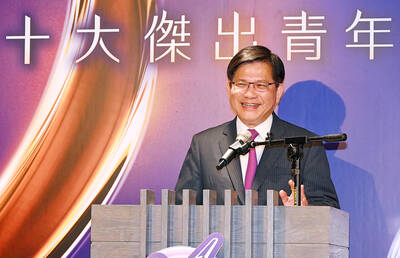
The following three paragraphs are just some of what the local Chinese-language press is reporting on breathlessly and following every twist and turn with the eagerness of a soap opera fan. For many English-language readers, it probably comes across as incomprehensibly opaque, so bear with me briefly dear reader: To the surprise of many, former pop singer and Democratic Progressive Party (DPP) ex-lawmaker Yu Tien (余天) of the Taiwan Normal Country Promotion Association (TNCPA) at the last minute dropped out of the running for committee chair of the DPP’s New Taipei City chapter, paving the way for DPP legislator Su
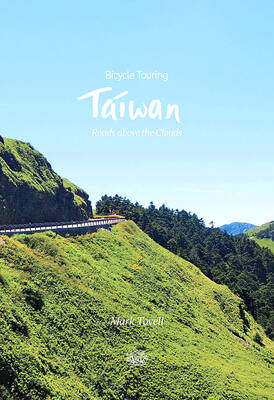
It’s hard to know where to begin with Mark Tovell’s Taiwan: Roads Above the Clouds. Having published a travelogue myself, as well as having contributed to several guidebooks, at first glance Tovell’s book appears to inhabit a middle ground — the kind of hard-to-sell nowheresville publishers detest. Leaf through the pages and you’ll find them suffuse with the purple prose best associated with travel literature: “When the sun is low on a warm, clear morning, and with the heat already rising, we stand at the riverside bike path leading south from Sanxia’s old cobble streets.” Hardly the stuff of your
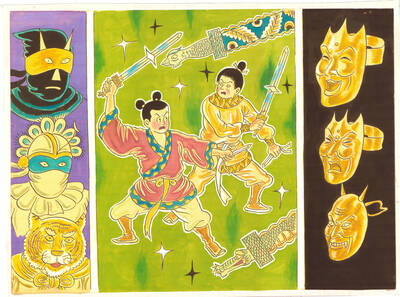
April 22 to April 28 The true identity of the mastermind behind the Demon Gang (魔鬼黨) was undoubtedly on the minds of countless schoolchildren in late 1958. In the days leading up to the big reveal, more than 10,000 guesses were sent to Ta Hwa Publishing Co (大華文化社) for a chance to win prizes. The smash success of the comic series Great Battle Against the Demon Gang (大戰魔鬼黨) came as a surprise to author Yeh Hung-chia (葉宏甲), who had long given up on his dream after being jailed for 10 months in 1947 over political cartoons. Protagonist


 RSS
RSS