


Popular TV host Hu Gua (胡瓜) and his ex-wife Hsiu Hsiu (秀秀) have been on frosty terms since their divorce nearly a decade ago, but the cold front may finally be dissipating.
The former couple’s daughter, Hu Ying-chen (胡盈禎), recently celebrated her birthday at a restaurant in Taipei’s East District (東區) with her mom and egregious plastic surgeon husband Lee Chin-liang (李進良). Hu Gua and his current love Ting Ro-an (丁柔安) were noticeably absent. Gossip reporters asked if the two were “afraid to show up” because of the long-standing tension between Hu Gua and Hsiu Hsiu. Hu Ying-chen explained that she planned to have dinner with her father and Ting soon. Her mother added, “if they are willing to invite me along, then I will go” — a statement Apple Daily called no less than “astonishing.”
Hu and Hsiu Hsiu divorced in 2001. He and Ting have recently been spotted dining with his daughter and her husband. But while the relationship between Hu’s daughter and his girlfriend appears cordial enough, gossip rags report that tension surfaced this summer when Ying-chen allegedly tried to engineer a reunion between her mother and father. At her birthday dinner, Ying-chen let slip that she wanted to celebrate with her mother first before meeting up with her dad and Ting.
Hsiu Hsiu, however, said she’d be happy to tag along to the second dinner, adding that “it’s been 10 years, what’s past is past.” When questioned by an Apple reporter, Hu Gua responded “of course” he’d be happy to see his ex-wife. Whether the reunion will come to fruition or if the two former spouses will just continue to play a game of telephone via gossip reporters remains to be seen.
While the focus this week was on the thawing of the cold war between Hu Ying-chen’s parents, Apple couldn’t help poking fun at husband Lee, who is currently on an enforced three-month sabbatical after being found guilty of illegally inserting silicone breast implants into a patient. Lee, who is also rumored to be a serial philanderer, looked a bit “high” at the party, the newspaper reported, with bright red, glazed-over eyes. When someone asked him how often he “fries rice” (炒飯), a euphemism for sex (presumably just with his wife), he replied giggling “twice a week!”
Far less open to publicity than the Hu family is Ady Ann (安以軒). The actress and singer once enjoyed a reputation for being a buttoned-down daddy’s girl, but has “unfolded like a peach blossom” with a series of alleged affairs, our sister newspaper the Liberty Times noted. Ann has been romantically linked to F4 member and actor Vanness Wu (吳建豪) and H. Brothers Media (華誼兄弟) head Wang Zhonglei (王中磊).
Two months ago, Ann was spotted strolling to a hot pot restaurant in heavy rain with a tall man who held an umbrella over her the entire way. A reporter saw the duo again last week while they were out shopping. “On closer inspection, it appears that Ann’s new boyfriend is Chinese Nationalist Party (KMT) Legislator Hsieh Kuo-liang’s (謝國樑) former aide, Chang Po-chin (張卜今),” wrote the Liberty Times. Upon learning that Chang’s identity had been uncovered, Ann wailed over the telephone to a reporter, “I’m going to cry now!
“We really are just friends. In the future, we might do business together,” she added through what the Liberty Times wrote sounded like tearful sniffling.
In addition to his political activities, Hsieh is known for his six-year relationship with Breeze Center (微風廣場) art director, Michelle Liao (廖曉喬), the sister of the luxury mall’s owner, and was recently photographed going home with a “hot chick” (辣妹) to “watch a DVD.” But Chang’s record now tops that of his former boss, the Liberty Times remarked. He is rumored to have had an affair with children’s television host and singer Momo Chu (朱安禹) while still a player with the Super Basketball League’s Yulon Dinos (裕隆恐龍).
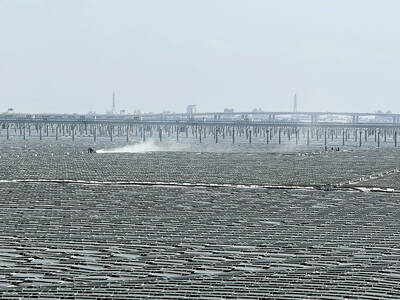
The arithmetic is straightforward and uncomfortable. By the end of 2025, Taiwan had committed itself to a 50-30-20 electricity mix — half natural gas, 30 per cent coal, 20 per cent renewables. The Ministry of Economic Affairs’s (MOEA) own monthly energy reports tell a different story. Natural gas reached 47.8 per cent of generation last year. Coal stood at 35.4 per cent, comfortably above its target ceiling. Renewables came in at 13.1 per cent, well short of the 20 per cent Taipei had pledged a decade earlier. Installed renewable capacity reached roughly half of the 12 gigawatts (GW) the government
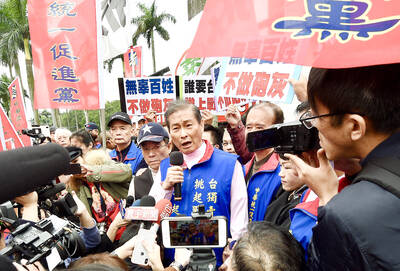
There are shadowy cabals plotting to sell out Taiwan to be annexed by China, by invasion if necessary. Fortunately, they are buffoons. In 2019, former Bamboo Union gangster and founder of the China Unification Promotion Party (CUPP), Chang An-le (張安樂, colorfully known as “White Wolf”), led a protest at the Legislative Yuan against comments made by then-premier Su Tseng-chang (蘇貞昌) that in the event of an attack by China, he would never surrender, but would protect the nation by fighting to the end, even if he only had a broom. Chang had party members bring a wooden casket that they
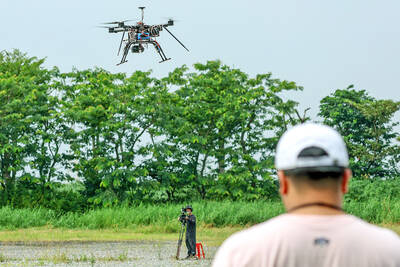
Taiwan’s drone exports are taking off, fuelled by the war in Ukraine, as Taiwanese companies seek a stake in the fast-growing global market for unmanned aerial vehicles (UAV). Low-cost drones used for reconnaissance and strikes are in high demand as governments around the world boost defense spending in the face of intensifying conflicts. A relative new player in the increasingly competitive industry, Taiwan’s pitch is to be an “Asian hub” for the production of UAVs and components free of Chinese materials, or “non-red.” That means its UAVs can be up to three times more expensive than their Chinese competitors, like the world’s biggest

It seems every few days one bumps into one of those “real man” comments in which Taiwan is urged to “face reality” or similar, and “make a deal,” with the speaker implying that soon it will be too late. “Deal” advocates always present themselves as having a superior grip on reality, and the manly ability to make the “hard choice.” Their testosterone-laden language often echoes that of Taiwan sellout advocates. Note that such commentary always specifies a process (“make a deal, work with, make progress”), never the end state of what occupation by a violent authoritarian colonialist state will entail. In


 RSS
RSS