


Pop Life is the most cunning show imaginable. I am tempted to call it artful. On the one hand it concerns itself with fame, fortune and the links between them from Warhol to Hirst, centering on artists who have used the mass media to create their own brand and persona. On the other, it is destined to be a surefire winner for Tate Modern, not to mention all the many collectors, artists and dealers involved, spinning money-minded art smoothly back into money under cover of historical scholarship.
Pop Life deserves to be a hit, though, because it tries so hard to get the genie back into the bottle — to distil, as far as possible, a whole chapter of modern times in which a particular kind of art turned itself into pure commodity.
So this is Andy Warhol selling two portraits for the price of one, his face to Vidal Sassoon and his reputation to Drexel Burnham Lambert. It is Jeff Koons turning his most famous steel sculpture — of a balloon — back into real balloon, 15m high and leasing it for PR purposes to Macy’s.
It is Takashi Murakami spreading his super-flat pop art all across the globe from art fairs and glossy magazines to actual shops. And not just art shops but branches of Louis Vuitton — where his bright logos sell the exorbitant handbags — and Tokyo 7-Elevens, where customers get a tiny plastic Murakami figure with their gum.
It is most certainly the gavel coming down on a Koons’ love heart for approximately 80 million times the price of similar gewgaws at an accessory store. The tales are legion, the headlines ubiquitous: what a pageant of greed, what an allegory of supply, demand, ingenuity, inflation, excess. The only problem is how to convey it in objects.
The first room at Tate Modern is a knock-out: Koons’ Rabbit (1986), that gleaming cast of an inflatable bunny that turns a balloon into a voodoo doll, horrifying yet inanely reflective; Andy Warhol’s terrific late self-portrait, a skull in a scarlet fright-wig bowing out into the darkness; Murakami’s appalling monument of a manga fantasy woman, teensy waist, colossal breasts spouting skipping ropes of milk as she sweetly smiles: the frightening potency of graphics emerging in three dimensions.
Each of these artists has a subsequent gallery — or three, in the case of Warhol, who surely deserves the space as patron saint of almost everything that follows.
The curators have aimed for period authenticity by reconstructing some eventful shows. Keith Haring’s Pop Shop, with its trademark wall drawings and its chiming till, has been recreated complete with fully operational shop. Nothing like the zip and register of the graphics, incidentally: insistently recognizable and undimmed by the years through the commercial ruse of timeless black and white.
Less arduous, at least in practical terms, is the exact facsimile of Richard Prince’s Spiritual America. This involved the rephotographing of Garry Gross’ infamous 1976 photograph for Playboy Press of a 10-year-old Brooke Shields wearing nothing but mascara. The frame is ornamental, the lighting low, the walls are red. These are the “quotation marks” in which Prince supposedly offers his state of the nation address.
Koons’ 1989 Made in Heaven show — soaringly, eye-poppingly gross — hasn’t been recreated in quite a while. That may have something to do with the anal sex, or the gigantically impractical sculpture of Koons straddling the porn star Ilona Staller on a rock; or perhaps it has something to do with the bitter end of their marriage.
That show — from the colorful billboard for a non-existent movie starring the lovers, to the unambiguous Ilana’s Asshole — was rejected by the art world, which felt Koons had taken exploitation too far. But it is instructive to read the reviews, which fastidiously avoid the noticeably hardcore porn.
Perhaps the art of those bad aesthetic times was prophylactically sealed against reality. Better to talk about provocation, institutional critique, the raising of consciousness, the way in which Koons always referred to high art — bling, but with added rococo — than the content. For what is the content, if not a poke in the eye?
Bright yet dark, shrewd yet vacuous: Koons’ art remains poised in equal tension. And when you get to Damien Hirst’s gallery full of gold calves in formaldehyde, gold spot paintings, gold vitrines dazzling with diamonds, it is no longer so obvious to whom he owes the greater debt: the production line of Koons or Warhol?
The British galleries of Pop Life give Tate Modern its first chance to show Hirst, Emin, Lucas, Gavin Turk et al as international history, which has the effect of deactivating their art. What were slick, rude, crude, epigrammatic, hilarious or willfully dumb now look like the artifacts of air-conditioned archives.
Not everyone will lament this, of course, but the Americans do generally get a better presentation. Warhol’s silkscreened gemstones are shown in ultra-violet light, Haring has a great rap sound track, Koons gets all the floodlight he could want. The show is buzzy, theatrical, densely jammed and much more of a blast than expected.
It is of course composed of fast art: nothing to detain you for long, though plenty to prime the post-show conversation. How quickly repetition set in as modus operandi: the series, the reiteration, the flogged horse, the running gag, the market-servicing multiple and edition. How often sex sold art, how often artists sold their looks, how indivisible art frequently seemed from prostitution, promotion and pornography.
And how empty the provocations often were — and still are.

In late October of 1873 the government of Japan decided against sending a military expedition to Korea to force that nation to open trade relations. Across the government supporters of the expedition resigned immediately. The spectacle of revolt by disaffected samurai began to loom over Japanese politics. In January of 1874 disaffected samurai attacked a senior minister in Tokyo. A month later, a group of pro-Korea expedition and anti-foreign elements from Saga prefecture in Kyushu revolted, driven in part by high food prices stemming from poor harvests. Their leader, according to Edward Drea’s classic Japan’s Imperial Army, was a samurai

The following three paragraphs are just some of what the local Chinese-language press is reporting on breathlessly and following every twist and turn with the eagerness of a soap opera fan. For many English-language readers, it probably comes across as incomprehensibly opaque, so bear with me briefly dear reader: To the surprise of many, former pop singer and Democratic Progressive Party (DPP) ex-lawmaker Yu Tien (余天) of the Taiwan Normal Country Promotion Association (TNCPA) at the last minute dropped out of the running for committee chair of the DPP’s New Taipei City chapter, paving the way for DPP legislator Su
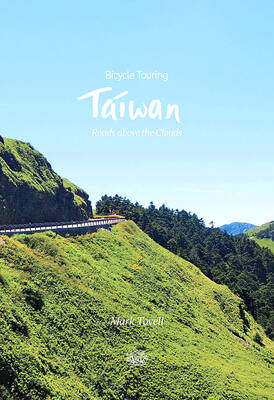
It’s hard to know where to begin with Mark Tovell’s Taiwan: Roads Above the Clouds. Having published a travelogue myself, as well as having contributed to several guidebooks, at first glance Tovell’s book appears to inhabit a middle ground — the kind of hard-to-sell nowheresville publishers detest. Leaf through the pages and you’ll find them suffuse with the purple prose best associated with travel literature: “When the sun is low on a warm, clear morning, and with the heat already rising, we stand at the riverside bike path leading south from Sanxia’s old cobble streets.” Hardly the stuff of your
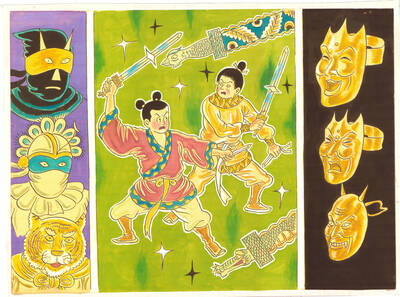
April 22 to April 28 The true identity of the mastermind behind the Demon Gang (魔鬼黨) was undoubtedly on the minds of countless schoolchildren in late 1958. In the days leading up to the big reveal, more than 10,000 guesses were sent to Ta Hwa Publishing Co (大華文化社) for a chance to win prizes. The smash success of the comic series Great Battle Against the Demon Gang (大戰魔鬼黨) came as a surprise to author Yeh Hung-chia (葉宏甲), who had long given up on his dream after being jailed for 10 months in 1947 over political cartoons. Protagonist


 RSS
RSS