


La Pietra del Paragone (The Touchstone) is one of Rossini’s earliest works. It was written when he was 20 and is now almost never performed. But the Chatelet Opera in Paris has come up with a groundbreaking version, using the ultimate in technology to create a truly bizarre stage — and now DVD — experience.
Split onstage screens are only the start of it. Characters and props fly through the air, are magnified or (most often) diminished, and the whole confection is served up as a chic, hi-tech, fey charade. The music is at times played very fast, and is fundamentally high-spirited anyway. But Rossini’s youthful exuberance and the ubiquitous French penchant for chic combine well. If you want to be amazed, without bothering too much about fundamental artistic quality, you will probably love this ultra-luxuriously-packaged pair of DVDs.
The innovative director is Pierrick Sorin, an installation artist who caught Paris’ eye with animated department store window-dressings that were apparently like theater themselves. He’s relocated the opera to the 1950s, and the singers trot about wearing the brightest of ultra-chic costumes and carrying glasses of champagne as the music clatters and chatters away. The whole thing goes off like a champagne bottle, with a fizzy bang.
But, being French, the participants must, in addition to all this chic, analyze their creation with a serious, focused intellectuality, and so a second DVD is provided filled with that sort of bonus material. You may not want to watch all of it.
Musically, though, it’s appropriately zestful, with the Ensemble Matheus under Jean-Christophe Spinosi combining with a cast vigorously led by contralto Sonia Prina. The final effect is less of opera than of animation using live human beings. It’s sung in Italian but, inexplicably, has only English subtitles.
A contrasting example, of a Rossini opera performed entirely traditionally, is his one-act La Cambiale di Matrimonio (The Marriage Contract) directed by Michael Hampe for the Schwetzinger Festspiele in 1989 (issued on DVD by EuroArts in 2006).
This was Rossini’s first ever operatic venture, produced when he was 18. A Canadian merchant is in Europe looking for a wife, and the joke is that he treats it all simply as a business arrangement in a way that was apparently seen as typical of Americans and Canadians at the time. But the plot switches and, after he’s been rejected, he saves the situation with his unaffected selflessness and goodness of heart.
It’s arguable that musiclovers will in the event re-watch this affectionate portrayal more often than they will the eye-catching Pietra del Paragone. Novelty doesn’t always win the day, even in France.
Paul Hindemith’s opera Cardillac is, at 88 minutes, also short. It was something of a sensation when it was first produced in 1926, but then it largely disappeared from view, despite the composer issuing a revised version of the score in 1952. It was revived in 1985 by the celebrated opera director Jean-Pierre Ponnelle who staged it as far as possible in the “expressionist” style of its first production. Deutsche Grammophon then issued a DVD of Ponnelle’s production in 2007.
Expressionism involves larger-than-life effects — masks, grotesque scenery and costumes, plus dramatic and non-naturalistic lighting. The style characterized early, silent cinema but has had a lasting influence on pop videos — far more so than the muted, atmospheric, unsensational “impressionism” with which its name sets it in contrast.
The opera’s story is set in 17th-century Paris and involves a mysterious jeweler, Cardillac, who commits a series of murders, each centered around a priceless artifact he has created. Fear and fascination are carefully balanced, however, and Cardillac’s death at the end (lynched by the crowd) isn’t entirely a cause for relief.
The cast is led by the veteran Wagnerian baritone Donald McIntyre (the Wotan in the 1976 Boulez/Chereau Ring cycle). The music is a great deal more dramatic and vigorous than might be expected from a composer often considered avant-garde, and the result is a strong DVD experience.
Finally, the Berlin Philharmonic has become involved in an interesting venture. It’s now possible to watch all its concerts live, or as part of a digital archive. There’s a catch, of course, in the form of a subscription — US$213 for a year, US$56 for 30 days, or US$14 for a single concert (live or from the archive).
The live performances are not instantly attractive in Asia because of the time difference — they mostly take place in the early hours of our mornings. But the uptake has been strong in the region, with Japan accounting for 13 percent of all subscribers, second only to those from Germany itself. There are tours on the orchestra’s Web site in Chinese, Japanese and Korean, and clearly a strong following from these population areas is anticipated.
Full details of the scheme are available on these two sites: dch.berliner-philharmoniker.de and dch.berliner-philharmoniker.de/#/en/prices/tickets. The Berliners’ next concert, featuring Haydn’s The Seasons, is on Wednesday at 8pm Berlin time. It will be conducted by Simon Rattle, with soloists Thomas Quasthoff, Christiane Oelse and John Mark Ainsley.

In late October of 1873 the government of Japan decided against sending a military expedition to Korea to force that nation to open trade relations. Across the government supporters of the expedition resigned immediately. The spectacle of revolt by disaffected samurai began to loom over Japanese politics. In January of 1874 disaffected samurai attacked a senior minister in Tokyo. A month later, a group of pro-Korea expedition and anti-foreign elements from Saga prefecture in Kyushu revolted, driven in part by high food prices stemming from poor harvests. Their leader, according to Edward Drea’s classic Japan’s Imperial Army, was a samurai

The following three paragraphs are just some of what the local Chinese-language press is reporting on breathlessly and following every twist and turn with the eagerness of a soap opera fan. For many English-language readers, it probably comes across as incomprehensibly opaque, so bear with me briefly dear reader: To the surprise of many, former pop singer and Democratic Progressive Party (DPP) ex-lawmaker Yu Tien (余天) of the Taiwan Normal Country Promotion Association (TNCPA) at the last minute dropped out of the running for committee chair of the DPP’s New Taipei City chapter, paving the way for DPP legislator Su
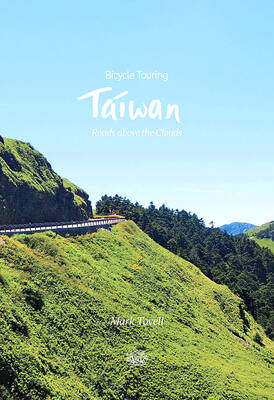
It’s hard to know where to begin with Mark Tovell’s Taiwan: Roads Above the Clouds. Having published a travelogue myself, as well as having contributed to several guidebooks, at first glance Tovell’s book appears to inhabit a middle ground — the kind of hard-to-sell nowheresville publishers detest. Leaf through the pages and you’ll find them suffuse with the purple prose best associated with travel literature: “When the sun is low on a warm, clear morning, and with the heat already rising, we stand at the riverside bike path leading south from Sanxia’s old cobble streets.” Hardly the stuff of your
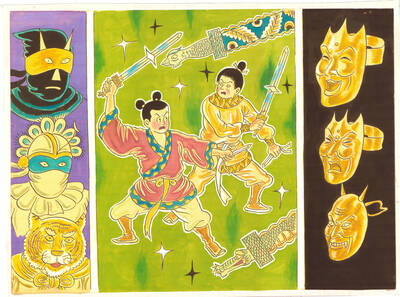
April 22 to April 28 The true identity of the mastermind behind the Demon Gang (魔鬼黨) was undoubtedly on the minds of countless schoolchildren in late 1958. In the days leading up to the big reveal, more than 10,000 guesses were sent to Ta Hwa Publishing Co (大華文化社) for a chance to win prizes. The smash success of the comic series Great Battle Against the Demon Gang (大戰魔鬼黨) came as a surprise to author Yeh Hung-chia (葉宏甲), who had long given up on his dream after being jailed for 10 months in 1947 over political cartoons. Protagonist


 RSS
RSS