


Adam Lepak looked over at his mother and said, “You’re fake.”
It was a Tuesday late last month, and Cindy Lepak could see that her 19-year-old son was exhausted. Long days like this one, with hours of physical therapy and memory drills — I had a motorcycle accident, I hit my head and have trouble remembering new things, I had a motorcycle accident — often left him making these accusations.
“What do you mean ‘fake,’ Adam?” she said.
He hung his head. “You’re not my real mom,” he said. His voice changed. “I feel sorry for you, Cindy Lepak. You live in this world. You don’t live in the real world.”
Doctors have known for nearly 100 years that a small number of psychiatric patients become profoundly suspicious of their closest relationships, often cutting themselves off from those who love them and care for them. They may insist that their spouse is an impostor; that their grown children are body-doubles; that a caregiver, a close friend, even their entire family is fake, a duplicate version.
Such delusions are often symptoms of schizophrenia. But in the last decade or so, researchers have documented similar delusions in hundreds of people who are not schizophrenic but have neurological problems including dementia, brain surgery and traumatic blows to the head.
A small group of brain scientists is now investigating misidentification syndromes, as the delusions are called, for clues to one of most confounding problems in brain science: identity. How and where does the brain maintain the “self”?
What researchers are finding is that there is no single “identity spot” in the brain. Instead, the brain uses several different neural regions, working closely together, to sustain and update the identities of self and others. Learning what makes identity, researchers say, will help doctors understand how some people preserve their identities in the face of creeping dementia, and how others, battling injuries like Adam’s, are sometimes able to reconstitute one.
“When I wrote up my first case like this back in 1987, no one was much interested; it was a curiosity,” said Todd Feinberg, a neurologist and psychiatrist at the Albert Einstein College of Medicine and Beth Israel Medical Center, who has just published a book on the topic, From Axons to Identity. (Axons are nerve fibers.)
“Now there’s an explosion of interest in these cases,” Feinberg said, “because of their relation to the self, to the neurobiology of identity — to what it means to be human.”
WHO IS THAT?
“Who is that, Adam?” a physical therapist named Mike said on a recent morning, supporting the young man’s lean frame in front of a full-length mirror; a nurse supported him from the other side. “Who do you see there?”
“Mike.”
“That’s right,” said Pat Taisey, the nurse, who spends most days with him at home when the Lepaks are at work. “But who else do you see in the mirror, Adam?”
“You. Pat.”
“Yes, but who else?” she said.
An uncertain smile creased Adam’s face.
Two years ago it was not a hard question to answer. He was a first-year college student with a girlfriend, a tight group of buddies. A vegetarian, a fitness nut, a master of sarcasm, of the lunatic prank. He was the drummer for Sacred Pledge, a “straight edge” band (no drugs, no alcohol, no promiscuous sex) that was breaking into the hard-core scene in the Syracuse area.
After his senior year of high school in Weedsport, he climbed into a van and drove with the band across the country, playing clubs and parties, sleeping on people’s floors, Dumpster diving for food, sleeping on the beach in California.
“I was so happy we let him go,” Cindy Lepak said. “He decided that that life wasn’t for him.” He enrolled at Cayuga Community College in nearby Auburn.
He was running late to class on an October morning in 2007, flying over a slight rise on Weedsport Sennett Road on the family’s Honda Interceptor motorcycle, when he saw — too late — a car in his lane, stopped to make a turn. He dodged the car; he was wearing a helmet, but he lost the bike and tumbled hard over the asphalt. He spent most of the next six months in a near-vegetative state, mute and virtually immobile.
The diagnosis was diffuse axonal injury. “The textbook definition is essentially a blow that shuts down the bundle of wires responsible for keeping us conscious,” said Jonathan Fellus, a neurologist at Kessler Institute for Rehabilitation in West Orange, New Jersey, who has overseen Adam’s gradual recovery. “It’s as if the major highways have taken a hit, and now the brain has to use back roads to function. But every brain responds differently. I have given up making predictions.”
Researchers who have taken images of the brain as it processes information related to personal identity have noticed that several areas are particularly active. Called cortical midline structures, they run like an apple core from the frontal lobes near the forehead through the center of the brain.
These frontal and midline areas communicate with regions of the brain that process memory and emotion, in the medial temporal lobe, buried deep beneath each ear. And studies strongly suggest that in delusions of identity, these emotion centers are either not well connected to frontal midline areas or not providing good information. Mom looks and sounds exactly like Mom, but the sensation of her presence is lost. She seems somehow unreal.
The classic delusion of identification is called Capgras syndrome, after the French psychiatrist Jean Marie Joseph Capgras, who with Jean Reboul-Lachaux described in 1923 the case of a 53-year-old patient “who transformed everyone in her entourage, even those closest to her, such as her husband and daughter, into various and numerous doubles.”
In an analysis of such cases published in January in the journal Neurology, Orrin Devinsky, a neurologist at New York University, documented that people with the delusion typically have more damage to their right hemisphere than their left. Linear reasoning and language tend to be predominantly left-hemisphere functions, while holistic judgments — of intonation, of emphasis — tend to be processed more in the right. Devinsky argues that when people lack a familiar emotional glow in the company of a parent or loved one, the left hemisphere, unchecked by a damaged right, resolves the conflict with its categorical logic. The person must be an impostor.
“And if you have other damage in the cortical areas that check reality, that make judgments about what’s right and wrong, then you have no way to correct that error,” Devinsky said.
On good days, like that morning in physical therapy, Adam’s emotional centers appeared to be joining the working circuits of his brain. After a couple of moments staring at his image in the mirror, his smile changed from uncertain to mischievous and he answered the therapists’ question.
“Me?” he said.
BROTHER, FRIEND AND SON
After the accident, Adam’s younger brother, Nick, helped out as much as he could, and one way to do that, experts say, is simply to act like a brother again. Nick did his best.
“I got him down on the floor in the kitchen the other day, and held an ice cube over his head and let it drip on his forehead; kind of a Chinese water torture thing,” Nick said. “He went crazy, he was so mad. He had a great day after that, though.”
No one knows what treatments or exercises will drive an injured brain to preserve or reconstruct a coherent identity — to pave its neural back roads. But neuroscientists generally agree that it can so do. The brain is “plastic,” recent research suggests; intact areas can recruit nearby, healthy brain tissue to bypass damage and compensate for lost function.
It does not seem to happen, however, without effort; to reroute signal traffic down back channels, the brain needs traffic, scientists say. It needs to be active, solving problems, meeting social expectations.
For people recovering from a severe brain injury, several recent experiments suggest that there is some promise in hitting it hard with what it has lost, contact with its familiar social environment. In one 2005 brain imaging study, neuroscientists in New York found that the sound of a loved one’s voice activated widely distributed circuits in the brains of two severely brain-injured patients who were only occasionally able to respond to commands. Last year, a team of Spanish neuroscientists duplicated the finding.
In studies of dementia, researchers have found that some people who are lucid until a very old age have brains that appear riddled with Alzheimer’s disease. Many of them remain social to the end, engaged in regular card games or debates with friends who make mental demands of them.
During his first six months at Kessler in New Jersey, as he lay mute, Adam heard many familiar voices. His mother was at his side every day; his father made the four-hour drive from New York every weekend. His girlfriend, Sarah Huey, visited with her mother every other weekend. His friends came in groups. In time he began to move his thumb in response to questions and commands — a sure sign that he had entered a minimally conscious state, a necessary transition to recovering full conscious awareness. “It was very tough at the beginning,” said his father, Mike Lepak. “You just hope you can somehow jump-start his brain.”
At home he has experienced another kind of familiarity and begun to walk, unsteadily, and talk, so far in brief sentences. His mother has handled much of the hard labor of caring for him at home: memory drills, the constant questions, the hiring of daytime care, haggling with insurers. The Lepaks have made do with a combination of private insurance and state and federal aid. His father built a small addition to the house to make it easier for Adam to navigate; he still spends much of his time in a wheelchair.
Yet as much as possible, the people in his life have begun to treat him like Adam. “I figure this is my opportunity to get back for all the stuff he did to me,” Nick said. “He’s my brother.”
His friends frequently drop by and take him out to get lunch, to crack him up.
Sitting around the dining room table on a recent afternoon, eight of them told stories about the years just before the accident. The center of attention seemed sullen at first. He stirred after hearing a few familiar stories. The one about nabbing bags of stale doughnuts from a local coffee shop and whipping them at taxis. The time he knocked a friend off a chair with a well-placed firecracker. The laughter escalated with each story, Adam showed a smile, and then, after a while, the group grew quiet.
“You got a story, Adam?” said one friend, Sean Steinbacher.
“Yeah, speak up,” said another, Shane DiRisio. He was not kidding. “What’s wrong with you, Adam? You don’t have a story?”
He did not. He had a comment. He looked up at them affectionately. “These guys,” he said with a smile, “all suck.”
STARTING OVER
Feinberg sees delusions of identification as primitive psychological defenses, as a result of injuries in the right frontal lobes that most such patients are struggling with. Such defenses include denial that a disability exists, the projection of the problem onto others or the fantasy that daily life is somehow unreal.
“These are the defenses of a child of age 3 to 8,” Feinberg said. “But it’s important to understand that these defenses are a positive adaptation. The brain is fighting for survival.”
The ability to inhibit those defenses, to understand that not everyone shares them, is evidence that the frontal areas of the brain are coming back online, he said.
In recent weeks, Adam has been having fewer and fewer delusions. On an hourlong drive last month to a ranch in Groton, New York, that offers horseback riding for people with disabilities, Adam’s mind was churning. “Ma,” he asked repeatedly. “What happened to me?”
“You tell me, Ad,” his mother said at one point. “You just told me a minute ago. You know what happened. You know.”
“I don’t want to tell you,” he said.
“Why not?”
“Because you’ll think I’m crazy,” he said.
“No I won’t. Tell me.”
“No,” said Adam Lepak, and he looked out the window for a while, seemingly lost in thought.
“Ma?” he said, still staring out the window.
“Yes, Ad.”
“I think I had a motorcycle accident.”

In late October of 1873 the government of Japan decided against sending a military expedition to Korea to force that nation to open trade relations. Across the government supporters of the expedition resigned immediately. The spectacle of revolt by disaffected samurai began to loom over Japanese politics. In January of 1874 disaffected samurai attacked a senior minister in Tokyo. A month later, a group of pro-Korea expedition and anti-foreign elements from Saga prefecture in Kyushu revolted, driven in part by high food prices stemming from poor harvests. Their leader, according to Edward Drea’s classic Japan’s Imperial Army, was a samurai

The following three paragraphs are just some of what the local Chinese-language press is reporting on breathlessly and following every twist and turn with the eagerness of a soap opera fan. For many English-language readers, it probably comes across as incomprehensibly opaque, so bear with me briefly dear reader: To the surprise of many, former pop singer and Democratic Progressive Party (DPP) ex-lawmaker Yu Tien (余天) of the Taiwan Normal Country Promotion Association (TNCPA) at the last minute dropped out of the running for committee chair of the DPP’s New Taipei City chapter, paving the way for DPP legislator Su

It’s hard to know where to begin with Mark Tovell’s Taiwan: Roads Above the Clouds. Having published a travelogue myself, as well as having contributed to several guidebooks, at first glance Tovell’s book appears to inhabit a middle ground — the kind of hard-to-sell nowheresville publishers detest. Leaf through the pages and you’ll find them suffuse with the purple prose best associated with travel literature: “When the sun is low on a warm, clear morning, and with the heat already rising, we stand at the riverside bike path leading south from Sanxia’s old cobble streets.” Hardly the stuff of your
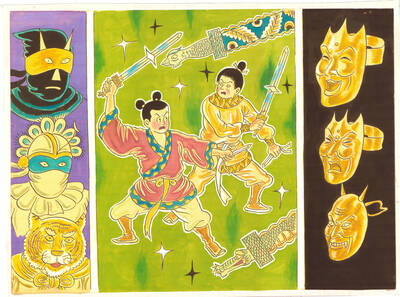
April 22 to April 28 The true identity of the mastermind behind the Demon Gang (魔鬼黨) was undoubtedly on the minds of countless schoolchildren in late 1958. In the days leading up to the big reveal, more than 10,000 guesses were sent to Ta Hwa Publishing Co (大華文化社) for a chance to win prizes. The smash success of the comic series Great Battle Against the Demon Gang (大戰魔鬼黨) came as a surprise to author Yeh Hung-chia (葉宏甲), who had long given up on his dream after being jailed for 10 months in 1947 over political cartoons. Protagonist


 RSS
RSS