


No single development has had as great an impact on how we live today than the microchip. The world’s military powers seized on the immense potential of computers to refine the art of war, which became more precise and deadlier: whoever took the lead in the technological arms race gained an advantage.
In one instance, however, computer technology became a deterrent against the folly of warfare. Small enough to fit in the palm of the hand, the computer chip guaranteed Taiwan’s survival.
So argues Craig Addison in his documentary Silicon Shield: Two Chinas, One World. More so than any other flash point across the globe, the Taiwan Strait exemplifies how the semiconductor has not only made our world smaller, but changed the nature of warfare forever — and not for the reasons you might think.
For the 25 years after the Chinese Nationalist Party (KMT) scrambled across the Taiwan Strait following its defeat to the Communists in 1949, the focus of the many academics, diplomats and military experts who tackled the question of Taiwan was on how, through conventional balance-of-power means, war could be averted. Weapons were sold, alliances pitting the “free world” against a seemingly communist front were made, and the world held its breath as the brinkmanship of Chiang Kai-chek (蔣介石) and Mao Zedong (毛澤東) threatened international security, more so after China successfully detonated its first nuclear device in October 1964.
Gradually, as the People’s Republic of China (PRC) gained diplomatic recognition, the isolation of the Republic of China on Taiwan (ROC) became increasingly acute.
GOING ELECTRONIC
Seeing the writing on the wall and understanding that isolation exacerbated the threat to the ROC’s survival, the government in Taipei launched an initiative in the 1970s to turn Taiwan’s mostly labor-intensive industrial base into a high tech one. This achievement, which through interviews with key participants and historical footage Silicon Shield outlines with brio, would not have been possible without the dedication of former premier Sun Yun-suan (孫運璿), who spearheaded the initiative and sought help from overseas Taiwanese. Top engineers and scientists, among them Pan Wen-yuan (潘文淵), were brought back to Taiwan to brainstorm about the future of the country. In a matter of days, Pan elaborated a strategy that would spawn an economic miracle.
In 1976, Taiwan sent a team of young, bright Taiwanese to the US to study the nascent field of semiconductors and bring back the know-how. That same year, US electronics manufacturer RCA licensed its 7-micron metal oxide semiconductor (MOS) process (which lagged about a decade behind the most advanced technology at the time) to Taiwan for US$3.5 million. This was a huge gamble and Sun put his career on the line when detractors criticized the millions of dollars that were being spent on a “novelty.”
But the leap of faith paid off, as back in the US, a pair of young technicians — Steve Jobs and Steve Wozniak — produced the first commercially successful computer.
The rest, of course, is history and Taiwan happened to be in the right place at the right time. Computers needed memory chips, and Taiwan, having successfully performed a technological leapfrog thanks to its investment in RCA and the bright young minds who made the technological transfer possible, soon became the nerve center of the semiconductor industry. By the 1990s, California’s Silicon Valley and Hsinchu, where most semiconductor manufacturers established themselves, were joined at the hip. Around that time, successful Taiwanese engineers working in the US, such as Morris Chang (張忠謀), then at Texas Instruments, were persuaded to return to Taiwan to lead the semiconductor revolution.
As Taiwan consolidated its lead in the sector, it came to produce about one-fifth of worlds chips, more than the total production in the entire EU. In 2006, contract chip manufacturers TSMC and UMC alone accounted for 67 percent of the global foundry work, while Taiwan ranked No. 1, with 30 percent of global market share, in chip assembly and testing, and No. 2, at 20 percent, in design. By then, the total semiconductor industry was worth about US$250 billion annually, the equivalent of Thailand’s GDP.
SILICON SHIELD
Control of tensions in the Taiwan Strait, Addison argues, is not contingent on arms buildup or savvy politics, but rather on the semiconductor, which has become so important to the global economy that disrupting its cycle of production and distribution — as an attack by China against Taiwan could — would be self-destructive. Intel giant Andy Grove called this “the computing equivalent of mutually assured destruction.”
Thus was born the concept of the silicon shield, an invisible yet extremely resilient wall that deters cross-strait conflict, a notion that Addison first expounded in his book Silicon Shield: Taiwan’s Protection Against Chinese Attack (Fusion Press, 2001). In other words, the level of economic integration and interdependence between Taiwan and China is such that the latter would be committing suicide by attacking the former.
Economic integration in the Taiwan Strait, the documentary argues, is analogous to Europe after World War II, when US president Harry Truman called for the consolidation of Europe’s coal and steel industries to create interdependence and thereby reduce the risk of war. While the analogy is helpful, one interviewee in Addison’s documentary observes that there are substantial differences between post-war Europe, where all future members of the EU already existed as states, and the cross-strait situation. Taiwan’s political status remains undetermined, which has implications for the ease with which economic integration can be realized — especially when the principal partner is China.
If somewhat obliquely, Silicon Shield posits that the 1995-1996 Taiwan Strait missile crisis — the closest the neighboring countries came to war in decades — didn’t escalate because of the silicon shield, and that Beijing was dissuaded from turning military saber-rattling into all-out invasion after weighing the economic consequences of an attack.
Interviewed for this documentary, former president Lee Teng-hui (李登輝) provides what is probably a better assessment of the reasons why China did not attack: a precariously positioned, just-installed president Jiang Zemin (江澤民) was being pressured by the military to send a message to Taiwan ahead of its first presidential election. There was no intention to attack Taiwan to begin with.
As William Perry, US secretary of defense under then US president Bill Clinton, tells the interviewer, the silicon shield raises the stakes, but it is not an absolute deterrent.
It would have been helpful if decision-makers in Beijing who played a role in the crisis had been interviewed, but at no point in Addison’s documentary are his assumptions tested by having Chinese officials discuss the matter. This is probably the greatest weakness in what is an otherwise interesting documentary.
So far, so much unproven.
Given that the bulk of the foundries that buttress Taiwan’s semiconductor industry are located in Hsinchu, it would be relatively easy for China to circumvent the silicon shield by simply not attacking the area.
Addison’s argument is also predicated on the notion of the rational actor model, in which decisions are made based on rational cost-benefit analysis. When it comes to Chinese nationalism and the question of Taiwan, however, it could be dangerous to assume rationality in Beijing, or that it would not countenance the economic cost of an attack — especially if it believed it could quickly achieve its military objectives.
It is too soon to forecast what will happen to the silicon shield in President Ma Ying-jeou’s (馬英九) rush to forge closer ties with China, which Silicon Shield the documentary, released late last year, takes into consideration toward the end.
While some see greater economic interdependence as benefiting both China and Taiwan, others worry of a “hostage effect,” whereby Taiwanese companies could become so dependent on China that Taipei will be vulnerable to leverage from Beijing. Another fear is the “hollowing out” effect, or “brain drain.” Lastly, there is no reason why China, as it gains access to, or steals advanced Taiwanese technologies, and as Taiwanese chipmakers build higher specification fabs in China, could not emulate the technological leapfrogging that Taiwan achieved in the 1970s and 1980s and become the new center of semiconductor manufacturing, in the process obviating Addison’s thesis in the Silicon Shield.
Did the silicon shield prevent war between China and Taiwan over the past three decades? That’s debatable. But as China shows no sign of abandoning its goal of annexing Taiwan — by force if necessary — a silicon shield is better than a fig leaf.
An extended version of the documentary is available at
www.youtube.com/siliconshield.

In late October of 1873 the government of Japan decided against sending a military expedition to Korea to force that nation to open trade relations. Across the government supporters of the expedition resigned immediately. The spectacle of revolt by disaffected samurai began to loom over Japanese politics. In January of 1874 disaffected samurai attacked a senior minister in Tokyo. A month later, a group of pro-Korea expedition and anti-foreign elements from Saga prefecture in Kyushu revolted, driven in part by high food prices stemming from poor harvests. Their leader, according to Edward Drea’s classic Japan’s Imperial Army, was a samurai

The following three paragraphs are just some of what the local Chinese-language press is reporting on breathlessly and following every twist and turn with the eagerness of a soap opera fan. For many English-language readers, it probably comes across as incomprehensibly opaque, so bear with me briefly dear reader: To the surprise of many, former pop singer and Democratic Progressive Party (DPP) ex-lawmaker Yu Tien (余天) of the Taiwan Normal Country Promotion Association (TNCPA) at the last minute dropped out of the running for committee chair of the DPP’s New Taipei City chapter, paving the way for DPP legislator Su
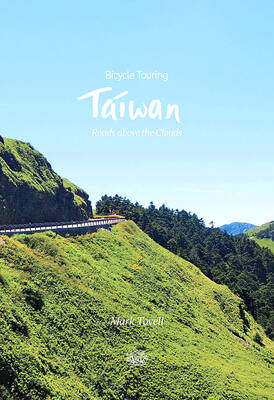
It’s hard to know where to begin with Mark Tovell’s Taiwan: Roads Above the Clouds. Having published a travelogue myself, as well as having contributed to several guidebooks, at first glance Tovell’s book appears to inhabit a middle ground — the kind of hard-to-sell nowheresville publishers detest. Leaf through the pages and you’ll find them suffuse with the purple prose best associated with travel literature: “When the sun is low on a warm, clear morning, and with the heat already rising, we stand at the riverside bike path leading south from Sanxia’s old cobble streets.” Hardly the stuff of your
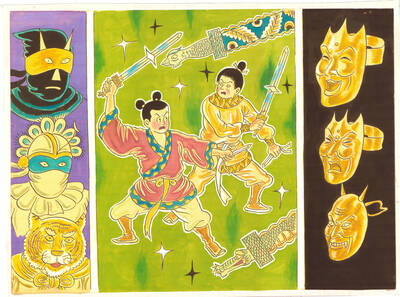
April 22 to April 28 The true identity of the mastermind behind the Demon Gang (魔鬼黨) was undoubtedly on the minds of countless schoolchildren in late 1958. In the days leading up to the big reveal, more than 10,000 guesses were sent to Ta Hwa Publishing Co (大華文化社) for a chance to win prizes. The smash success of the comic series Great Battle Against the Demon Gang (大戰魔鬼黨) came as a surprise to author Yeh Hung-chia (葉宏甲), who had long given up on his dream after being jailed for 10 months in 1947 over political cartoons. Protagonist


 RSS
RSS