


During good times, an auction is the obvious choice for any collector wanting to sell a work of art. But as the recession takes its toll, many collectors have changed strategies and retreated to the more hidden — and potentially less lucrative — world of private sales.
For many sellers, the driving factor is fear. Fear that their friends will discover they need money. Fear that if a Picasso or Warhol, Monet or Modigliani doesn’t sell at auction, it will be considered yesterday’s goods. If they don’t have to, fewer collectors are putting their holdings up for auction at Sotheby’s and Christie’s, where prices and profits have plummeted. But executives at both houses say business in their private-sale departments has more than doubled in recent months.
Even institutions like the Museum of Modern Art in Manhattan are avoiding auctions. This season it has decided to sell two early classic 1960s paintings by Wayne Thiebaud through Haunch of Venison, a gallery owned by Christie’s. In 2005, when the market was nearing its peak, it sold a variety of works at auction at Christie’s for strong prices.
“There’s an element of uncertainty with an auction that in this climate makes it more prudent to sell privately,” said Ann Temkin, chief curator in the department of painting and sculpture at MoMA. (The Thiebauds were donated to the Modern with the express purpose of selling them to raise cash for future acquisitions.)
“The game has definitely shifted,” said Christopher Eykyn, a former head of Impressionist and modern art at Christie’s who is now a dealer in New York. “A lot of clients don’t want to be seen selling, so the private route is suddenly more attractive.”
Just six months ago Sotheby’s Impressionist and modern art sale brought US$223.8 million; its May 5 sale is expected to fetch only US$81.5 million. Christie’s Impressionist and modern art auction in November totaled US$146.7 million; its May 6 sale is estimated at only US$94.9 million.
“Clients want it now,” said Marc Porter, president of Christie’s in America. “And that means cash in their pockets.” Why wait months for the regularly scheduled auctions when you can have instant money, even if it means forfeiting the possibility of sparking a bidding war at auction?
Another factor is that collectors, seeing prices fall, are for the most part hanging onto their art, waiting for the auction market to rebound.
So secret are private transactions that confidentiality agreements bind the dealers and auction-house executives. Still, the art world loves to talk, and in recent months among the expensive paintings that have quietly changed hands are a 1970s De Kooning abstract canvas sold for around US$30 million; a Cy Twombly Blackboard painting for US$12 million; one of Gerhard Richter’s Color Charts for US$18 million; and Jeff Koons’ Hanging Heart Violet sculpture for US$11 million.
There are exceptions, of course. Estates continue to go to auction because executors have a fiduciary responsibility and prices are rarely challenged after public sales.
For the auction houses, private sales are lucrative and inexpensive. Generally Sotheby’s and Christie’s charge 5 to 10 percent of the purchase price of an artwork, depending on its value and the agreement with the seller. (If a work goes to auction the houses charge sellers 25 percent of the first US$50,000, 20 percent of the next US$50,000 to US$1 million and 12 percent of the rest.) Money earned from private transactions comes cheap, without expenses like advertising, insurance and shipping associated with auctions.
The dismal sales in New York in November, when night after night paintings by Monet and Matisse, Bacon and Warhol went unsold, meant big losses for Sotheby’s and Christie’s, which had a financial interest in most of this expensive art in the form of guarantees, undisclosed sums paid to sellers regardless of a sale’s outcome.
After the fall auctions, both houses immediately began changing the way they conduct business. In addition to announcing hundreds of layoffs — with perhaps more to come — they mostly halted the practice of guarantees and stopped giving consignors a cut in the fees they charge buyers. The days of publishing luscious catalogs have ended as well.
For their part, dealers say that their phones started ringing after Sept. 15, the day Lehman Brothers filed for bankruptcy. “It’s been pretty steady ever since,” said Steven Henry, director of the Paula Cooper Gallery in Chelsea. He said he had been getting inquiries about selling art from people who had investments with Bernard Madoff, or who had seen the value of their stock or real estate assets collapse.
Matthew Marks, another Chelsea dealer, has noticed that sellers “just aren’t into gambling anymore and auctions are no longer a sure thing.”
Dealers say that despite the increase in private sales, deals do not happen as briskly as they did in the days when collectors were on waiting lists for hot artists. “Everything is a negotiation,” Marks said.
Still, he is grateful for business. “I’m not asking sellers any questions,” Marks said. “I’m just happy the phone is ringing.”

In late October of 1873 the government of Japan decided against sending a military expedition to Korea to force that nation to open trade relations. Across the government supporters of the expedition resigned immediately. The spectacle of revolt by disaffected samurai began to loom over Japanese politics. In January of 1874 disaffected samurai attacked a senior minister in Tokyo. A month later, a group of pro-Korea expedition and anti-foreign elements from Saga prefecture in Kyushu revolted, driven in part by high food prices stemming from poor harvests. Their leader, according to Edward Drea’s classic Japan’s Imperial Army, was a samurai

The following three paragraphs are just some of what the local Chinese-language press is reporting on breathlessly and following every twist and turn with the eagerness of a soap opera fan. For many English-language readers, it probably comes across as incomprehensibly opaque, so bear with me briefly dear reader: To the surprise of many, former pop singer and Democratic Progressive Party (DPP) ex-lawmaker Yu Tien (余天) of the Taiwan Normal Country Promotion Association (TNCPA) at the last minute dropped out of the running for committee chair of the DPP’s New Taipei City chapter, paving the way for DPP legislator Su
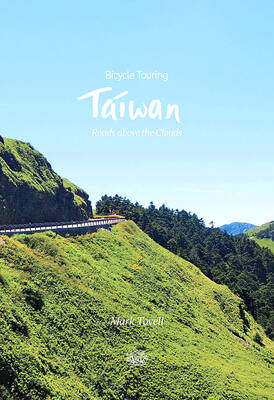
It’s hard to know where to begin with Mark Tovell’s Taiwan: Roads Above the Clouds. Having published a travelogue myself, as well as having contributed to several guidebooks, at first glance Tovell’s book appears to inhabit a middle ground — the kind of hard-to-sell nowheresville publishers detest. Leaf through the pages and you’ll find them suffuse with the purple prose best associated with travel literature: “When the sun is low on a warm, clear morning, and with the heat already rising, we stand at the riverside bike path leading south from Sanxia’s old cobble streets.” Hardly the stuff of your
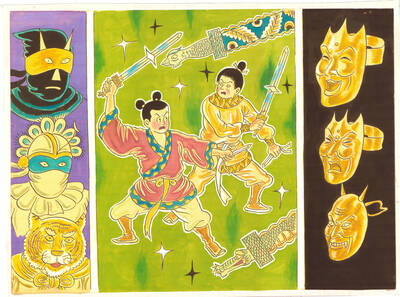
April 22 to April 28 The true identity of the mastermind behind the Demon Gang (魔鬼黨) was undoubtedly on the minds of countless schoolchildren in late 1958. In the days leading up to the big reveal, more than 10,000 guesses were sent to Ta Hwa Publishing Co (大華文化社) for a chance to win prizes. The smash success of the comic series Great Battle Against the Demon Gang (大戰魔鬼黨) came as a surprise to author Yeh Hung-chia (葉宏甲), who had long given up on his dream after being jailed for 10 months in 1947 over political cartoons. Protagonist


 RSS
RSS